Plan your visit. 225 Madison Avenue at 36th Street, New York, NY 10016.

Plan your visit. 225 Madison Avenue at 36th Street, New York, NY 10016.

Secrets From The Vault

  • By Carolyn Vega
    Thursday, December 8, 2011

    John Ruskin was just ten years old when he wrote and illustrated The Puppet Show: Or, Amusing Characters for Children. The little book is filled with twenty-nine short poems, each of which is accompanied by two pen-and-ink drawings. The poems, as far as I can determine, are Ruskin's own, although some of the illustrations are copied from George Cruikshank's vignettes in Grimm's German Popular Stories, which was first published in London in 1823.

  • By Carolyn Vega
    Thursday, October 13, 2011

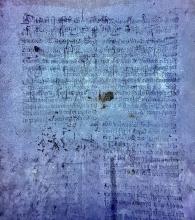
    King John, oh King John. Best remembered for signing the Magna Carta (after being forced by his barons to do so), losing most of England's territory on the continent (in a war triggered partially by his marriage to Isabelle of Angoulâme), and trying to seize the crown from his elder brother Richard the Lionheart (while Richard was being held captive by Duke Leopold of Austria), John's life and sixteen-year reign was violent and unpopular. The 13th-century chronicler Matthew Paris went so far as to declare "Hell is too good for a horrible person like him," although this general view has been somewhat tempered in the intervening 800 years.

  • By Carolyn Vega
    Thursday, March 31, 2011

    Lafcadio Hearn could be a cruel correspondent. One-eyed, diminutive, poor, and socially awkward, he was nonetheless a hit with certain ladies -- at least fifty, by his own count. One of these ladies, Ellen Freeman, emphatically did not excite reciprocal feelings.

  • By Carolyn Vega
    Thursday, March 22, 2012

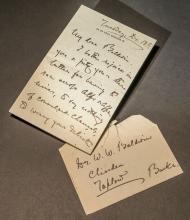
    If you're going to write a love letter, you should probably get the name on the address panel correct. At least, if I was a fashionable young singer in the 18th century, I would probably pause a bit when opening a letter from an admirer (who had a reputation), which he seemed to have first addressed to someone else entirely.

  • By Carolyn Vega
    Thursday, June 2, 2011

    He thought he saw an Albatross
    That fluttered round the lamp:
    He looked again, and found it was
    A Penny-Postage-Stamp.
    “You’d best be getting home,” he said:
    “The nights are very damp!”

  • By Sal Robinson
    Friday, August 24, 2018

    One of the questions my co-cataloguer on the Levy Project, Pam Abernathy, and I pose as we work our way through the collection of letters and manuscripts in the Morgan’s holdings is: how was it made? In most cases, it’s not complicated: the letter was written by hand, by the person who was responsible for its content. But in the case of MA 6390.3, a small scrap of paper that forms part of the Morgan’s large Lewis Carroll collection, matters were not so clear.

  • By Sam Mohite
    Monday, February 26, 2024

    This Black History Month at the Morgan Library & Museum, I introduce my fellowship project as a Belle da Costa Greene Curatorial Fellow. The project goal is a daunting one: to find and organize a comprehensive checklist of creators with Black, Indigenous, and other marginalized identities represented within the Morgan’s Printed Book collections.

  • By Sal Robinson
    Tuesday, October 1, 2024
    In 1974, the Morgan purchased a large collection of materials related to the painter Édouard Manet from the American scholar Mina Kirstein Curtiss. Curtiss had acquired them in Paris in the 1950s from Lucienne Tabarant, the daughter of the art historian and journalist Adolphe Tabarant, who published an early catalogue raisonné of Manet’s work, Manet: Histoire catalographique (1931), as well as other important texts on Manet and on the Impressionists.

  • By Carolyn Vega
    Friday, November 12, 2010

    In this letter, dated September 28, 1791, Marie Antoinette writes to the Austrian diplomat Florimond Claude, comte de Mercy-Argenteau, about the need for the royal family to regain the trust of the French people. The comte de Mercy-Argenteau was instrumental in arranging the 1770 marriage of the young Marie Antoinette, then Archduchess of Austria, and Louis-Auguste, the Dauphin of France. When Louis became King Louis XVI in 1774, the comte de Mercy-Argenteau assumed a prominent role in the French court, and he was a frequent recipient of letters from Marie Antoinette.

  • By Carolyn Vega
    Thursday, April 21, 2011

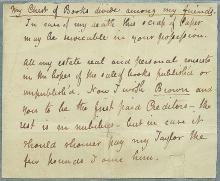
    The Romantic essayist William Hazlitt described Mary Lamb as the most “reasonable woman” he ever knew. This choice of adjective -- reasonable -- is not the first thing that comes to mind when I think of Mary Lamb. Interesting, perhaps, or articulate, or even brilliant, but reasonable seems an odd choice to describe a woman who, in a “fit of mania,” killed her mother with a kitchen knife.