Plan your visit. 225 Madison Avenue at 36th Street, New York, NY 10016.

Plan your visit. 225 Madison Avenue at 36th Street, New York, NY 10016.

Secrets From The Vault

  • By Christine Nelson
    Friday, April 6, 2018

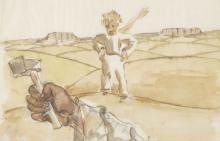
    The Little Prince, a story of an intergalactic traveler in search of meaningful connection, was published in New York seventy-five years ago today—on April 6, 1943. This guest post is by Adrian Arturo Peña, a student in CUNY’s Language Immersion Program (CLIP), whose class recently visited the Morgan with instructor Gretchen Irwin-Harada to view and discuss Antoine de Saint-Exupéry’s draft manuscript and watercolor drawings for The Little Prince.

  • By John McQuillen
    Monday, September 12, 2022

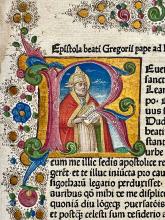
    The 15th-century Venetian artist known as the Master of the Pico Pliny enjoyed a career spanning 1460 to 1505, in which they produced hand-painted decoration in both manuscripts and incunabula and designed woodcuts for printed books.

  • By Declan Kiely
    Friday, April 29, 2011

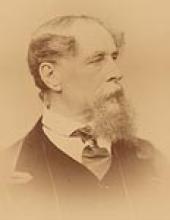
    Last month, browsing the Bonhams auction catalogue Papers & Portraits: The Roy Davids Collection Part II, I came across a description of a three-page manuscript short story by Charles Thomas Clement James (1858–1905), a prolific author whose name and work were completely unknown to me. The story bears the Dickensian title “Concerning the Sinkingsop and Slush Railway” and the footnote accompanying the lot description is amusingly arch: “This manuscript is a fine example, the only one seen commercially, of the remarkable similarity in the handwritings of Charles Dickens and Charles James.

  • By Rebecca Filner
    Thursday, September 16, 2010

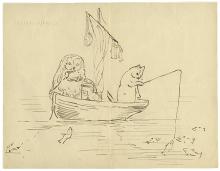
    Edward Lear, British landscape painter and writer, wrote many limericks and "nonsenses" (as he called them) for children. One of his most famous nonsense poems is "The Owl and the Pussy-Cat," shown here in his hand.

    Lear ends this copy of his humorous poem with a note that he "meant to have illustrated it, but there ain't time."

    Although The Morgan does not have Lear's illustration of his poem, we do have a sketch of the poem by Beatrix Potter. In an 1897 letter to a young boy named Noel Moore, Potter draws him a "picture of the owl and the pussy cat after they were married."

  • By Carolyn Vega
    Thursday, March 17, 2011

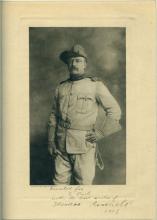
    Theodore Roosevelt was the second president of United States to write a book-length autobiography, but he was the first to give a lengthy account of his presidency or to give details about the private life of an American head of state.

    Abraham Lincoln had written a few brief sketches of his life, and Ulysses S. Grant was the first to compose a full autobiography. But, written while the penniless Grant was dying of throat cancer in an attempt to ensure that his family would have a means of support after his death, his Personal Memoirs of Ulysses S. Grant (published posthumously by Mark Twain) deals primarily with his military career.

  • By Anna Culbertson
    Tuesday, March 22, 2011

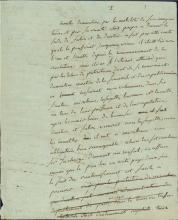
    19th century dramatist and collector Victorien Sardou demonstrates a keen understanding of the varying nature of excess during the French Revolution via his meticulous assemblage of manuscripts, letters and engravings. Shortly after Sardou’s death, a manuscript by Maximilien Robespierre, two pamphlets, three letters, an original pencil sketch and an astonishing fifty-three engravings were mounted in a lavish volume of heavily gold-tooled red morocco by Zaehnsdorf, perhaps as a tribute to the avid investigator of all things revolutionary. The spine, shown here, and the upper and lower boards bear striking symbols of the Revolution, including a guillotine, a Phrygian or “liberty” cap, a triangle with plumb-line to represent perfect balance, and a spider’s web...

  • By Mary Creed
    Tuesday, September 8, 2020

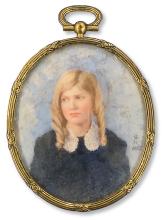
    Virtually no art object is without a complicated history concerning its creation and its journey from the artist to the museum. As repositories for art, museums no longer merely preserve the past—they must also actively work toward interpreting and uncovering tangled and often discomforting histories with a critical eye and open mind. During the prolonged period of working from home, and with the aid of snapshots taken by my colleague Maria Fredericks, Director of the Morgan’s Thaw Conservation Center, I embarked on a campaign to better understand and describe a group of miniatures on ivory that have been in the collection since 1991 but have not been thoroughly researched or interpreted.

  • By Anna Culbertson
    Wednesday, May 11, 2011

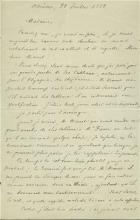
    Edouard Manet made a promise to his favorite model, Victorine Meurent – a promise in the form of a gratuity that she hoped never to have the need to collect, but clearly never forgot. Several months after Manet’s death in 1883, Meurent authored the following letter to his widow explaining their arrangement and essentially, attempting to cash in.

  • By Declan Kiely
    Friday, November 18, 2016

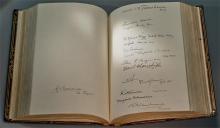
    I always had a strong suspicion that one of my favorite poets, William Butler Yeats, must have visited Pierpont Morgan’s library during one of his four visits to New York City between 1911 and 1933.

  • By Sandra Carpenter
    Monday, July 13, 2020

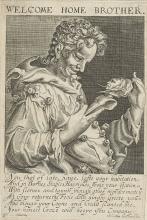
    Without knowing its underlying historical context, a viewer is likely to find this print from the Morgan’s collection bafflingly obscure. Once you learn it was published in London during the dark days of the Great Plague of 1665–1666, however, the meaning and significance of “Welcome Home Brother” begins to come into focus and strike an uncomfortably contemporary note.