Plan your visit. 225 Madison Avenue at 36th Street, New York, NY 10016.

Plan your visit. 225 Madison Avenue at 36th Street, New York, NY 10016.

Secrets From The Vault

  • By Joshua O'Driscoll
    Tuesday, January 26, 2021

    In 1911, Pierpont Morgan purchased fifty-seven leaves of Persian and Mughal miniatures and calligraphy. Orchestrated largely through the efforts of Belle Da Costa Greene, Morgan’s librarian, the acquisition marked a turning point in the history of the Islamic collections at the Morgan. A core set of these leaves once formed part of a magnificent album compiled for Husain Khan Shamlu (r. 1598–1618), governor of Herat (Afghanistan) and one of the most powerful rulers in Persia in the early seventeenth century.

  • By Carolyn Vega
    Tuesday, April 12, 2011

    The first shots of the American Civil War were fired 150 years ago today from Fort Sumter, South Carolina, and the two-day bombardment ended in the surrender of the fort to Confederate General Beauregard. There were no casualties in this initial engagement, but in the following four years at least 618,000 died. It remains the bloodiest war in United States history.

  • By Jennifer Tonkovich
    Thursday, November 2, 2023

    On my first day as an intern at the Morgan in the autumn of 1993, the head of the department of drawings and prints, William M. Griswold, asked me to accompany him on a trip uptown to return a group of framed drawings to Lore Heinemann.

  • By Debarati Sarkar
    Friday, May 24, 2024

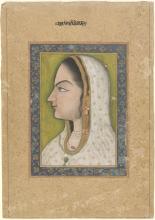
    While the identity of most portraits in the Walter collection of Indian paintings at the Morgan remains obscured, an eighteenth-century portrait (M.1074.1) identifies the subject as “Nur Jihan Begum” in Nagari script. This painting has since been interpreted as an idealized portrait, “an imaginative rendering.” Such portraits were often commissioned by the Rajput courtiers in Rajasthan.

  • By Carolyn Vega
    Friday, October 1, 2010

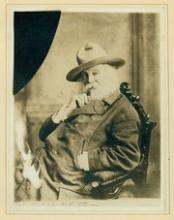
    Leaves of Grass has been described as "shocking," "too sensual," and "trashy, profane and obscene." Yale University President Noah Porter compared it to "walking naked through the streets," and an early British reviewer suggested that one "throw it immediately behind the fire." First published in 1855, it was effectively banned in Boston nearly 30 years later, when district attorney Oliver Stevens demanded that some poems (such as "Song of Myself," "I Sing the Body Electric," and "To a Common Prostitute") be removed because of their pornographic nature. Whitman refused to alter his work and was forced to find a new publisher. When he did, the first printing of the new edition sold out in a single day.

  • By Carolyn Vega
    Thursday, May 26, 2011

    Charlotte Brontë was only ten years old when she penned her earliest known work, and she was barely a tween when she began writing in earnest -- at her own count she had written over twenty complete works by the time she was fourteen.

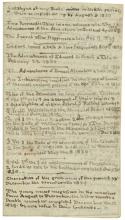
    One list, which she has headed Catalogue of my Books with the periods of their completion up to August 3, 1830, gives twenty-two titles, including A Book of Rhymes, which, now lost, apparently contained 10 poems.

  • By Carolyn Vega
    Thursday, November 18, 2010

    Samuel Taylor Coleridge’s 1796 notebook contains eight of his poems.

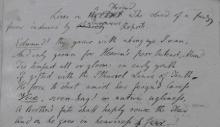
    The opening lines of Coleridge’s “Lines on a Friend Who Died of a Frenzy Fever Induced by Calumnious Reports.” This is one of four extant manuscripts of the poem.

    Extensive revisions and corrections throughout show that this was a working notebook, and Ernest Hartley Coleridge, the poet’s grandson, refers to it as the “MS quarto copy-book” in his 1912 The Complete Poetical Works of Samuel Taylor Coleridge. The first portion of the copy-book contains two fragments and six complete poems, including “Songs of the Pixies,” “Lines to a Beautiful Spring in a Village,” and “Lines on a Friend Who Died of a Frenzy Fever Induced by Calumnious Reports.”

  • By Carolyn Vega
    Thursday, September 15, 2011

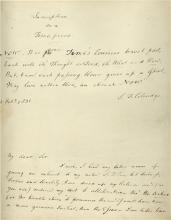
    Sometime probably in the late 1890s, and unknown dealer or private collector assembled about 200 letters that were bound into volumes and titled "Sir Walter Scott: Letters of his Friends and Contemporaries." The letters aren't to, from, or even necessarily about Scott, but they provide an artifactual record of both his personal circles and the leading public figures of the day.

  • By Carolyn Vega
    Thursday, March 24, 2011

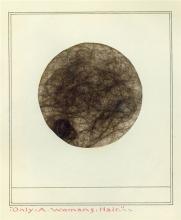
    "Only A Woman's Hair:" it can't really be called a lock, and we aren't even sure whose hair it is. Mounted, almost as an afterthought, on the last page of a volume, it is possibly Elizabeth Hawthorne's. These rich brown curls were teased out and preserved by Stephen H. Wakeman in his collection of Nathaniel Hawthorne related material.

  • By Richard Thompson
    Thursday, May 5, 2022

    Douglas Cooper’s acclaimed 1938 translation of Vincent van Gogh’s Letters to Émile Bernard owes a debt to the uncompleted work of author and critic, Peter Burra, who died in a flying accident in April 1937. Intended or not, Cooper (writing under the pseudonym Douglas Lord) failed to acknowledge the work that Burra had already undertaken on the Bernard Letters with the result that his contribution to Van Gogh scholarship has been overlooked.