Plan your visit. 225 Madison Avenue at 36th Street, New York, NY 10016.

Plan your visit. 225 Madison Avenue at 36th Street, New York, NY 10016.

Secrets From The Vault

  • By Carolyn Vega
    Thursday, October 27, 2011

    Robert Fulton's steamboat first chugged up the Hudson River in August, 1807. The flat-bottomed boat, which was only 12 feet wide, was fitted with side wheels and powered by a coal-fired steam engine. It clocked an impressive 4 to 5 miles per hour against the current and made the 150-mile trip from New York to Albany in about 32 hours.

  • By Carolyn Vega
    Thursday, February 17, 2011

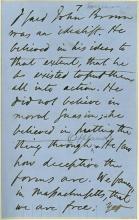
    During the trial for his involvement in the raid on Harpers Ferry, abolitionist John Brown declared: "If it is deemed necessary that I should forfeit my life for the furtherance of the ends of justice and mingle my blood with the blood of millions in this slave country whose rights are disregarded by wicked, cruel, and unjust enactments, I say let it be done." The October 16th raid had been a failure -- no slaves were freed and fully half of his men died -- and, after only forty-five minutes of deliberation, John Brown was sentenced to die by the gallows on December 2, 1859.

  • By Kate Kasten
    Tuesday, August 18, 2015

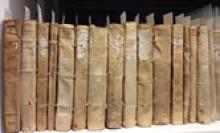
    In September 2014, I began an internship in the Department of Printed Books and Bindings at the Morgan Library & Museum while studying for a Master’s of Library Science degree with an emphasis on Special Collections. My academic background is in French literature and cultural studies. The department was looking for an intern to work on the Ramey Collection, and I was pleased to arrive in the right place at the right time.

  • By Austėja Mackelaitė
    Friday, June 26, 2020

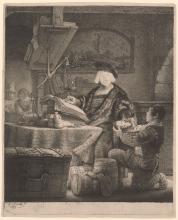
    Rembrandt’s portrait prints of secular patrons—city officials, physicians and apothecaries, dealers, collectors, and fellow artists—generally depict individuals he knew well. While in most cases, the focus is chiefly on the sitters, in a handful of highly ambitious works, the artist places them in carefully described interior spaces.

  • By Rachel Federman
    Sunday, April 19, 2020

    Exhibitions are often multiyear projects. With a monographic exhibition—one that focuses on a single artist—the subject, even when not alive, can come to feel like a significant presence in the life of a curator. As someone who has focused on artists who came to prominence in the second half of the increasingly historical twentieth century, I have been fortunate to “get to know” some of the late artists I have worked on, not only through research in libraries and archives, but also through conversations with the artists’ familes, friends, and acquaintances.

  • By Rachel Federman
    Tuesday, May 5, 2020

    At the end of the first installment of this series on an exhibition in progress, I had discovered, to my horror, that the most robust source available on the subject of an obscure artist named Rick Barton—an essay by Dave Archer (née David Nelson)—had been removed from the Internet.

  • By Rachel Federman
    Monday, June 1, 2020

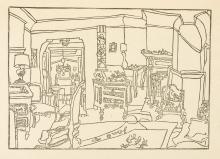
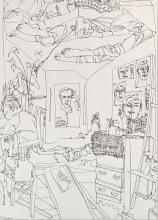
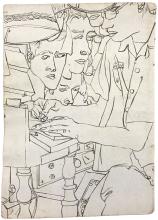
    In the early days of 2018, I arrived in Los Angeles with appointments to see Henry Evans’s Peregrine Press papers at the Clark Memorial Library and a cache of over 700 drawings by Rick Barton at UCLA Library Special Collections. Although I had been assured that the drawings would be available, I worried that something might go wrong or that the drawings would not have been worth the trip.

  • By Rachel Federman
    Friday, July 10, 2020

    In early 2018, I received the welcome news that UCLA Library Special Collections would consider lending drawings by Rick Barton to an exhibition at the Morgan. Moreover, more than 600 drawings that had not been located at the time of my visit were now available to view. My next opportunity to travel to Los Angeles would not arrive until October of that year. But in the interim, I made a number of crucial discoveries.

  • By Carolyn Vega
    Friday, December 31, 2010

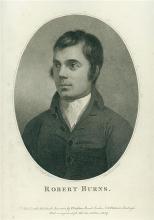
    In the early 1790s the Scottish music collector George Thomson approached Robert Burns, asking for help in compiling and editing his Select Collection of Original Scotish Airs. Burns readily agreed (although with the proviso that his name not be attached to the publication), and the nearly 60 letters from Burns to Thomson that survive are filled to the brim with working and fair copies of some of Burns’s most famous songs.

    One letter, written in early September of 1793, discusses in detail no fewer than 74 songs – and it is within this letter, buried nearly at the end, that we find his full text to Auld Lang Syne.

  • By Rachel Federman
    Monday, July 27, 2020

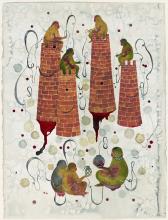
    My attraction to Shiva Ahmadi’s Tower (2017) was immediate, but it is a challenging work in both its content and execution. In discussing it, I find it helpful to speak in terms of dualities: seduction and repulsion, translucency and opacity, chaos and control, background and foreground. Ahmadi has done this herself in quotations like the one above.