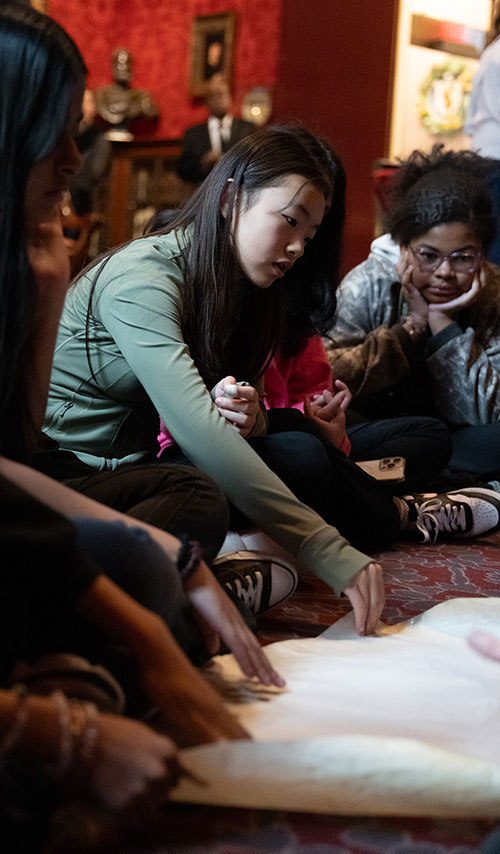
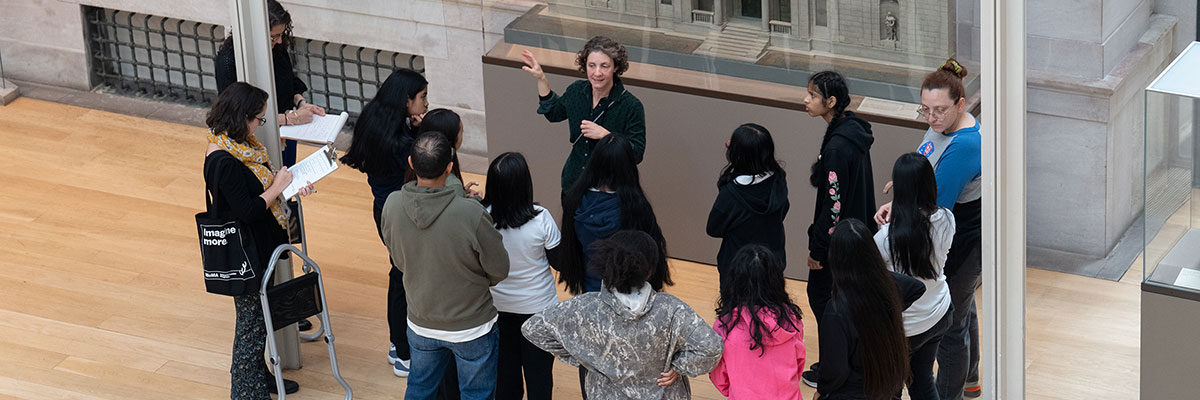
School programs at the Morgan Library & Museum offer students an opportunity to look closely, ask questions, make meaning, and find personal relevance in a wide range of objects. The Morgan’s collections and exhibitions highlight the creative process throughout history and align with learning standards to support and supplement K–12 classroom curricula.
The Morgan also offers summer camp programs in July and August. Student and youth groups are invited to participate in fun, interactive explorations in the galleries. Program details will be announced soon.
We schedule programs by semester:
| Semester | Booking opens |
|---|---|
| September–December | July 1 |
| January–June | November 1 |
| July and August | May 1 |
Please note:
- Please schedule your tour at least three weeks in advance.
- Reservations are required for all school and youth group visits.
- The Morgan does not allow self-guided, unguided, or unscheduled school and youth group visits.
- We do not have lunch space available on the premises. Please e-mail schools@themorgan.org for a list of nearby restaurants and green spaces.
Schedule Your Visit
How to use the scheduling platform.
College groups, please visit this page for more information on college visits.
Group Rates:
| Schools | Rate |
|---|---|
| New York City Department of Education Public Schools located in the five boroughs | Waived |
| All Other School Groups | $300 per class of up to thirty-four students and six chaperones |
Summer Camp Program
Available July 1 through September 25, 2026
Recommended for grades 3–12 or ages 8+
Tarot!
Experience the world of tarot, past and present! Campers are invited to discover the long artistic tradition of tarot cards and the symbolism within. Participants will explore the exhibition Tarot! Renaissance Symbols, Modern Visions through an interactive workshop that includes touch objects, drawing activities, and discussion.
Available School Programs (90 minutes each)
Colors of the World: Illuminated Manuscripts in the Age of Exploration, Part I
Explore some of the finest examples of medieval and Renaissance manuscripts in the Morgan’s collection, identify the different parts of a manuscript, and consider how books were made before the printing press. Through primary sources, maps, and touch objects, students discuss the Silk Road and other trade routes, and trace the origins of natural resources, such as saffron, malachite, and lapis lazuli, that were used to make pigments and paints for illuminated manuscripts.
Colors of the World: Illuminated Manuscripts in the Age of Exploration, Part II
In this hands-on workshop students learn some of the medieval and Renaissance bookmaking techniques covered in Colors of the World, Part I. Using traditional tools, students grind natural materials to make pigments, mix watercolor paints, learn how to apply 22-karat gold leaf, and create an original painted initial inspired by the Morgan’s manuscript collection. This unique, fun, and experiential program invites students to understand and appreciate the steps and skills required to make illuminated manuscripts, and better understand why they are collected and cared for in institutions such as the Morgan. Colors of the World, Part II must be booked in combination with Colors of the World, Part I.
Reading a Building: J. Pierpont Morgan and His Library
Through objects and architecture, students travel back to the Gilded Age in New York City during the time of J. Pierpont Morgan. Groups explore highlights of the Morgan Library & Museum’s buildings and collections, and consider what we can learn from primary sources about people, places, and time periods. Discussions include themes such as collecting, architectural styles, design, and libraries.
Myths and Symbols: From Mesopotamia to Modern
Throughout history, myths and symbols have been used to construct and convey personal and cultural narratives. Explore a range of objects created over time in a variety of cultures, from ancient Mesopotamia to modern and contemporary art, and uncover the meaning of symbols used in sculptures, manuscripts, paintings, decorative arts, and architecture. Through close looking, discussion, and activities, students will consider how individuals and cultures use myths and symbols to protect, adorn, and define themselves, and consider their own use of myths and symbols today.”
Virtual School Programs
Virtual visits are available on a limited basis by request. E-mail schools@themorgan.org.