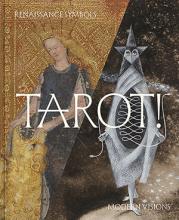
Conceived in two parts, this exhibition explores the origins of tarot in Renaissance Italy and its contemporary relevance as an enduring source of inspiration for twentieth- and twenty-first-century artists.
Originally created as a courtly game of skill, tarot was not associated with occult secrets, divination, or the power of fate until centuries later. By the twentieth century, the cards came to serve as a source of inspiration for artists, offering an alternative to the strictures of modernist aesthetics and allowing them to explore other universes and imaginative possibilities.
The first part, Renaissance Symbols, focuses on the earliest surviving tarot decks from the fifteenth century, examining the rich court culture from which the cards emerged, the development of the cards’ imagery, and how that imagery became the basis for later divination practices. The impetus for this exhibition was the Morgan’s Visconti-Sforza Tarot cards, the most famous deck to survive from the Renaissance. Tarot! reunites all the figural cards in the Morgan’s collection with those in the collection of Accademia Carrara, Bergamo, Italy, marking the first time the majority of the cards from this important deck will be displayed together in North America.
The second part, Modern Visions, traces artists’ engagement with tarot imagery during four distinct historical moments in which the occult assumed greater prominence within the larger culture. This section takes as its starting point the legendary 1909 Rider-Waite-Smith deck conceived by mystic Arthur Edward Waite and illustrated by artist Pamela Colman Smith, tracing the influence of this deck and others on later practitioners and the imagery’s adoption by artists like André Breton, Leonora Carrington, Remedios Varo, Jess, Niki de Saint Phalle, Betye Saar, Kerstin Brätsch, and Chris Ofili.
Also included in the exhibition is a video reel that explores Tarot’s sustained presence in cinema and popular culture across several decades of filmmaking. The reel brings together a range of influential films including Agnès Varda’s Cléo from 5 to 7 (1963), Live and Let Die (1973), Alejandro Jodorowsky’s The Holy Mountain (1973), and Drylongso (1998), among others.
Inspired by Tarot! Renaissance Symbols, Modern Visions, the Morgan is hosting a Summer Reading Challenge for teens.
Renaissance Symbols is organized by Joshua O’Driscoll, Melvin R. Seiden Curator and Department Head of Medieval and Renaissance Manuscripts, and Frank Trujillo, Sherman Fairchild Director of the Thaw Conservation Center. Modern Visions is organized by Claire Gilman, Acquavella Curator and Department Head of Modern and Contemporary Drawings, with Esther Levy, Curatorial Assistant, Modern and Contemporary Drawings.
Tarot! Renaissance Symbols, Modern Visions is made possible by the Elaine and Alexandre Rosenberg Charitable Foundation, an anonymous donor, in memory of Melvin R. Seiden, Beatrice Stern, the Vasari Fund for Exhibitions, the William Randolph Hearst Fund for Scholarly Research and Exhibitions, and an anonymous donor. Generous support is provided by Alyce Williams Toonk, the Lucy Ricciardi Family Exhibition Fund, and Susanna and Livio Borghese, in memory of Agnes Gund, with additional support from Marguerite Steed Hoffman, Dr. Wendy A. Stein and Mr. Bart Friedman, and Rachel and Alex Stern.
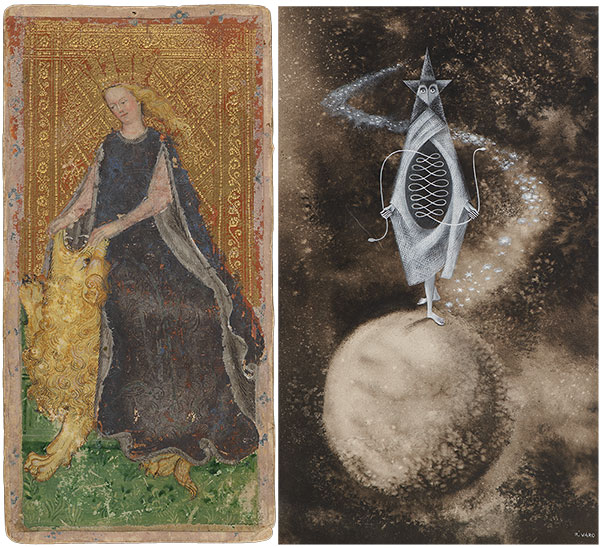
Strength/Fortitude, Visconti di Modrone Tarocchi. Italy, 1441–42
Beinecke Rare Book & Manuscript Library. Yale University
Remedios Varo (Spanish, 1908–1963), El Otro Reloj (The Other Clock), 1957. Gouache on cardboard, 15 3/16 × 9 1/8 in. Private Collection, New York. © 2026 Remedios Varo, Artists Rights Society (ARS), New York / VEGAP, Madrid. Courtesy of Wendi Norris Gallery