Plan your visit. 225 Madison Avenue at 36th Street, New York, NY 10016.

Plan your visit. 225 Madison Avenue at 36th Street, New York, NY 10016.

Blog

  • By Carolyn Vega
    Thursday, October 13, 2011

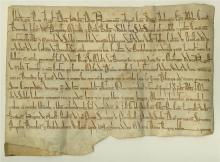
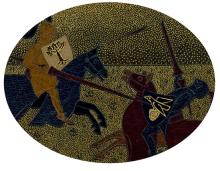
    King John, oh King John. Best remembered for signing the Magna Carta (after being forced by his barons to do so), losing most of England's territory on the continent (in a war triggered partially by his marriage to Isabelle of Angoulâme), and trying to seize the crown from his elder brother Richard the Lionheart (while Richard was being held captive by Duke Leopold of Austria), John's life and sixteen-year reign was violent and unpopular. The 13th-century chronicler Matthew Paris went so far as to declare "Hell is too good for a horrible person like him," although this general view has been somewhat tempered in the intervening 800 years.

  • By Carolyn Vega
    Thursday, September 29, 2011

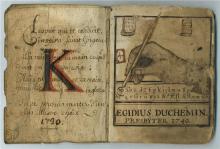
    This little book is something of a mystery. The fifty-eight pages of the booklet are sewn in a single gathering and bound with a sheet of old vellum, which is now partially discolored from use. From this first opening (shown below), we know that it was completed by the priest Aegidius (or Gilles) Duchemin in 1740.

  • By Thaw Conservation Center
    Saturday, September 24, 2011

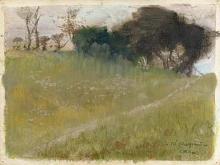
    In the early 1890s, when Degas' work became increasingly less naturalistic, he produced a series of pure landscapes that freely interpret the scenery he encountered on his way to visit the painter and printmaker Pierre-Georges Jeanniot in the village of Diénay, near Dijon. There Degas produced about fifty monotypes, which he enhanced with vivid pastel work.

  • By Thaw Conservation Center
    Friday, September 23, 2011

    In 2011 the manuscript of A Christmas Carol received extensive treatment by conservators at the Morgan's Thaw Conservation Center.

  • By John Bidwell
    Monday, September 19, 2011

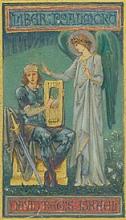
    Bible. O.T. Psalms. The Book of Psalms [London?: s.n., ca. 1890]. Purchased on the Gordon N. Ray Fund, 2011.

  • By Carolyn Vega
    Thursday, September 15, 2011

    Sometime probably in the late 1890s, and unknown dealer or private collector assembled about 200 letters that were bound into volumes and titled "Sir Walter Scott: Letters of his Friends and Contemporaries." The letters aren't to, from, or even necessarily about Scott, but they provide an artifactual record of both his personal circles and the leading public figures of the day.

  • By Thaw Conservation Center
    Friday, September 9, 2011

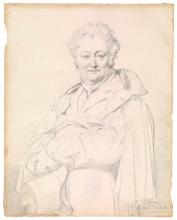
    Whether he was making portraits of family and friends or preliminary studies for important history paintings, Jean-Auguste-Dominique Ingres (1780–1867) created drawings of great subtlety and nuance. Close examination of the paper and media allows us to glimpse the working methods of one of the greatest draftsmen and portraitists in French history.

  • By John Bidwell
    Tuesday, September 6, 2011

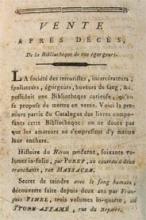
    Vente après décès, de la bibliothèque de nos égorgeurs. [Rouen: s.n., 1795]. Purchased on the Henry S. Morgan Fund, 2011.

  • By Carolyn Vega
    Thursday, September 1, 2011

    Sir Walter Scott, arguably the most successful writer of his day, was the first English-language novelist to be represented by a literary agent. In the last twenty years of his life, he published 23 works of fiction -- all anonymously -- and James Ballantyne, who was also Scott's business partner, sometimes-printer, and former schoolfellow, acted as a liaison or agent to help to obscure Scott's identity.

  • By John Bidwell
    Tuesday, August 30, 2011

    Pierre Laujon (1727-1811). Les a propos de societé, ou, Chansons de M. L. Paris : Joseph-Gérard Barbou, 1776. 3 vols. Purchased on the Gordon N. Ray Fund, 2011.

  • By John Bidwell
    Wednesday, August 3, 2011

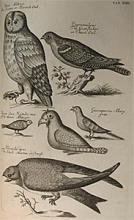
    Francis Willughby (1635-1672). Ornithologiae libri tres, in quibus aves omnes hactenuscognitae in methodum naturis suis convenientem redactae accuratè describuntur, descriptiones iconibus elegantissimis & vivarum avium simillimis, aeri incisisillustrantur. London: Printed for John Martyn, printer to the Royal Society, 1676. Purchased on the Henry S. Morgan Fund, 2011.

  • By John Bidwell
    Tuesday, July 26, 2011

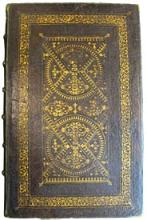
    Francesco Patrizi (1413-1494). Enneas de regno, & regis institutione. Paris: Printed by Pierre Vidoue for Galliot du Pré, 1519. Purchased as the gift of Mrs. Livio Borghese and on the E. Clark Stillman Fund and the Henry S. Morgan Fund, 2011.

  • By Carolyn Vega
    Friday, July 22, 2011

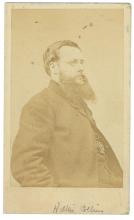
    Wilkie Collins, who not as well known today as his contemporary and collaborator Charles Dickens, was, in his heyday, a literary celebrity -- and he is perhaps best remembered now as the author of The Moonstone, which T. S. Eliot described as the first and greatest of English detective novels.

  • By Carolyn Vega
    Friday, June 24, 2011

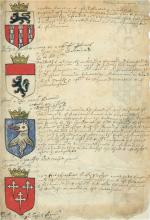
    This armorial was compiled in England around 1597, and in over four hundred entries it chronicles the coats of arms of British royals and nobles up to the reign of Elizabeth I.

  • By John Bidwell
    Thursday, June 16, 2011

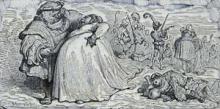
    Felix Jean Gauchard (1825–1872) after Gustave Doré (1832–1883). Rejected woodblock for the headpiece, “Comment Gargantua nasquit en façon bien estrange,” chapter six in François Rabelais, Oeuvres(Paris: Garnier Frères, 1873). Purchased on the Gordon N. Ray Fund, 2011.

  • By Carolyn Vega
    Thursday, June 2, 2011

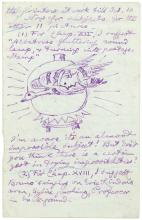
    He thought he saw an Albatross
    That fluttered round the lamp:
    He looked again, and found it was
    A Penny-Postage-Stamp.
    “You’d best be getting home,” he said:
    “The nights are very damp!”

  • By Carolyn Vega
    Thursday, May 26, 2011

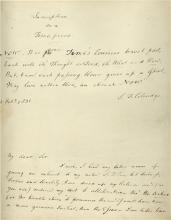
    Charlotte Brontë was only ten years old when she penned her earliest known work, and she was barely a tween when she began writing in earnest -- at her own count she had written over twenty complete works by the time she was fourteen.

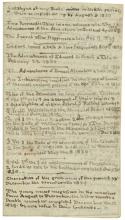
    One list, which she has headed Catalogue of my Books with the periods of their completion up to August 3, 1830, gives twenty-two titles, including A Book of Rhymes, which, now lost, apparently contained 10 poems.

  • By Anna Culbertson
    Friday, May 20, 2011

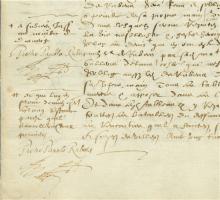
    In 1621, Peter Paul Rubens received Marie de’ Medici’s commission to create 24 tableaux for the decoration of two galleries in the Luxembourg Palace. The commission, which would come to be known as The Marie de' Medici Cycle, included a series of 21 paintings constructing a panegyric “visual biography” of Marie de’ Medici along with three portraits – of Marie, her mother and father. By early 1622, the terms of the contract were negotiated and Rubens had three years in which to finish one of the most challenging projects of his life, both artistically and intellectually.

  • By Christine Nelson
    Thursday, May 19, 2011

    Does the physical diary/scrapbook live on in the digital age? Claire Hamilton, a BBC journalist, tells her story.

  • By Christine Nelson
    Thursday, May 19, 2011

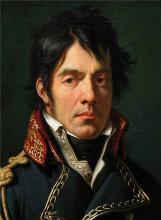
    You may not be able to judge a published book by its cover, but can you judge a diarist by his notebook? Sandrine Lacorie looks at the journal of battlefield physician Dominique Jean Larrey (1766–1842)