Plan your visit. 225 Madison Avenue at 36th Street, New York, NY 10016.
Plan your visit. 225 Madison Avenue at 36th Street, New York, NY 10016.
Search
-
Carroll, Lewis, 1832-1898.London : Macmillan and Co., 1889.PML 352392ClassificationDepartment
-
Combe, William, 1742-1823.London : Printed for R. Ackermann...by L. Harrison and J.C. Leigh, 1814.PML 75951-2ClassificationDepartment
-
This is the only surviving manuscript of The Professor, the first of four novels by the English author Charlotte Brontë (1816–1855).
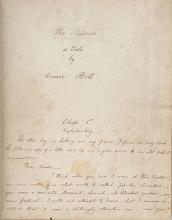 Digital Facsimile
 -
September 14, 2001, through January 13, 2002The brilliant and celebrated writer, dramatist, aesthete, wit, and self-proclaimed "lord of language" was the focus of Oscar Wilde: A Life in Six Acts, originally organized by the British Library. Wilde's (1854–1900) rise to success as a literary and social figure was meteoric. His decline to notoriety and disgrace was equally dramatic. Twelve years after publishing his first work of fiction, in 1888, he was dead at the age of forty-six, buried in a pauper's grave on the outskirts of Paris.

-
View images and descriptions of all works in William Blake's World: "A New Heaven Is Begun," listen to a curatorial discussion and Jeremy Irons read Blake poetry, and watch a multimedia presentation on Blake narrated by former director Charles Ryskamp.
Online Exhibitions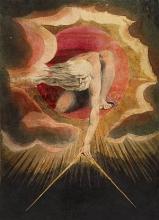
-
This is a two-page manuscript of the final nine stanzas Anne Brontë's poem “Views of Life”.
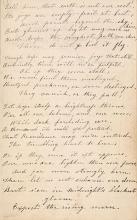 Digital Facsimile
 -
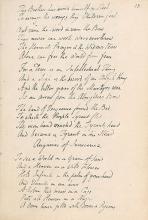
This manuscript in William Blake's hand is the sole source for seven of his poems, including “Auguries of Innocence.”
 Digital Facsimile
 -
May 20 through August 29, 1999This milestone exhibition—the Morgan's first devoted exclusively to twentieth-century art—served as the centerpiece of the institution's yearlong celebration of its seventy-fifth anniversary.
-
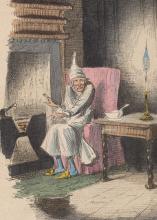
November 25, 2025 through January 11, 2026Every holiday season, the Morgan displays Charles Dickens's original manuscript of A Christmas Carol in J. Pierpont Morgan's Library.
-
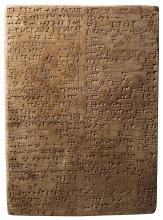
View all five objects in an exhibition that explores the development of writing in Mesopotamia—the wedge-shaped system that we call cuneiform—that was in use for over three thousand years.
Online Exhibitions