
Accession number
MS M.1240
Object title
Leaf from the Giltlingen Missal (MS M.1240).
Created
Germany, Augsburg, 1484-1485
Credit line
Purchased as the gift of Virginia M. Schirrmeister, James H. Marrow and Emily Rose, Sharon Dunlap Smith, and William M. Voelkle, 2023.
Description
1 leaf : parchment, illuminated ; 350 x 262 mm
Provenance
Commissioned by Abbot Johannes von Giltlingen (r. 1482-1496) for the Abbey of Sts. Ulrich and Afra in Augsburg; removed from the manuscript before 1852; Maurice Feuillet (perhaps purchased from H.P. Kraus in 1959); Belgian private collection; auctioned in Bruges, Rob Michiels, 8 October 2021, lot 446; Quaritch (Catalogue 1451, no. 33).
Notes
A leaf from a deluxe missal illuminated by Conrad Wagner and commissioned by Abbot Johannes von Giltlingen (r. 1482-1496) for the Abbey of Sts. Ulrich and Afra in Augsburg.
This leaf once formed part of a well-documented illuminated missal belonging to the imperial abbey of Sts. Ulrich and Afra in Augsburg, an important center of book production and learning in the late fifteenth century. Commissioned by the art-loving abbot Johannes von Giltlingen, the manuscript is documented by a contemporary chronicler (Wilhelm Wittwer, Catalogus abbatum monasterii SS. Udalrici et Afrae Augustensis) as being painted by the artist Conrad Wagner, whom Wittwer praised for his exceptional skill.
The leaf contains readings for the second and third masses of Christmas, beginning with Luke 2:15-20.
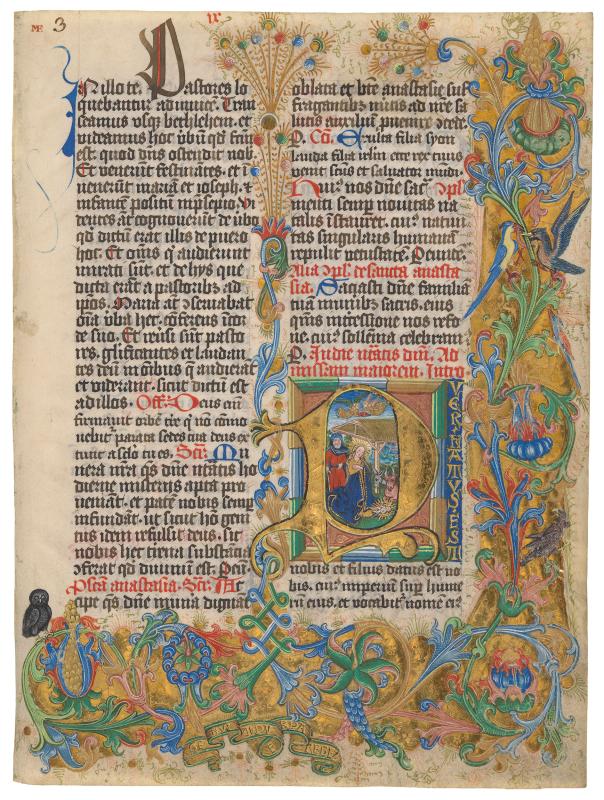
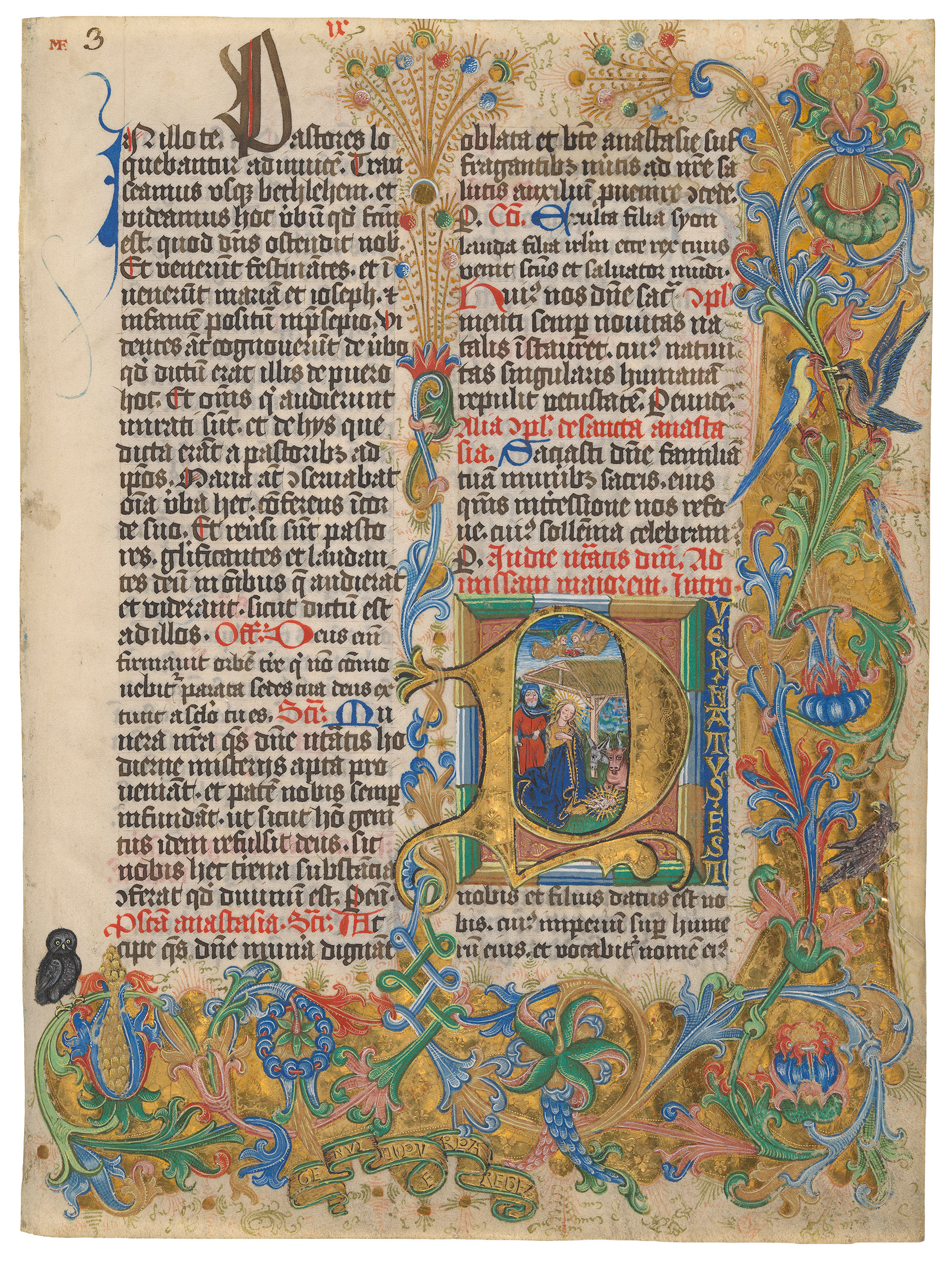
Decoration: Large eleven-line historiated initial P (for Puer natus est), enclosing a depiction of the Nativity, set against a painted panel framed in alternating segments of green, blue, and gold. An elaborate decorative border fills the outer and lower margins as well as between the text columns. The border features highly burnished and delicately tooled gold, brightly painted foliage, and five birds (including an owl and a hawk). At bottom center a painted inscription GENUIT PUERP[ER]A REGEM ("The mother birthed a king"). Alternating initials in blue and red ink.
Dispersed at some point before 1852, nineteen related leaves are preserved in the collections of the Germanisches Nationalmuseum (Nuremberg, Mn 1-10), the Victoria & Albert Museum (London, inv. 274:2), Ecole des Beaux arts (Paris, Masson MS 134), Houghton Library (Cambridge, Mass., MS Typ 288), Columbia University (New York, Plimpton 36a-c), as well as three private collections. Four additional leaves have yet to surface, but likely contained illustrations for Advent, the Crucifixion, the Te igitur, and the Ascension.
This leaf once formed part of a well-documented illuminated missal belonging to the imperial abbey of Sts. Ulrich and Afra in Augsburg, an important center of book production and learning in the late fifteenth century. Commissioned by the art-loving abbot Johannes von Giltlingen, the manuscript is documented by a contemporary chronicler (Wilhelm Wittwer, Catalogus abbatum monasterii SS. Udalrici et Afrae Augustensis) as being painted by the artist Conrad Wagner, whom Wittwer praised for his exceptional skill.
The leaf contains readings for the second and third masses of Christmas, beginning with Luke 2:15-20.
Decoration: Large eleven-line historiated initial P (for Puer natus est), enclosing a depiction of the Nativity, set against a painted panel framed in alternating segments of green, blue, and gold. An elaborate decorative border fills the outer and lower margins as well as between the text columns. The border features highly burnished and delicately tooled gold, brightly painted foliage, and five birds (including an owl and a hawk). At bottom center a painted inscription GENUIT PUERP[ER]A REGEM ("The mother birthed a king"). Alternating initials in blue and red ink.
Dispersed at some point before 1852, nineteen related leaves are preserved in the collections of the Germanisches Nationalmuseum (Nuremberg, Mn 1-10), the Victoria & Albert Museum (London, inv. 274:2), Ecole des Beaux arts (Paris, Masson MS 134), Houghton Library (Cambridge, Mass., MS Typ 288), Columbia University (New York, Plimpton 36a-c), as well as three private collections. Four additional leaves have yet to surface, but likely contained illustrations for Advent, the Crucifixion, the Te igitur, and the Ascension.
Script
textura quadrata
Language
Latin
Century
Catalog link
Classification
Department