Plan your visit. 225 Madison Avenue at 36th Street, New York, NY 10016.

Plan your visit. 225 Madison Avenue at 36th Street, New York, NY 10016.

Blog | Collection

  • By S. Bevan
    Monday, March 31, 2025
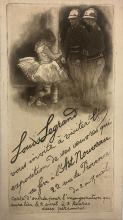
    On the front page of La Nation on April 15, 1896, Siegfried Bing (1838–1905), the famous Parisian dealer in Japanese fine and decorative arts, was described by an anonymous critic as a man with foresight—a man driven by the desire to demonstrate the value of the overlooked and undiscovered.

  • By Emerald Lucas
    Tuesday, February 25, 2025
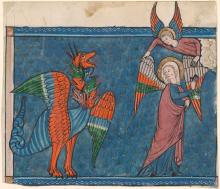
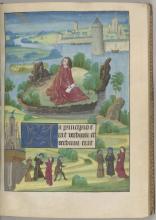
    In the late eighteenth century, the Swiss dealer Peter Birmann assembled a monumental album of 475 miniatures, which he had removed from illuminated manuscripts. Named after the man to whom he sold the album, Daniel Burckhardt-Wildt (1752–1819), it remained in private hands for nearly two hundred years.

  • By Dale Stinchcomb
    Wednesday, January 15, 2025
    There’s an old adage in the theater that says plays are not written, they are rewritten. For most of the twentieth century that rewriting happened on the road during two-week stints known as tryouts. These trial runs, in cities like Boston, Chicago, and Philadelphia, gave new productions time away from the critical spotlight to get their acts together and avoid landing belly-up on Broadway.

  • By Debarati Sarkar
    Friday, May 24, 2024

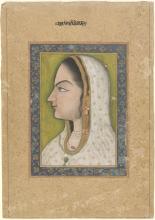
    While the identity of most portraits in the Walter collection of Indian paintings at the Morgan remains obscured, an eighteenth-century portrait (M.1074.1) identifies the subject as “Nur Jihan Begum” in Nagari script. This painting has since been interpreted as an idealized portrait, “an imaginative rendering.” Such portraits were often commissioned by the Rajput courtiers in Rajasthan.

  • By John McQuillen
    Thursday, March 7, 2024

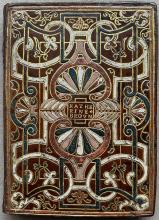
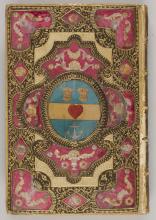
    Tracing a book’s ownership history—its provenance—is for me one of the most enjoyable, if sometimes frustrating, aspects of book history. This post will highlight the provenance of European books owned by women during the sixteenth century and focus on how ownership might be denoted on the binding of the book, particularly through the inclusion of a personal name.

  • By Jacqueline Yu
    Wednesday, May 24, 2023

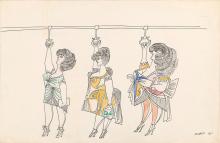
    For more than six decades, Saul Steinberg (1914–1999) tackled themes of immigration, identity, war, and other complex issues in humorous yet insightful illustrations for acclaimed publications like The New Yorker. Drawing on his experiences as a Jewish Romanian immigrant who had fled to the United States from Italy at the onset of World War II, Steinberg’s unique perspective and artistic language quickly established him as one of the most renowned cartoonists of the twentieth century.

  • By John McQuillen
    Monday, September 12, 2022

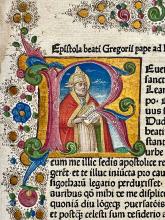
    The 15th-century Venetian artist known as the Master of the Pico Pliny enjoyed a career spanning 1460 to 1505, in which they produced hand-painted decoration in both manuscripts and incunabula and designed woodcuts for printed books.

  • By John McQuillen
    Wednesday, August 17, 2022

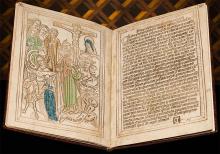
    The Morgan recently acquired a rare copy of the Ars moriendi blockbook, printed in the Netherlands about 1467–69 (identified in the literature on blockbooks as edition IIA, that is, the first state of the second edition). This fragmentary copy—only fifteen of twenty-four total leaves—was in a private collection in Belgium.

  • By Philip Palmer
    Monday, June 13, 2022

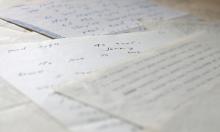
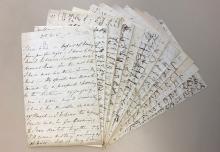
    The Morgan has acquired thirteen letters written by the American writer J.D. Salinger (1919–2010) to his editor at The New Yorker in the 1940s and 50s, Gustavus “Gus” Lobrano (d. 1956). The letters are part of a larger acquisition of letters, manuscripts, and printed books related to Gus Lobrano and his daughter, Dorothy “Dotty” Lobrano Guth (1928–2016), who also worked at The New Yorker.

  • By Rachel Federman
    Tuesday, March 22, 2022

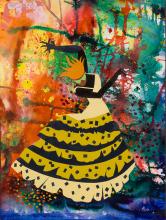
    During the 2021 winter holiday season, the Morgan received as a gift Rondo, a group of twenty-four collages by feminist-art pioneer Miriam Schapiro (American, born in Canada, 1923–2015). The donors, Peter and Kirsten Bedford, commissioned them in 1988 for a series of clothbound artists’ books published under their San Francisco imprint, Bedford Arts.

  • By Sandra Carpenter
    Monday, March 7, 2022

    The shelves of most rare book and manuscript libraries contain their fair share of mysterious items of unidentified origin or authorship, residing in obscurity beside works by the famous and celebrated as a lingering challenge to contemporary catalogers and researchers.

  • By Roger S. Wieck
    Monday, February 14, 2022

    On December 21, 2021, the Department of Medieval and Renaissance Manuscripts received an exciting gift from Marguerite Steed Hoffman, member of the department’s Visiting Committee. It is a Book of Hours illuminated by an important fifteenth-century French artist—the Master of the Burgundian Prelates—whose work, prior to this donation, was not represented at the Morgan.

  • By Isabelle Dervaux
    Thursday, December 16, 2021

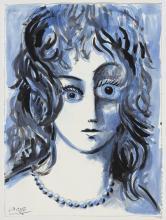
    “I kind of draw like you are walking through the forest,” Condo explains. “You don’t really know where you are going. You just start from some point and randomly travel through the paper until you get to a point where you finally reach your destination.”

  • By John McQuillen
    Thursday, September 23, 2021

    One of the most interesting aspects of researching rare books is finding signs of use that a volume has accrued over the centuries. Ownership inscriptions, marginal annotations, bookplates, and bindings are all clues as to where a book has been and who has used it over its long life. A 500-year old book that looks like it has never been read is a perplexing problem.

  • By John McQuillen
    Friday, September 17, 2021

    In the spring of 2019 former Morgan trustee Jayne Wrightsman bequeathed to the museum an exceptional collection of books bound for the highest echelons of eighteenth-century French society. This donation forms the core of the exhibition Bound for Versailles: The Jayne Wrightsman Bookbindings Collection, on view through January 30, 2022.

  • By John Bidwell
    Friday, August 20, 2021

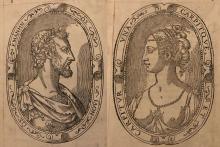
    As if genius is not enough, a lyric poet has got to be in love. Pierre de Ronsard was still serving his literary apprenticeship in 1545 when he met Cassandre Salviati at a ball in the Château de Blois. Around fourteen-years-old at that time, she was the daughter of a Florentine banker who helped to finance the reign of Francis I. She married a local nobleman a year later, but that was not an obstacle to the conventions of courtly love. She was Ronsard’s muse, a source of inspiration like Beatrice was for Dante and Laura for Petrarch.

  • By John Marciari
    Wednesday, August 4, 2021

    This post is extracted from the catalogue of the Morgan's exhibition Architecture, Theater, and Fantasy: Bibiena Drawings from the Jules Fisher Collection, a show that celebrates the promised gift of a group of Bibiena drawings. This essay aims to put the new drawings in the context of the Morgan's existing collection, and to discuss the collecting of Bibiena drawings more generally.

  • By Mary Creed
    Wednesday, June 30, 2021

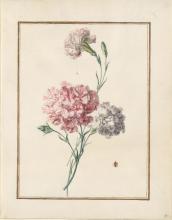
    The mid-eighteenth century witnessed the flourishing of scientific illustration in Europe. In an intellectual climate that valued curiosity and experimentation, the goals of the artist frequently merged with those of the scientist. Before the invention of photography, artists needed to document botanical specimens quickly before they decayed. These visual records of plants aided in their identification and classification and also functioned as aesthetically pleasing works of art.

  • By Jamie Kwan
    Tuesday, June 1, 2021

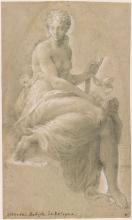
    Figure of Faith is one of the Drawing Department’s more enigmatic works. Rendered in soft black chalk with highlights in opaque white added with a brush, it features a seated woman covered in delicate, classical drapery. Upon closer inspection, you can see that strangely, the figure’s head has been cut out and pasted onto the sheet and that the figure was drawn on a sheet that has been trimmed in the shape of an arch and pasted onto a matching sheet of paper.

  • By John Marciari
    Monday, May 31, 2021

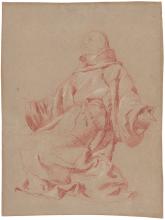
    The Morgan’s collection of drawings by the members of the Tiepolo family is one of our great strengths, for we hold roughly 200 drawings by Giambattista Tiepolo (1696–1770), 100 by his son Giandomenico (1727–1804), and a few by his younger son Lorenzo (1736–1776).