Plan your visit. 225 Madison Avenue at 36th Street, New York, NY 10016.

Plan your visit. 225 Madison Avenue at 36th Street, New York, NY 10016.

Blog | Collection

  • By Sheelagh Bevan
    Friday, October 30, 2015

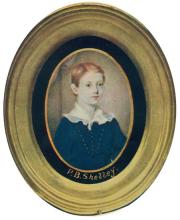
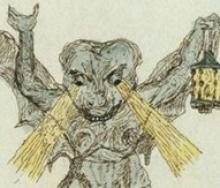
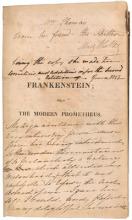
    What would Halloween be without monsters, and what would monsters be without Mary Shelley’s Frankenstein (1818)? The work has been cited as the most widely published English novel of all time—a book, written by a 19-year-old, that launched a thousand translations, imitations, and adaptations on stage and screen.

  • By Kate Kasten
    Tuesday, August 18, 2015

    In September 2014, I began an internship in the Department of Printed Books and Bindings at the Morgan Library & Museum while studying for a Master’s of Library Science degree with an emphasis on Special Collections. My academic background is in French literature and cultural studies. The department was looking for an intern to work on the Ramey Collection, and I was pleased to arrive in the right place at the right time.

  • By John Bidwell
    Friday, July 24, 2015

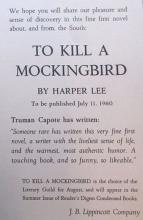
    While cataloging the latest gifts to the Carter Burden Collection of American Literature, we noticed and admired the prepublication hoopla for Go Set a Watchman, an earlier version of Harper Lee’s Civil Rights Era classic To Kill a Mockingbird.

  • By John Bidwell
    Thursday, February 26, 2015

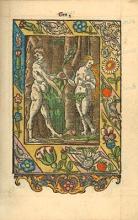
    Willem van Branteghem, Pomarium mysticum tum novorum tum veterum fructuum, animae Christianae. Antwerp: Willem Vorsterman, 1535. Purchased on the Curt F. Bühler Fund, 2014.
     

  • By John Bidwell
    Wednesday, May 2, 2012

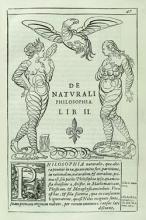
    Ottavio Farnese (1598–1643). Quaestiones definitae ex triplici philosophia, rationali, naturali, morali, in Parmensi Academia publicè triduum disputatae. Parma: Anteo Viotti, 1613. Purchased on the L. C. Harper Fund, 2012.

  • By John Bidwell
    Wednesday, April 18, 2012

    Russell Maret. Specimens of Diverse Characters. [New York, N.Y.]: Russell Maret, 2011. Purchased on the Henry S. Morgan Fund, 2012.

  • By Sheelagh Bevan
    Tuesday, March 27, 2012

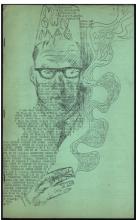
    My Own Mag (Barnet, England: Jeff Nuttall / Homosap, Inc., [1963]-1966). 17 nos.

  • By Carolyn Vega
    Thursday, March 22, 2012

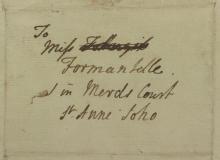
    If you're going to write a love letter, you should probably get the name on the address panel correct. At least, if I was a fashionable young singer in the 18th century, I would probably pause a bit when opening a letter from an admirer (who had a reputation), which he seemed to have first addressed to someone else entirely.

  • By Carolyn Vega
    Thursday, March 8, 2012

    Letter-writers are not always consistent about dating their correspondence, especially quick casual notes. In order to determine when something was written, we often have to consult postmarks or notes made by the recipient. But, much to the chagrin of researchers and librarians everywhere, sometimes the only clues lie in the actual contents of the letter.

  • By John Bidwell
    Friday, February 17, 2012

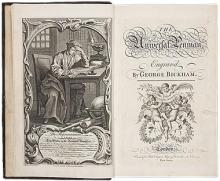
    George Bickham (1684?-1758?). The Universal Penman. London: Robert Sayer, [ca. 1760]. Purchased on the Henry S. Morgan Fund, 2012.

  • By Carolyn Vega
    Tuesday, February 14, 2012

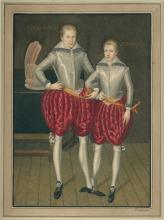
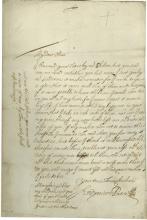
    This charming love letter was written by the 17th-century English courtier Endymion Porter to his wife Olive. Penned in a clear italic hand, Porter professes his adoration and wishes he could leave court and come to her "for I never desired it more in my life."

  • By John Bidwell
    Thursday, February 2, 2012

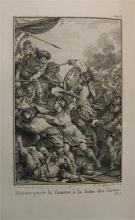
    Homer. L’Iliade, traduction nouvelle [par Charles-François Lebrun, duc de Plaisance]. A Paris: Chez Barbou, Moutard, Ruault, 1776. Purchased on the Gordon N. Ray Fund, 2011.

  • By John Bidwell
    Thursday, January 19, 2012

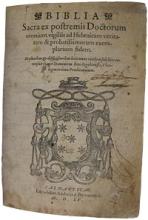
    Bible. Latin. Vulgate. 1555. Biblia sacra ex postremis doctorum omnium vigiliis ad Hebraicam veritatem & probatissimorum exemplarium fidem. Salamanca: Andrea de Portonariis, 1555. Purchased on the Henry S. Morgan Fund, 2011.

  • By Carolyn Vega
    Thursday, January 5, 2012

    Life, & the world, or whatever we call that which we are & feel, is an astonishing thing. The mist of familiarity obscures from us the wonder of our being ... Life, the great miracle, we admire not, because it is so miraculous. It is well that we are thus shielded by the familiarity of what is at once so certain and so unfathomable, from an astonishment which would otherwise absorb and overawe the function of that which is its object.

  • By John Bidwell
    Tuesday, December 27, 2011

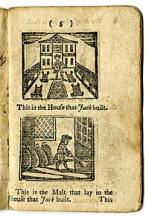
    The House that Jack Built: A Diverting Story for Children of All Ages. To Which is Added, Some Account of Jack Jingle. Shewing by Which Means he Acquired his Learning, and in Consequence Thereof Got Rich and Built Himself a House. With a Collection of Riddles Written by Him. The Whole Adorned with a Variety of Cuts by Master Collett. London: Printed and sold by John Marshall, at No. 4, Aldermary Church-Yard in Bow-Lane; and no. 17, Queen-Street, Cheapside, [between 1787 and 1798]. Purchased on the Elisabeth Ball Fund, 2011.

  • By Carolyn Vega
    Saturday, December 24, 2011

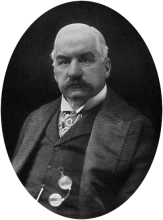
    What do you get for the dad who has everything? Something more personal than a sweater or tie, for sure. Books tend to be a good choice, but if he has already built a stunning three-tiered library and study to house his growing collection of books and manuscripts, the latest bestseller just won't do. One year, J.P. Morgan, Jr. (known as Jack) found a perfect little gift for his father. In 1906 and 1907, Pierpont Morgan had acquired some manuscripts of the American writer Bret Harte. Largely forgotten today, Harte was one of America's most popular (and well-paid) writers of the late 19th century. Jack built on this interest of his father's by giving him, for Christmas in 1909, the manuscript of Harte's short story How Santa Claus came to Simpson's Bar.

  • By Carolyn Vega
    Monday, December 19, 2011

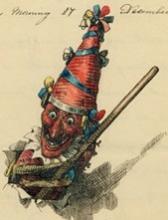
    Just a week before Christmas in 1843, the 19-year-old artist Richard Doyle wrote this illustrated letter to his father, playfully, but apologetically, putting off work that he had promised to finish before Christmas. He is in the midst of preparing his first contributions to the magazine Punch and wants to let his father know that "the nearer it becomes to Christmas the more awful does my situation, with regard to certain annual productions called "Christmas things" appear." Punch is seen here, somewhat maniacally bursting through the page.

  • By Carolyn Vega
    Thursday, December 8, 2011

    John Ruskin was just ten years old when he wrote and illustrated The Puppet Show: Or, Amusing Characters for Children. The little book is filled with twenty-nine short poems, each of which is accompanied by two pen-and-ink drawings. The poems, as far as I can determine, are Ruskin's own, although some of the illustrations are copied from George Cruikshank's vignettes in Grimm's German Popular Stories, which was first published in London in 1823.

  • By John Bidwell
    Wednesday, November 2, 2011

    Jean Chenel, sieur de La Chappronnaye (fl. 1614-1617). Les revelations de l’hermite solitaire sur l’estat de la France. Paris: Toussaincts du Braÿ, 1617. Purchased on the Gordon N. Ray Fund, 2011.

  • By Carolyn Vega
    Thursday, October 27, 2011

    Robert Fulton's steamboat first chugged up the Hudson River in August, 1807. The flat-bottomed boat, which was only 12 feet wide, was fitted with side wheels and powered by a coal-fired steam engine. It clocked an impressive 4 to 5 miles per hour against the current and made the 150-mile trip from New York to Albany in about 32 hours.