
Listen to curator Josh O’Driscoll discuss the origins of tarot trump card imagery.
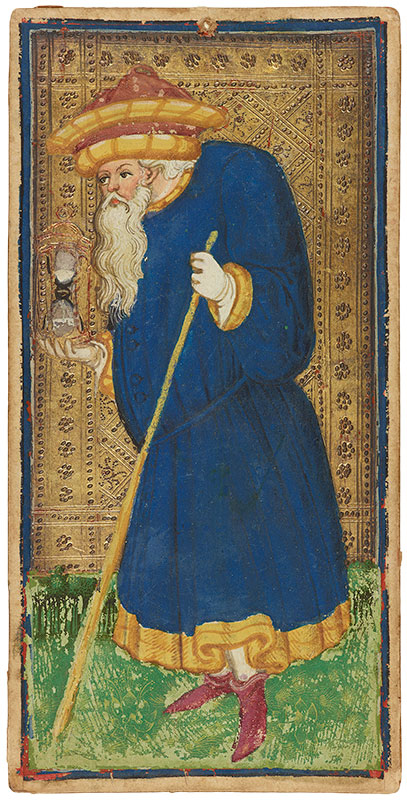
Time
Bonifacio Bembo (1420-1480)
The Visconti-Sforza Tarot
Italy, Lombardy, ca. 1456-58
Tempera, gold and silver leaf on pasteboard
The Morgan Library & Museum, New York
The striking imagery of tarot trump cards did not emerge in isolation—rather, it was shaped by the rich visual and intellectual culture of the Renaissance. The first artists to create tarot cards drew on a wide range of familiar symbols, figures, and ideas that would have been immediately recognizable to their audiences.
At the core of this imagery are allegorical figures—personifications of concepts like Love, Death, Fortune, and Time. These were not inventions of tarot, but part of a broader visual language used in manuscripts, paintings, and public works of art. Artists relied on established attributes to make these figures legible. For example, Justice appears with a sword and scales, while Time is often shown as an aged man leaning on a staff.
Religious and social hierarchies also shaped the cards. Figures such as the Emperor and the Pope reflect the structures of power that governed Renaissance life, while the Fool represents marginality and unpredictability.
These images were arranged into a loose hierarchy, moving from earthly concerns toward cosmic and spiritual realms. Though the precise logic of their sequence remains uncertain today, the overall structure suggests a journey—one that mirrors the Renaissance fascination with order, morality, and the nature of existence.
Rather than encoding hidden meanings, these cards reflect a shared cultural vocabulary. Their power lies not in secrecy, but in their ability to bring together familiar images into a compelling and thought-provoking sequence.