
Listen to curator Josh O’Driscoll discuss the Mantegna Tarot.
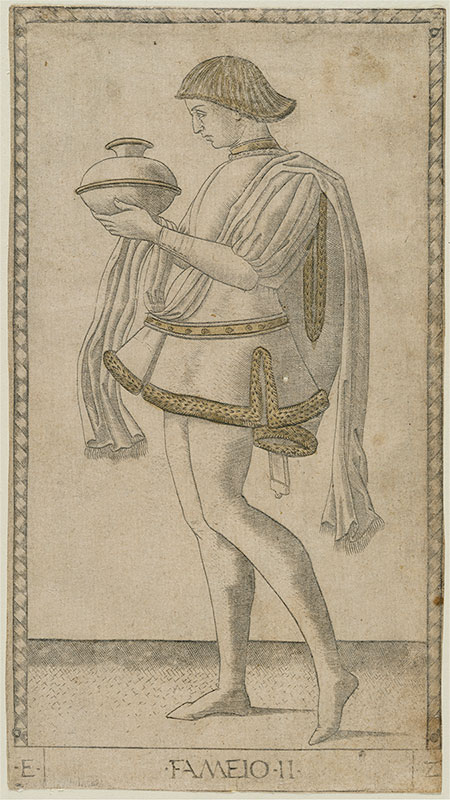
Servant (Fameio)
Master of the E-Series Tarocchi (Lazzaro Bastiani?)
The “Mantegna Tarot”
Northern Italy (Venice?), ca. 1462–67
Museum of Fine Arts, Boston
Photograph ©2026 Museum of Fine Arts, Boston
Often called the “Mantegna Tarot,” this remarkable set of prints is neither a true tarot deck nor the work of the famous artist Andrea Mantegna. Likely created in Venice or Ferrara around 1465, the prints have recently been attributed to the Venetian artist Lazzaro Bastiani, though their patron remains unknown.
For centuries, scholars have searched for hidden meanings in these images, linking them to esoteric traditions such as Neoplatonism or Kabbalistic mysticism. Yet their structure is surprisingly clear. The prints are organized into five groups of ten, each carefully labeled and numbered. Together, they form a structured sequence of ideas: beginning with the conditions of human life, represented by the selection at left, then moving to the Nine Muses and Apollo, followed by the Liberal Arts, represented by the selection at center, then the Virtues, and then finally the Heavenly Spheres, at right. Rather than a game, this arrangement points to the use of the prints as a teaching tool, designed to guide students through a hierarchy of knowledge.
This intellectual ascent begins with the humblest figure—a beggar—and gradually rises through the realms of learning, morality, and cosmic order, culminating in the “first cause” of all things, that is God. This structure reflects a humanist understanding of a universe arranged by divine order. These prints were immensely popular in their time, and were often embellished with touches of gold or bound into books for safe keeping.