
Listen to curator Josh O’Driscoll discuss Besozzo’s prayer book and Marziano’s Tarot deck.
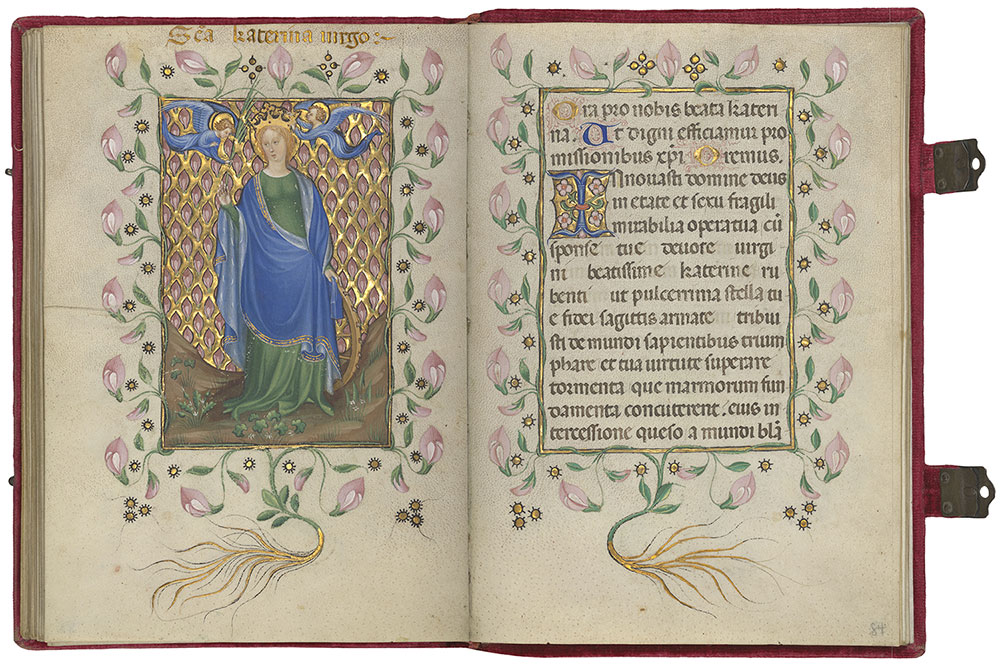
St. Catherine of Alexandria
Prayer Book, in Latin
Illuminated by Michelino da Besozzo
Italy, Milan, ca. 1410–20
The Morgan Library & Museum, MS M.944, fols. 83v-84r
Purchased with the generous assistance of Alice Tully in memory of Dr. Edward Graeffe, 1970
In the early fifteenth century, Marziano da Tortona—secretary, astrologer, and advisor to Duke Filippo Maria Visconti of Milan—invented a card game designed to challenge the intellect of a Renaissance prince. Painted by the renowned court artist Michelino da Besozzo, this luxurious deck has not survived. Yet Marziano’s detailed written account allows us to reconstruct its remarkable design.
Unlike a standard pack of cards, the deck was organized into four suits of birds—eagles, phoenixes, turtledoves, and doves—each representing an abstract concept: Strength, Riches, Virginity, and Pleasure. Each suit contained numerical and court cards, but the most innovative feature was a set of sixteen special cards depicting figures from Greco-Roman mythology. These are the earliest known examples of trump cards. To play the game, one had to identify each figure and remember its place in a strict hierarchy. Success depended not on chance, but on knowledge, memory, and skill.
To imagine how these cards may have looked, we can turn to Besozzo’s surviving prayer book, displayed here. Likely created for a member of the Visconti family, it exemplifies the refined style for which the artist was celebrated. Its figures are delicately rendered, with soft, rounded faces, half-closed eyes, and an almost dreamlike grace. Drapery flows in elegant, rhythmic lines, while surfaces shimmer with gold and richly colored pigments.
Featuring a different flower on each illuminated page, the manuscript’s borders and backgrounds are rich with naturalistic detail, reflecting Besozzo’s particular skill in depicting the natural world. This refined visual language offers a compelling point of reference for imagining Marziano’s lost deck. More than a simple deck of cards, it likely combined visual splendor and intellectual ambition to create a game intended not only to delight but also to instruct and exercise the mind.