
Listen to co-curator Sarah Lees discuss Renoir’s process of revisiting and revising compositions using drawings and tracings.
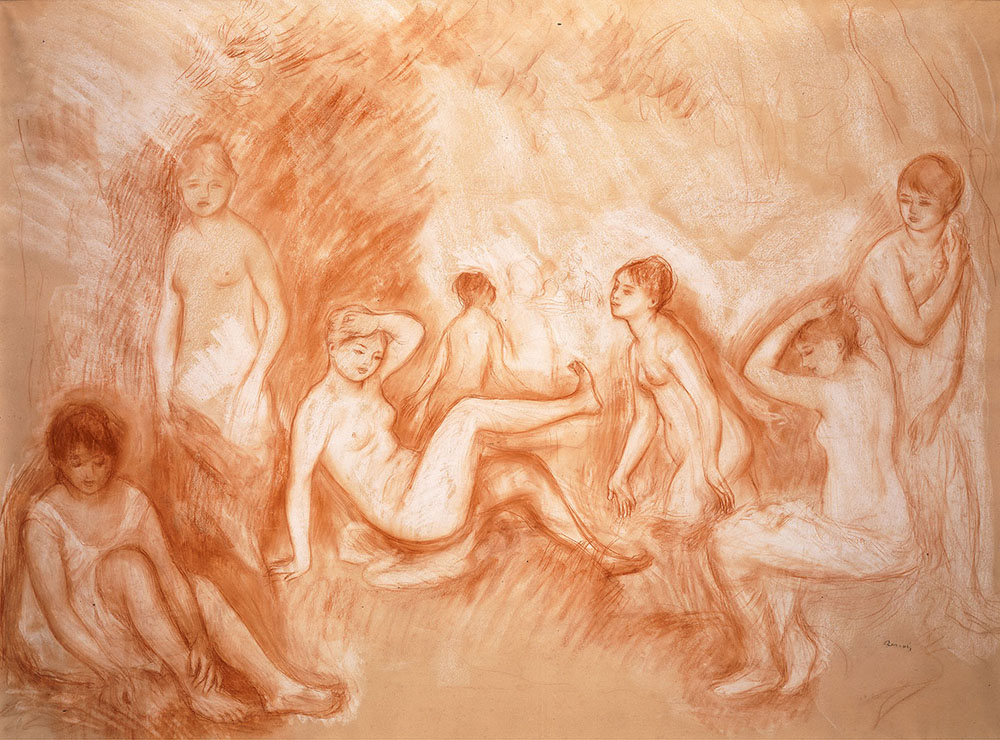
In 1897 Renoir revisited the subject of bathers interacting playfully in a woodland setting, some ten years after he completed his landmark canvas The Great Bathers. This sketch is one of many new preparatory studies that recombine figures from earlier works—the central reclining woman and the one about to splash her derive directly from The Great Bathers, while the seated bather on the right arranging her hair relates more closely to other images of individual models. Although this roughly drawn study and the more fully worked-up sheet next to it share the same six main figures, they differ considerably from the final painting in the Barnes Foundation, Philadelphia.
Bathers (Study for “Bathers in the Forest”), ca. 1897
Red and white chalk
Thyssen-Bornemisza Collections.
Sometime in late 1896 or early 1897, Renoir began to develop a new multi-figured composition of bathers in an outdoor setting as he had done about ten years earlier for The Great Bathers, a painting you can see elsewhere in this gallery. His practice of revisiting and reusing figures from earlier works is clearly evident in the new composition. Both this red and white chalk study and the even more roughly sketched version next to it center on a reclining woman raising her right arm and leg protectively and a second woman threatening to splash her, both figures derived directly from The Great Bathers. And the seated woman on the right arranging her hair seems related to several single seated nudes that Renoir had made in drawings and paintings over the previous decade. His habit of making tracings of completed figures that he was satisfied with probably enabled him to repeat figures in this way – as his son Jean recalled many years later: “he would make a tracing, put it aside, and go on with other work… he did not start using it on a new canvas until long afterwards, sometimes even months or years.” Renoir would then develop such repetitions further to create a new composition, as he did here, where numerous modifications to the rough sketch are noticeable in the more developed study. The composition changed even further in the final painting, which is in the Barnes Foundation in Philadelphia, as Renoir added and omitted figures and completed the verdant woodlands and pond surrounding the bathers. Later, Renoir probably made the graphite drawing on view nearby as a tracing of the completed painting, perhaps with a view to modifying the ensemble even further.