
Listen to Esther Levy talk about Leonora Carrington’s engagement with tarot Imagery.
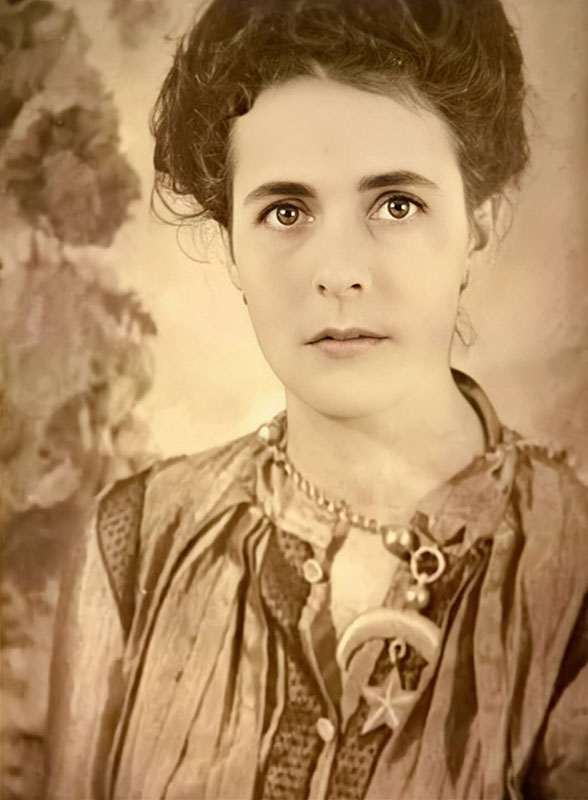
Cecil Beaton (British, 1904–1980)
Leonora Carrington, n.d. (ca. Late 1940s)
The British-born Mexican Surrealist Leonora Carrington maintained a lifelong interest in tarot, producing interpretations that range from incorporating traditional iconography to more abstract reformulations. This engagement is evident in a series of six card-sized gouache on vellum drawings, each depicting an isolated figure or event against a flat ground.
These drawings date from Carrington’s time in New York City, where she lived near the C.G. Jung Institute. At the Institute, she frequently consulted the Archive for Research on Archetypal Symbolism – an encyclopedic pictorial and written archive of symbolic images from across time and geography. This experience appears to have deepened her engagement with universal or inherited imagery like the Tarot Arcana, as a means of accessing patterns in human behavior.
This investigation can be seen in works like Cannibal, whose central figure bears a striking resemblance to the tarot card the Hanged Man with its crossed legs and suspended posture, while the red and purple hues in the background closely parallel those in Carrington’s own Hanged Man card – a version of which is on view in a nearby case.
In addition, a caduceus – also known as the rod of Hermes – appears on the figure’s face. Present in both the Rider-Waite-Smith and Thoth Tarot decks, the caduceus’ intertwining serpents symbolize the balancing of dual energies and the coexistence of opposites. These references to equilibrium resonate with the Hanged Man’s association with themes of suspended action, compromise, and the balance of the spiritual and material worlds.