
Listen to Claire Gilman discuss Victor Brauner’s painting “The Surrealist”
Victor Brauner (1903-1966)
The Surrealist, 1947
Oil on canvas
23 5/8 x 17 3/4 inches (60 x 45 cm)
Peggy Guggenheim Collection, Venice, 76.2553 PG 111
© 2026 Artists Rights Society (ARS), New York / ADAGP, Paris
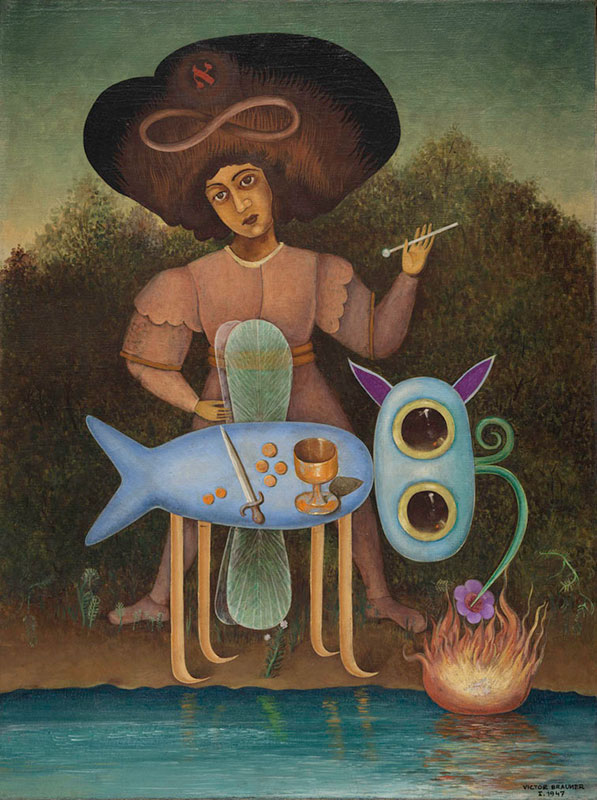
Victor Brauner’s The Surrealist is closely based on the first card in a traditional tarot deck: the Juggler or Magician. As a model for this work, Brauner referenced the eighteenth-century French deck known as the Tarot de Marseille which Brauner and his fellow surrealists had used as inspiration for their 1941 deck the Jeu de Marseille created while waiting in the French town for passage to the United States. The protagonist’s medieval costume and open stance are directly based on the eighteenth-century figure who similarly stands behind a table displaying the attributes of three tarot suits, a knife representing swords, a goblet representing Cups, and scattered Coins, while, in his left hand, he holds aloft a baton, representing Wands. In place of the table, Brauner has substituted a winged insect-like creature whose antenna culminates in a firey orb which in turn rests on a blue lake or ocean set against a verdant garden. In this way, Brauner invokes the four elements—air, fire, water and earth—each of which corresponded in occult magic to a specific tarot suit: swords, wands, cups and coins respectively. Able to control the elements, the tarot Juggler is a fitting stand-in for the Surrealist painter who, by extension, is presumed to be endowed with similar powers of mutability and self-determination.
Brauner depicted the Juggler and a Popess or High Priestess figure in another painting of 1947, entitled The Lovers. The inscriptions at either side of that canvas, Past—Present—Future and Fate/Necessity—Will/Magic—Surreality/Liberty, are written in Brauner’s hand on the back of the Peggy Guggenheim canvas and position Surrealism as conduit for artistic and political freedom.