
Listen to curator Josh O’Driscoll discuss the Sola Busca deck and its relation to Pamela Coleman Smith’s imagery.
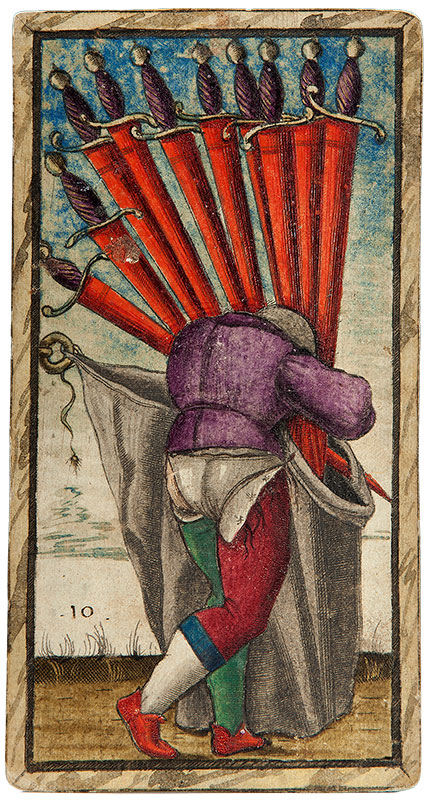
Ten of Swords
Nicola di Maestro Antonio (attributed)
Sola Busca Tarot
Hand-colored engravings
Italy, Venice, 1491
Pinacoteca di Brera, Milan
© Pinacoteca di Brera, Milano - MiC
Created in Venice around 1491, the Sola Busca deck represents one of the most innovative and experimental examples of Renaissance tarot. It is the earliest complete surviving tarot deck and the first known to feature fully illustrated number cards—an innovation that would have a decisive impact on the later history of tarot imagery.
Unlike more conventional Renaissance decks, its trump cards depict figures drawn from classical antiquity, including heroes, rulers, and other obscure or enigmatic characters. Their identities are often difficult to interpret, and in many cases remain uncertain, suggesting that the deck was intended for a small, learned audience capable of engaging with its erudite references.
Centuries later, this experimental approach would find renewed expression in the work of Pamela Colman Smith. Collaborating with Arthur Edward Waite and the publisher William Rider & Son, Smith produced what is now known as the Rider Waite Smith deck in 1909. Smith drew deeply from historical sources like the Tarot de Marseille and the Sola Busca deck, which she likely studied through photographs at the British Museum. In some instances, such as her Ten of Wands card, her reliance on Renaissance models is unmistakable. More often, however, she adapted basic concepts from older cards into her own distinctive visual language. Her delight in visual details and her talent for storytelling undoubtedly contributed to the great success of her imagery, which forms the basis for what is by far the most influential tarot deck of the modern era.