
Listen to curator Josh O’Driscoll discuss the occult reappraisal of tarot.
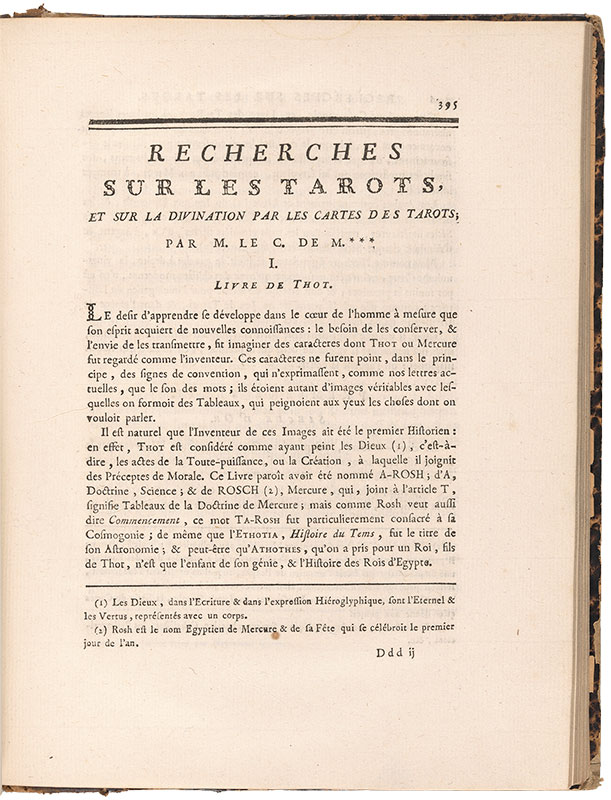
Antoine Court de Gébelin
The Primitive World Analyzed and Compared with the Modern World (Monde primitif analysé et comparé avec le monde moderne), vol. 8
Paris: Chez l’auteur, 1781
The Morgan Library & Museum, 603 C86
In the late eighteenth century, tarot cards were given an entirely new identity—one that continues to shape how they are understood today. At the center of this transformation was the scholar Antoine Court de Gébelin.
When he first encountered tarot cards while visiting a friend outside Paris, Court de Gébelin was struck by their imagery, which he described as strange and enigmatic. Almost immediately, he became convinced that these cards were not a game, but rather the remnants of an ancient Egyptian “book of magic” disguised as a deck of cards. In his monumental encyclopedia, he argued that each card preserved fragments of sacred knowledge, passed down from antiquity but gradually misunderstood over time by later card makers.
Directly following his essay, Court de Gébelin included a contribution from another author: the Count of Mellet, whose text is shown here. He identified tarot as the “Book of Thoth,” linking it to the Egyptian god of writing, magic, and wisdom. He was also among the first to suggest that the cards could be used for divination, offering early instructions for their interpretation.
Together, Court de Gébelin and the Count of Mellet established a theoretical foundation for the reappraisal of tarot as something significantly more important than a card game.