
Listen to exhibition curator Frank Trujillo discuss the Rosenwald Tarot.
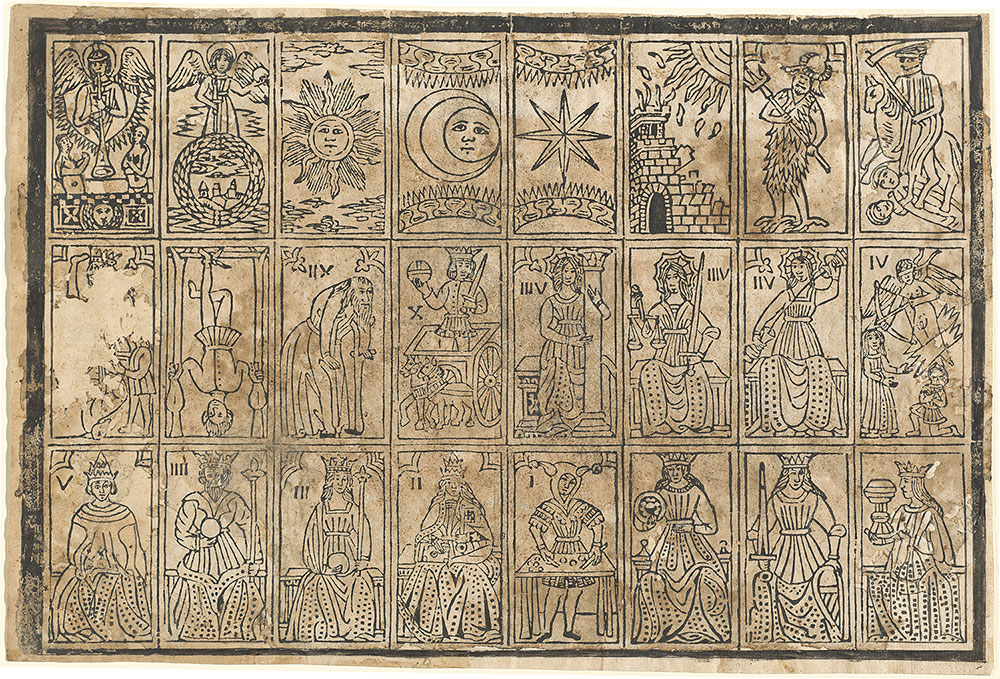
The Rosenwald Tarot
Woodcut on laid paper
Italy, Florence (?), ca. 1500
The National Gallery of Art, Washington, DC, Rosenwald Collection, 1951.16.7
These rare surviving woodcut sheets mark a shift in production from deluxe, handmade tarot decks to mass-printed cards that helped quickly spread the game beyond Italy. Rather than requiring a workshop of artists skilled in painting and manuscript illumination, a seventy-eight card deck could be printed by a single person on just four sheets of paper. After printing, the cards could be colored by hand, cut apart, and mounted on backing paper for durability. The sheet on the right depicts a complete series of trumps arranged according to the Florentine order of the game. The Fool was likely printed on a now lost sheet. At the top right corner are the Tower and Devil cards, which no longer exist in any of the Visconti Tarot decks. The sheet at left has the ace of each suit, several court cards, and the two through nine of cups. Despite the ease of printing sheets of cards, there are few extant examples of single woodcut cards. These woodcut sheets reflect a great material change from the opulence and grandeur of the gilded Visconti cards, but their adherence to the symbols, characters, and values of the Visconti TAROT helped prove the endurance of its imagery.