
Listen to exhibition curator Frank Trujillo discuss Franco Dei Russi.
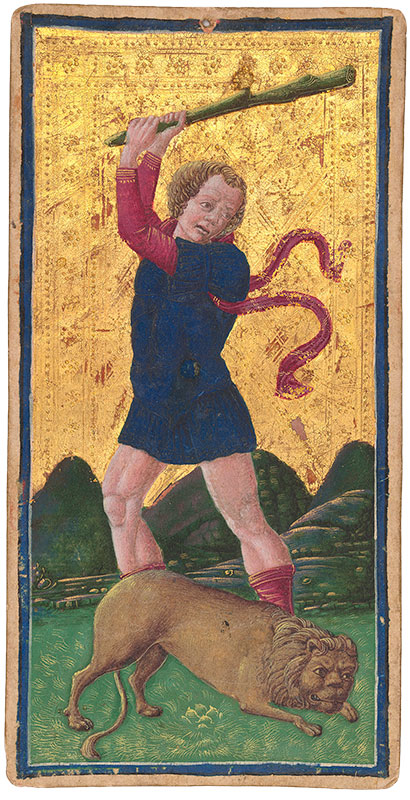
Fortitude
Franco dei Russi (attributed)
The Visconti-Sforza Tarot (replacement cards)
Ferrara (Veneto?), ca. 1465-70
The Visconti Tarot decks have previously been incorrectly attributed to a number of Italian Renaissance artists like Michelino da Besozzo, Francesco Zavattari, and Antonio Pisanello. Although the decks are now securely attributed to the Bembo family workshop, these six cards remain an outlier in that attribution. Materials testing reveals that the background gold leaf is distinct from the rest of the Visconti-Sforza deck, something that can also be determined with one’s eye. Harder to see without advanced analytical techniques is the fact that the lion in the Fortitude card and the handheld star in the Star card is painted with mosaic gold, an artificial yellow pigment that has been used as a gold substitute since the fourteenth century. These cards are now referred to as “replacement” cards and are counted as an integral part of the Visconti-Sforza deck. It is unclear whether they were made to replace lost or damaged cards or were not originally made with the rest of the deck. They were, however, designed to match the rest of the deck in exact size and in subject matter. These six cards have recently been attributed to Franco dei Russi, an illuminator born in Mantua and active in Lombardy, Ferrara and the Veneto. Dei Russi participated in the manuscript illumination of the Bible of Borso d’Este under the guidance of Taddeo Crivelli whose manuscript can be seen in the Tarot and Courtly Art section of the exhibition. The overlapping of artists, patrons, and styles in the Renaissance makes attribution difficult and subject to change with new and compelling evidence. We invite you to evaluate the replacement cards with Dei Russi’s Adoration of the Magi displayed to the left.