
Listen to exhibition curator Frank Trujillo discuss the three Visconti tarot decks.
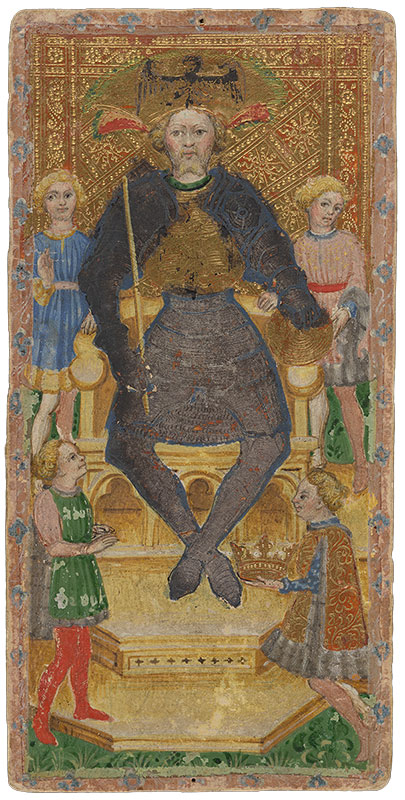
Emperor
Andrea Bembo (1431-1469)
The Visconti di Modrone Tarot
Italy, Lombardy, ca. 1441-42
Tempera and gold leaf on pasteboard
Beinecke Rare Book & Manuscript Library, Yale University, New Haven
Hi. I’m Frank Trujillo, the Drue Heinz Book Conservator in the Thaw Conservation Center, and co-curator of this exhibition.
Today the imagery and suits of the standard tarot deck are as familiar and well-established as those of standard playing cards, but the three Visconti decks here, attributed to the artist Bonifacio Bembo and his family workshop and created between 1441 and 1458, represent tarot’s very beginnings. Filippo Maria Visconti commissioned the oldest deck in the wall case at left to celebrate the marriage of his daughter, Bianca Maria, and his son-in-law Francesco Sforza. Known today as the Visconti di Modrone deck, the imagery and symbols were selected to reflect the two families, the fashions and styles of their courtly society, and the wealth and power that ensured their reign. The cards are arranged to show their categories within the game of tarot – the top row representing trump cards, the middle row showing court cards, and the bottom row a selection of pip cards. The Two of Coins in the bottom row depicts a blue Biscione, or viper, the heraldic emblem of the Visconti family. Uniquely among all tarot cards, the middle row has female knight and page cards, perhaps an acknowledgment of its recipient, Bianca Maria, on the occasion of her marriage.
In the case at center are six nearly iridescent pip cards from the Brambilla TAROT deck. The coins, or denari, are an almost exact one for one representation of the gold coins of the era. The Two of Swords depicts curved rather than straight swords, an appealing aesthetic choice that distinguishes the deck.
The Visconti-Sforza cards on the wall case at right have a slightly different visual effect than the two other decks. The trump and court cards use oro di metà, or half gold, a composite sheet of both gold and silver leaf, while the pip cards are on a white background. However, the imagery of the cards is consistent throughout all three decks. The depiction of Emperors, Kings and Queens, swords and cups, Death, Love, and the Last Judgement all come together to mark the beginning of tarot’s pictorial tradition based in the Renaissance and continuing through today.