
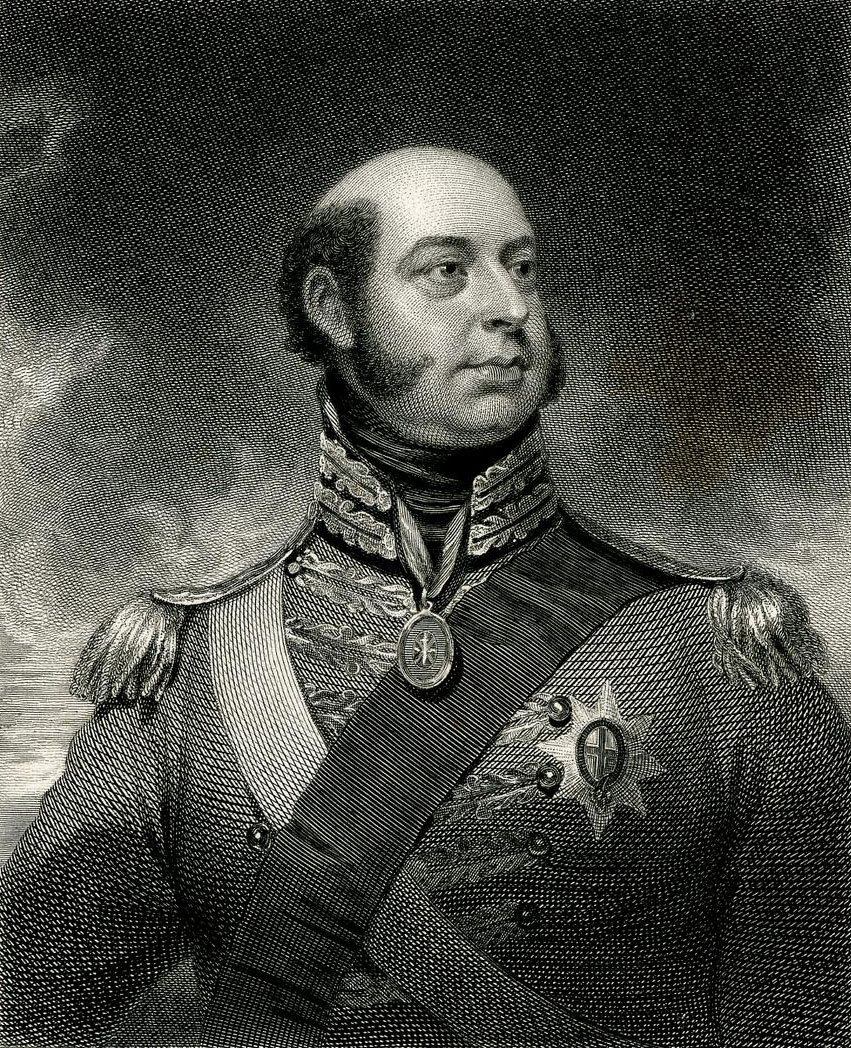
Portrait of Edward, Duke of Kent. © The Trustees of the British Museum. Shared under a Creative Commons Attribution-NonCommercial-ShareAlike 4.0 International (CC BY-NC-SA 4.0) license.
In late 1801, in London’s Kensington Palace, a British prince wrote two letters to a friend and political ally in Nova Scotia on a topic of mutual anxiety. The recipient—Sir John Wentworth, a native of New Hampshire and its last colonial governor who made a new life in Canada after the American Revolution—was in the midst of a crisis: his career and reputation were uncertain and, quite possibly, under threat. Clearly concerned for his friend, the prince—Edward, the Duke of Kent and fourth son of George III, now most well-known as the father of Queen Victoria—wrote to offer Wentworth advice, encouragement, and what inside knowledge he had of London’s government circles.
Prince Edward's assessment was blunt: An ongoing inquiry by the British government into Wentworth's handling of public funds was likely to result in his dismissal as lieutenant-governor of Nova Scotia and re-assignment to one of Britain’s Caribbean colonies. But Edward assured him of a silver lining, if this re-assignment were to occur: a certain posting in the West Indies would likely prove a financial windfall for Wentworth. "If St. Vincent should be chosen for you, that is likely to be very lucrative indeed, for, I believe, the Carib lands will be sold forthwith, to discharge the debts of the civil list, and the fees upon that are likely to be something very handsome." (MA 14909.22). Still, Edward promised to press Wentworth's case by ensuring his friend’s side of the story was known to the authorities in London. Edward wrote that he would forward to the colonial under-secretary "your letter to me, in which, you so fully, and yet so swiftly state the business of your accounts relative to the Maroons [...]" (MA 14909.23).
Wentworth’s “accounts relative to the Maroons” refers to the lieutenant-governor’s actions after the so-called Second Maroon War (1795–1796), in which the British military defeat of a community of Jamaican Maroons—descendants of Arawaks native to the island and people who had freed themselves from enslavement—resulted in over five hundred people being forcibly expelled from their homes in Jamaica and deported to Nova Scotia.1 As the chief executive of Nova Scotia, Wentworth attempted to settle the Maroons on a long-term basis in the province. The public funds he spent on these efforts—along with expenditures on provincial coastal defenses and a new official residence for himself—caused the career troubles he faced in late 1801.
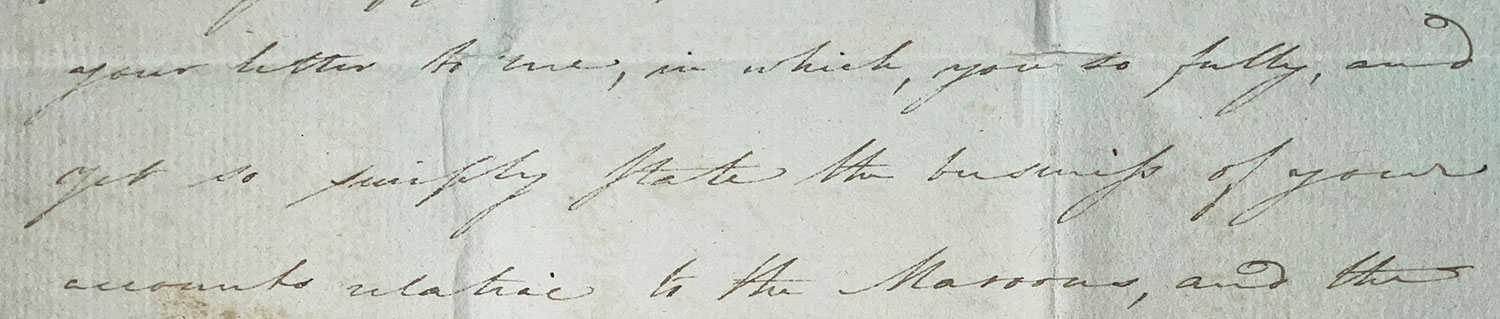
Detail of letter from Prince Edward Augustus, Duke of Kent, to John Wentworth, December 14, 1801. The Morgan Library & Museum, New York, bequest of Gordon N. Ray, 1987; MA 14909.23.
As for the "Carib lands" that Edward held out as a lucrative money-making opportunity for Wentworth: the Second Carib War (1795–1797) was another British colonial war in the Caribbean that ended in the defeat and forcible expulsion of thousands of Afro-Caribbeans from their homes. The lands that were to be sold by the British government to pay their debts—and from which Wentworth would personally earn a “handsome” profit—were taken from the mixed Indigenous-and-free-Black population on the island of St. Vincent. They were expelled to the island of Roatán off of the coast of Honduras, forming the Garifuna people.2
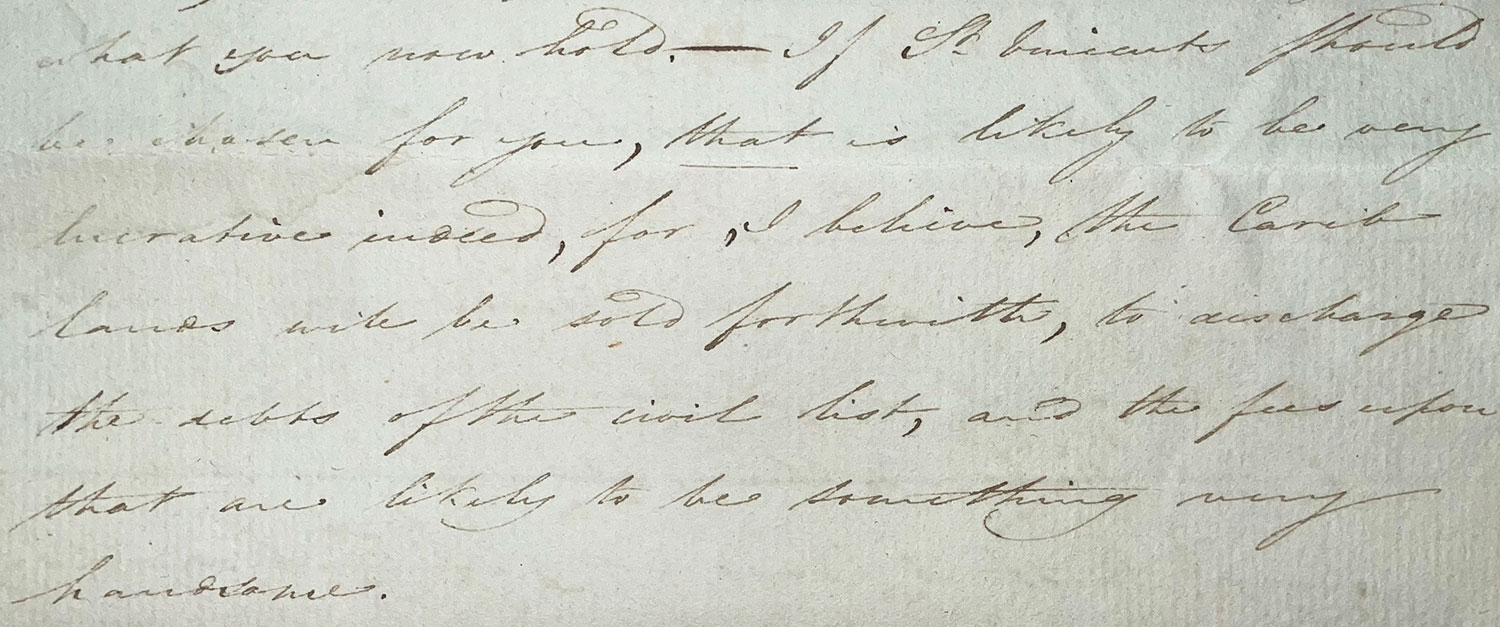
Detail of letter from Prince Edward Augustus, Duke of Kent, to John Wentworth, November 29, 1801. The Morgan Library & Museum, New York, bequest of Gordon N. Ray, 1987; MA 14909.22.
As it happens, John Wentworth was not removed from office until 1808–because of delayed mail, Sir John only learned of his dismissal after his replacement arrived in Halifax.
Though his career crisis of 1801 resolved favorably, and Wentworth and Prince Edward’s worries were not realized, these letters are of use to posterity. In either of those two short sentences, researchers in a number of different fields will find something of interest to their work. For historians of St. Vincent, the letters provide data on what happened to (and who profited from) the lands expropriated from the Carib people. Scholars of Atlantic migrations will find information relevant to the movements of Maroons, from Jamaica to Nova Scotia to Sierra Leone. Social historians of the British Empire find a concrete example of how well-connected individuals exercised informal influence to assist their social networks.
Documents like these add to the historical evidence through which “by slow degrees the thoughts of our forefathers, their common thoughts about common things, will have become thinkable once more."3
These kinds of records–letters, bills, memos, works-in-progress, and all kinds of everyday miscellanea–shed light on the thoughts, feelings, and actions of past people, as well as the unstated assumptions and implicit beliefs that made up their social world.
As the Shelby White & Leon Levy Fellow in Manuscript Cataloging, I have had the privilege of working with such records and learning the Morgan tradition of highly detailed, item-level cataloging. Our catalog records—available freely online on CORSAIR—summarize the items in our collections and list their associated persons, places, institutions, and events in a standardized format, so that our records are easily discovered by researchers searching for material related to their interests. By cataloging these manuscripts and making them available for use, the Morgan provides researchers with the evidence necessary to perform their work of uncovering, interpreting, and understanding our past—adding, in slow degrees, to our knowledge of human history and culture.
In “The Copper Breeches,” Sherlock Holmes—prodded by Dr. Watson to reach a premature conclusion about their current case—demurred, saying: "I can't make bricks without clay." He first needed data. The written remains of the past—such as these two letters from Prince Edward—provide a significant source of raw material with which historians and other scholars construct their investigations and analyses. Through the work of collecting, cataloging, and making available a variety of historical evidence, the Morgan facilitates scholarly research that increases and enriches our understanding of the past, present, and future.
James Gordon Emerson Shelby White and Leon Levy Fellow in Manuscript Cataloging The Morgan Library & Museum
Endnotes
- For further information, see: Richard Hart, Slaves Who Abolished Slavery: Blacks in Rebellion (University of the West Indies Press, 2002), 157–190.
- For further information, see: Christopher Taylor, The Black Carib Wars: Freedom, Survival, and the Making of the Garifuna (University Press of Mississippi, 2012), 115–141.
- Frederic William Maitland, Domesday Book and Beyond: Three Essays in the Early History of England (Cambridge University Press, 1897), 520.