
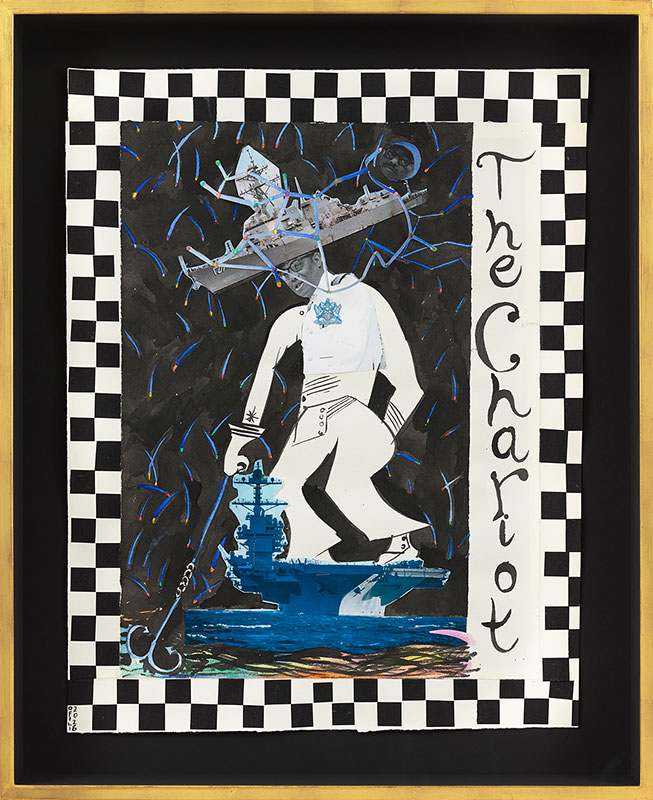
Chris Ofili
The Chariot, 2026
Signed, titled and dated verso
Ink, watercolour, staples and paper collage on paper
Framed: 28 3/4 x 23 1/2 x 3 1/2 in (73.1 x 59.8 x 9 cm)
© Chris Ofili. Courtesy the artist and David Zwirner
The Chariot plays with the idea of the display of military might, as Ofili connects the Chariot tarot card, with its origins perhaps in Roman military victory parades, with the long-running and dynamic intersection between the US navy and Trinidadian culture.
The Sailor Mas has been part of Trinidad Carnival since the 1880s, when the country’s waters were first occupied by British, French and American ships; the large naval presence maintained by the US Navy during World War II subsequently greatly increased its popularity. Beginning as a fairly realistic portrayal of the crewmen with which Trinidadians had become familiar, the sailor character developed offshoots including the King Sailor and Fancy Sailor – the latter known to sport extravagant headpieces that might take the shape of anything from a pack of cards to an aeroplane, while the former exhibit elaborated forms of the white, ceremonial dress of naval officers. Sailors often carry long poles, and they dance the sailor mas: inspired perhaps equally by observations of sailors with sea-legs and sailors under the influence, the carnival artist Ray Mahabir describes this as 'a side-to-side rocking of the torso and a quick heal-to-toe slide. [The sailor] also sticks out his abdomen and buttocks and with his legs does loose circles, meanwhile hunching his shoulders and moving his head forward and backwards. He moves forward in little hops, sometimes landing on the inside edges of his feet. With his hands he pantomimes various kinds of activity like flying a kite, driving a car, skiing.' 1
Ofili recruits the US Navy officer Samuel Lee Gravely Jr. to play his sailor. Born in Richmond, Virginia in 1922, Gravely served aboard a segregated submarine early in his career. He subsequently became the first black officer to command a United States warship (1962); the US Navy’s first black rear admiral (1971); and in 1976 he became its first black vice admiral, in charge of the Navy's Third Fleet, a command of 100 warships and 60,000 sailors and marines, by appointment of President Ford. The USS Gravely, a guided missile destroyer named in his honour, was commissioned in 2010; in late 2025 both it and the aircraft carrier USS Gerald R. Ford were sent to Trinidad as part of the naval build up that culminated in the US removal of Venezuela’s President Nicolás Maduro.
The pole that Gravely brandishes in his carnival guise takes the form of an anchor; his stance bears the stamp of the sailor dance, and his medals are represented by the new coat of arms that Trinidad officially adopted in 2025 – the steel pan, Trinidad’s national musical instrument and integral to Carnival, displacing Columbus’s three sailing ships. The USS Gerald R. Ford serves as his chariot, while he wears his namesake as his headpiece completed by a three-dimensional cut out of the Pegasus constellation. Nautical navigation was historically dependent on celestial bodies; as well as stars, Ofili’s sailor is accompanied by the moon, in which his face is reflected in a unification of internal and external guiding powers. Navigating a shower of sparks that might be guided missiles or shooting stars, he voyages onwards with a certain flourish of gravitas in which the interplay of power, its assumption and its subversion are finely balanced.