
Chris Ofili
Midnight Conjuror, 2026
Signed, titled and dated verso
Ink, watercolour, staples and paper collage on paper
Framed: 23 1/2 x 25 x 5 7/8 in (59.8 x 63.6 x 15 cm)
© Chris Ofili. Courtesy the artist and David Zwirner
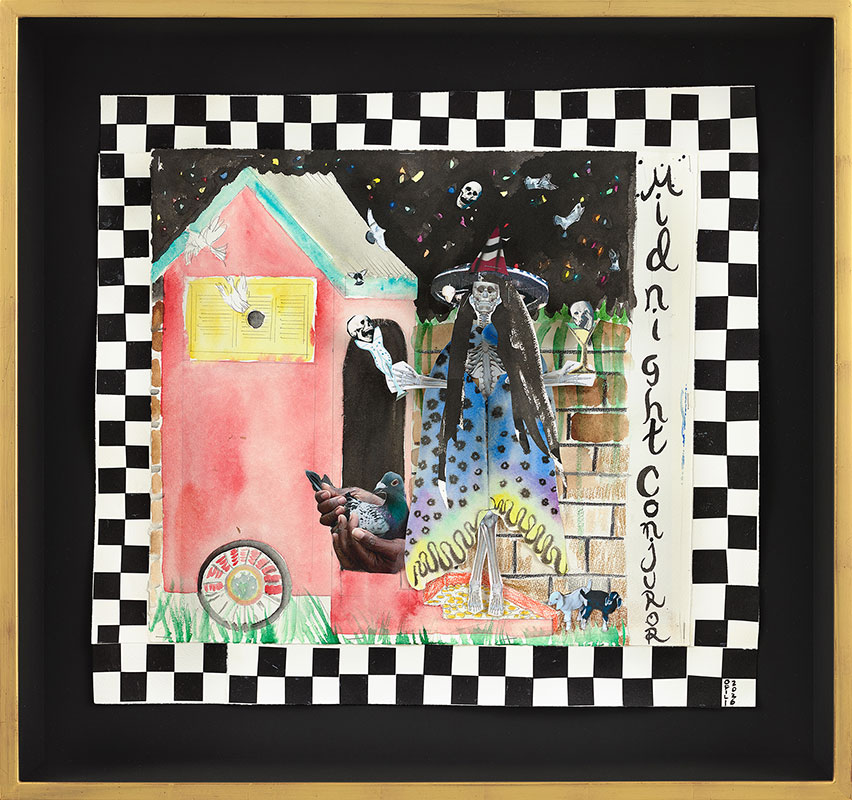
Drawing from Renaissance tarrochi imagery of the Conjuror – also variously known as the Juggler or Magician – the artist merges the archetype of the travelling performer and trickster with the Trinidadian Carnival character, the Midnight Robber.
The Midnight Robber is a storyteller and showman. He speaks in ‘Robber Talk’, derived from the tradition of the West African Griot – oral historians or storytellers – bragging about his ancestry, exploits of strength and fearlessness, and tales of vengeance on his former masters. His speech often includes riddles and allusions to history, religion and mythology, and might parody current events.
Ofili brings together elements of both traditions to evoke the mysterious and uncanny figure of the Midnight Conjuror. This hybrid character incorporates aspects of the distinctive costumes of both the Midnight Robber and the Conjuror: he wears a large fringed hat – its peak formed from an image of the Trinidadian flag – and is cloaked in a decorative cape which historically alluded to the American cowboys of Western movies, a motif referenced and reworked by Mas performers.
The artist conceals references from his own body of work in the central figure: the cocktail glasses precariously balanced by the Conjuror are taken from a series of works by Ofili featuring a spirit-like cocktail waiter; his long, flowing hair is taken from the artist’s 2008 painting The Healer, reappearing in the later series of works on paper, The Healer - Tarot (2025).
Dangling skulls are a recurrent feature of the Midnight Robber’s costume and the artist draws on this to evoke his titular character as an animated skeleton, performing a juggling act with a trio of skulls. The other-worldly figure stands within a coffin-shaped box filled with gold coins, in reference to the money boxes used by the carnival performers to cajole and teasingly coerce donations from the audience in exchange for their act, described as ‘mas for money’ by writer Elma Reyes.
The seasonal appearance of brightly coloured vendor huts in Queen’s Park Savannah in Port of Spain, Trinidad are one of the signifiers of the start of Carnival. Crowds gather for food, drink, and entertainment with some of the huts being used to stage a variety of card and dice games with the hosts taking bets from participants. The artist took inspiration from these huts for the setting of the Midnight Conjuror’s show. The hut also references the painting, The Juggler (The Magician) (1956) by Remedios Varo, which Ofili pays homage to throughout his image, from the juggler’s travelling hut to the multitude of animal companions.
The artist’s collaged photos describe an attendant audience of animals that are common or domestic in Trinidad: a cradled pigeon makes a nod to the local popularity for training homing pigeons, while the artist’s pet goats watch on, uncannily mirroring each other to embody the carnivalesque spirit.
In a further art historical reference, Ofili acknowledges the canon of works on this subject with reference to Hieronymus Bosch’s The Conjurer (1502). The spherical aperture in the Bosch painting is reappropriated and transformed into the hovering black orb in the side of the Conjuror’s hut in Ofili’s work, which could be at once both a window and an eerie planetary body, in this liminal, galaxial landscape.