
Listen to co-curator Chris Salmon describe an unfinished portrait of Mozart.
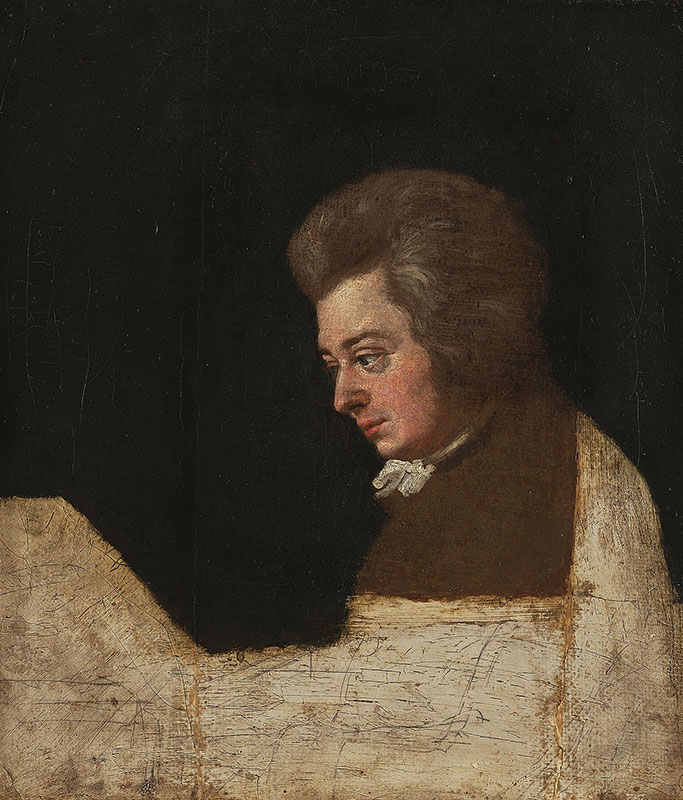
Portrayed during a private moment, as if unaware that he is being observed, Mozart is seen concentrating at the piano. This was his wife’s favorite portrait of him, and she later had it copied to appear in Georg Nikolaus Nissen’s biography. The painting has some mysterious aspects. Close observation reveals that the picture was enlarged around 1789. A sketched torso and the piano were added to a small, intimate study of Mozart’s head. The portrait dates from late in Mozart’s career, just after he completed his monumental last three symphonies, of which the “Jupiter” Symphony, K. 551, is the crowning finale.
Joseph Lange (1751–1831)
Portrait of Wolfgang Amadé Mozart
Vienna, ca. 1789 and earlier
International Mozarteum Foundation 291, L2026.98.41
This painting is one of the best-known portraits of Mozart from his Vienna years—yet one of the most misunderstood. It was created by his brother-in-law, Joseph Lange.
The portrait has long been described as unfinished, but the truth is more complex. Lange’s original composition was limited to Mozart’s head and upper shoulders. This smaller canvas was later affixed to a larger one, and additional painting was begun to show Mozart seated at the piano. It was this final stage—the enlargement and added details—that remains incomplete.
This enlargement may have been in progress by 1789. In a letter of April of that year, Mozart wrote to Constanze asking if Aloisia and Joseph Lange come to visit her very often and if “progress is being made with the portrait.” The original smaller work may have been painted as early as 1783.
Interestingly, Lange also painted a portrait of Constanze following a similar process: an initially smaller composition, later fixed to a larger canvas. In that instance, however, the enlargement was completed, and the finished painting now hangs in the Hunterian Museum at the University of Glasgow.