
Listen to co-curator Chris Salmon describe Mozart’s letter to his father Leopold, with an excerpt read by actor Christopher Inman.
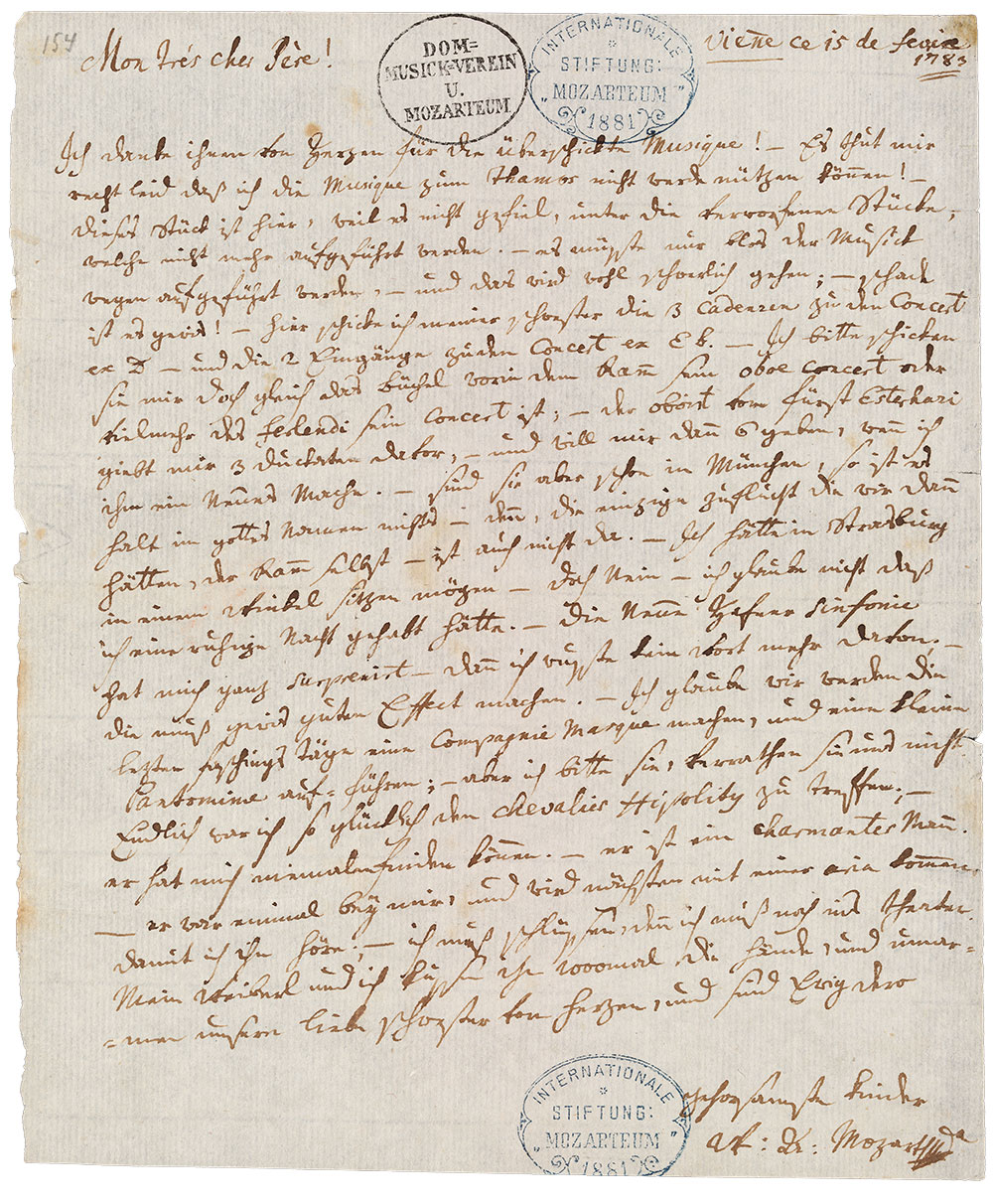
In the summer of 1782, Leopold Mozart asked his son to write a new composition for the celebration of Sigmund Haffner’s ennoblement in Salzburg. Haffner was a childhood friend of Wolfgang’s. The composer worked as quickly as possible and sent the score of the “Haffner” (Hafner) Symphony (K. 385) to Salzburg in several parts. The following year, he asked his father to return the score, as he wanted to perform the symphony on March 23, 1783, writing, “The New Haffner Symphony completely surprised me—I didn’t know a word about it anymore;—it must certainly have a good effect.”
WA Mozart (1756–1791)
Autograph letter to his father [Leopold Mozart] in Salzburg
Vienna, 15 February 1783
International Mozarteum Foundation, DocBD 728, L2026.98.65
In the summer of 1782, Mozart’s life was extraordinarily busy. Just after the successful premiere of The Abduction from the Seraglio, he was arranging that opera for wind instruments, composing a new serenade for winds, packing up his belongings, and moving into a new apartment. At the same time, he was making final preparations for his marriage to Constanze Weber.
Amid all this activity, Mozart received an urgent request from his father: he was to compose a symphony, and quickly, for the ennoblement of his Salzburg friend Sigmund Haffner. Remarkably, Mozart managed to complete this substantial and ambitious work in just eighteen days.
Later that year, Mozart asked his father to send the symphony to Vienna so he could perform it at a concert on 23 March 1783. When it finally arrived in February, Mozart was astonished. Writing to his father on the 15th, he confessed:
“The new Haffner Symphony completely surprised me—for I no longer knew a syllable of it; it is bound to be very effective.”
Mozart had, quite literally, forgotten how good his symphony was—perhaps a result of the haste with which it was written, and the many pressing personal and professional distractions surrounding its creation.