
Listen to the Morgan’s music curator Robinson McClellan describe the clavichord Mozart composed on, with a note by Constanze Mozart read by actor Carolyn Bost.
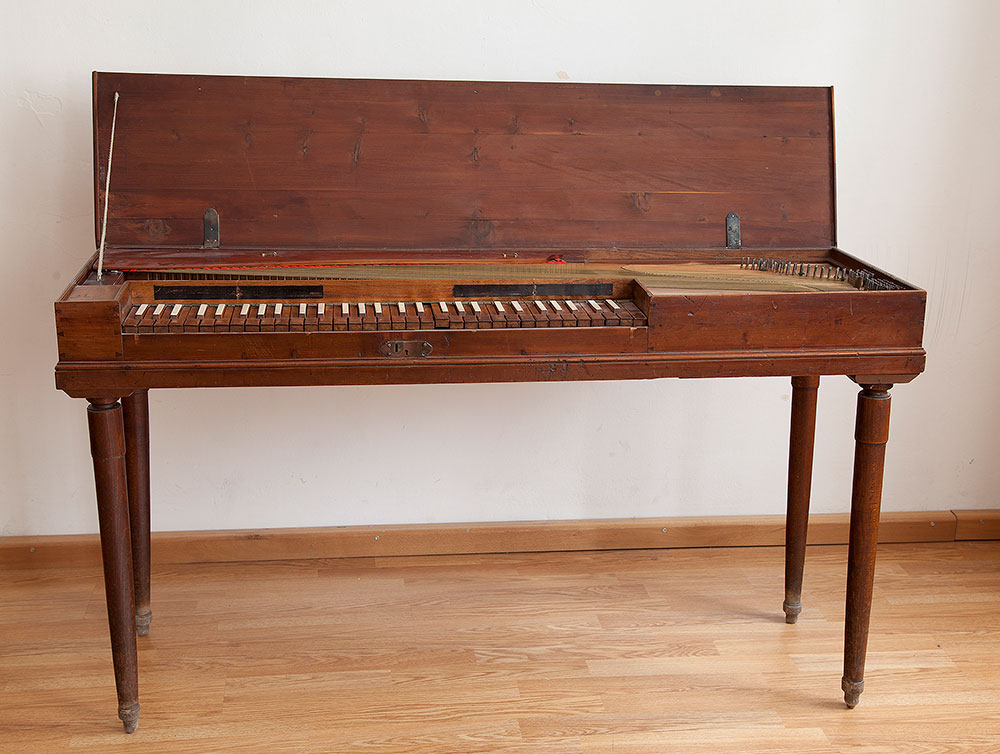
Mozart owned this portable clavichord while living in Vienna, keeping it at home and composing extensively on it. He often worked late into the night, and its soft, delicate sound was ideal. The black splotches on the top of the instrument appear to be ink stains left by Mozart. According to a handwritten certificate by Constanze Mozart found inside the instrument, her husband used it to compose Die Zauberflöte (The Magic Flute), La Clemenza di Tito, the Requiem, and the “Freemason Cantata” (K. 471). The Mozarteum received the clavichord from the estate of Mozart’s younger son, Franz Xaver.
Anonymous
Mozart’s Clavichord
Yew, Oak, Boxwood, Walnut, Metal
Austria or Bohemia, 1780s
International Mozarteum Foundation 181, L2026.98.33
This small keyboard instrument was used by Mozart toward the end of his life. Affixed inside the clavichord is a note written by his widow, Constanze Mozart, in the tremulous hand characteristic of her later years:
“On this instrument, my blessed, good husband composed The Magic Flute, La Clemenza di Tito, the Requiem, and the Freemason Cantata . . . As his widow Constanze, I can confirm.”
With its soft, mellifluous, and mandolin-like qualities, the clavichord was an ideal choice for Mozart’s domestic use, especially since he often worked late into the night. Ink stains are still seen on the top of the instrument, thought to be artifacts of his compositional activities.
The clavichord was presented to the Mozarteum by Mozart’s younger son, the pianist and composer Franz Xaver Mozart.
Rondo in D Major, K. 485, Wolfgang Amadeus Mozart.
Alexander Gergelyfi, clavichord. Mozart's Clavichord. ℗ 2025 Alpha Classics & Outhere Music France.