
Listen to co-curator Chris Salmon describe an image of Mozart in Verona, and hear the piece of music shown in the portrait, his Molto Allegro in G major, K. 72a.
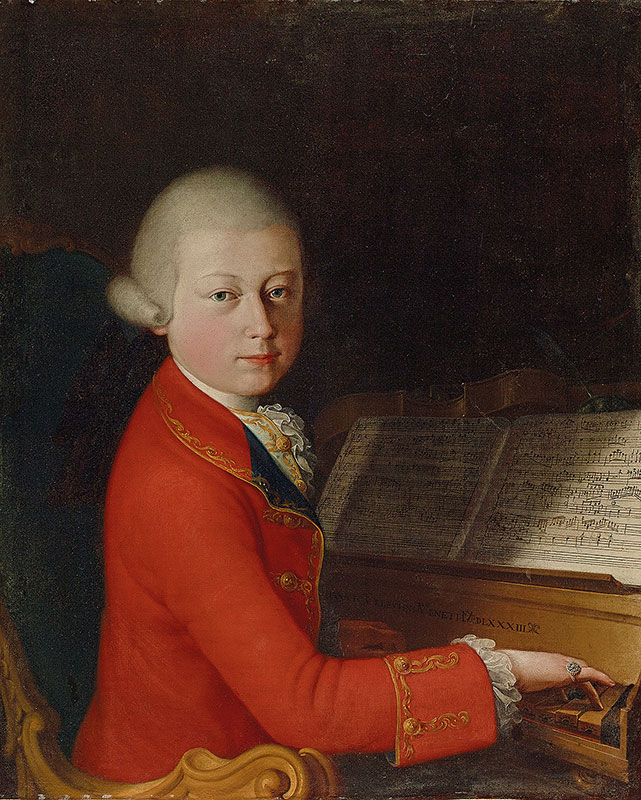
This portrait of Mozart was painted during his first journey to Italy in 1769–70. The fourteen-year-old sits at an antique harpsichord. He raises his little finger to display a diamond ring, which was likely given to him by Empress Maria Theresa in Vienna. Pietro Lugiati, an affluent Venetian official of finance who was astounded by Mozart’s talent, commissioned the painting. The artist meticulously rendered every note of the music in front of Mozart: a molto allegro in G major for solo piano, which breaks off at measure 35. The mysterious composition, now known as Mozart’s “Veronese Allegro,” only survives today because of this painting.
Giambettino Cignaroli (attr.; 1706–1770)
Portrait: Mozart in Verona
Verona, January 1770
International Mozarteum Foundation 078.013
Photograph courtesy of Christie’s via Alfred Cortot, L2026.98.21
In early January 1770, during the first of three Italian journeys undertaken by Wolfgang and his father Leopold, the Veronese nobleman and finance director Pietro Lugiati arranged for a portrait of the young prodigy to be made.
Mozart, gazing intently at the viewer, is seated at a harpsichord. The music on the stand is the only surviving fragment of a Molto Allegro in G major, K. 72a, the beginning of a sonata movement.
On the harpsichord rests a violin, symbolizing Mozart’s mastery of that instrument. An inkwell and quill allude to his accomplishments as a composer. Mozart wears a red coat trimmed with gold and a diamond ring on the raised fifth finger of his right hand, presented to him by Empress Maria Theresa. These details convey the image of a youthful yet already celebrated master.
Although the artist’s identity has not been established with certainty, current scholarship attributes the painting to Giambettino Cignaroli, who is mentioned in Leopold’s travel notes.
Molto Allegro in G major, K. 72a, Wolfgang Amadeus Mozart.
Bernard Foccroulle, organ. Life and Works: Wolfgang Amadeus Mozart. ℗ 2002 Naxos.