
Listen to co-curator Chris Salmon discuss an image of Leopold Mozart performing with his children, from 1764.
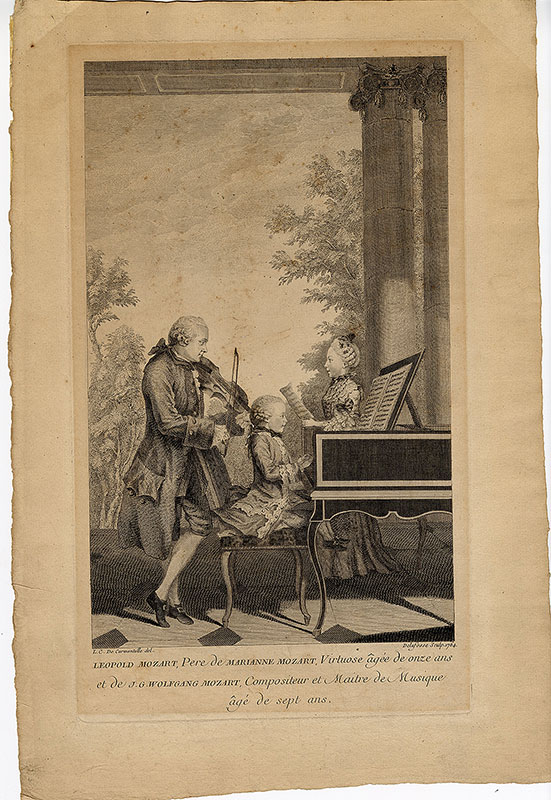
This 1764 engraving by Jean-Baptiste Delafosse is perhaps the most recognizable image from Mozart’s early childhood. Engraved after a watercolor by Louis Carrogis de Carmontelle, it depicts the young composer in performance with his sister, Maria Anna, and father, Leopold, during the family’s stay in France, where they played for King Louis XV’s court. The Mozarts sold prints as souvenirs as they continued their Grand Tour through 1766. According to a note on the back of this copy, it was acquired in Dunkirk in early August 1765, when the Mozart family was returning to Paris after spending fifteen months in London, performing for both royalty and everyday citizens.
Jean-Baptiste Delafosse (1721–1775) after Louis Carrogis de Carmontelle (1717–1806)
The Mozart Family
Paris, 1764
Christopher J. Salmon Collection, New York, L2026.97.3
Hello, I’m Chris Salmon, Research Fellow at the International Mozarteum Foundation, and co-curator of the exhibition.
This engraving by Jean-Baptiste Delafosse is an important work associated with the Mozart family’s Grand Tour, their journey across Europe from 1763 to 1766. It shows the young Mozart performing with his father Leopold and sister Nannerl. Based on a watercolor-enhanced drawing by Louis Carrogis de Carmontelle, it is the most famous and recognizable visual artifact of Mozart’s childhood.
This engraving—along with printed editions of Wolfgang’s music—were sold by Leopold Mozart as keepsakes or souvenirs for those who came to see the Mozart children perform, a novel and astute commercial innovation on his part. They bear witness to Wolfgang’s astonishing early emergence as both performer and composer and stand as a testament to Leopold Mozart’s skills as an entrepreneur and promoter.