
Chris Ofili
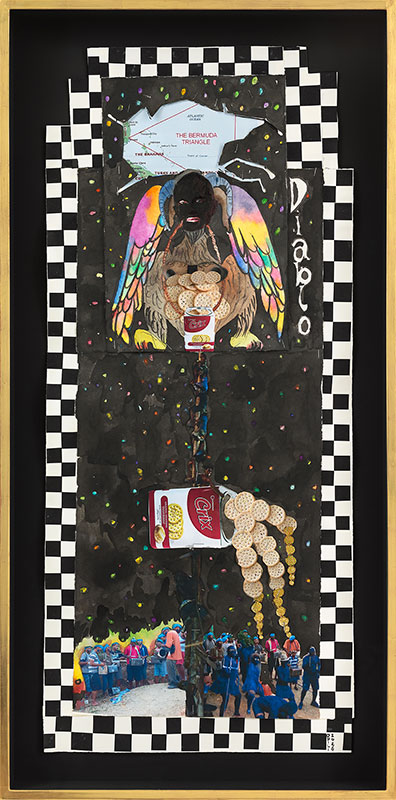
Diablo, 2026
Signed, titled and dated verso
Ink, watercolour, staples and paper collage on paper
Framed: 44 x 21 3/4 x 3 1/2 in (111.6 x 55.3 x 9 cm)
© Chris Ofili. Courtesy the artist and David Zwirner
Following tarot traditions, Ofili’s charismatic devil is a hermaphroditic, human-animal hybrid with female breasts, the colourful wings and talons of a mythological harpy, and goatlike legs. The devil’s belly has often been a focal point in tarot, influenced by biblical verses such as Philippians 3:19, which lists people who are enemies of Christ including those ‘whose god is their belly’. This devil’s belly is full of the iconic Trinidadian biscuits Crix, these and his blue horns linking him to the Jab Molassies and Blue Devils of Trinidad Carnival (both variants of the Devil Mas). ‘Jab Molassie’ is French patois, from diable (devil) and mélasse (molasses), the viscous black by-product of sugarcane processing. Today smeared with tar, grease, lard or dyes, the exaggerated blackness of the jab molassies has been interpreted as in part a response to the racist ‘blacking-up’ of white masqueraders to ‘play’ their slaves, who were banned from attending the original colonial carnivals. Additionally, in History of Carnival the historian LM Fraser invokes the history of sugarcane plantation fires and their consequences: ‘slaves on the surrounding properties would be mustered and marched to the spot, horns and shells blown to collect them and the gangs were followed by drivers cracking their whips’. The darkly frenzied energy of these scenes was then reinterpreted commemoratively in the ‘procession of the “Cannes Brulees”’, which ‘used to take place on the night of the 1st of August, the date of emancipation… After a time the day was changed and for many years past the Carnival days have been inaugurated by the “Cannes Brulees.” 1
The Blue Devils of the village of Paramin (where there isn’t a history of sugar cane plantations) meanwhile cover themselves in a distinctively blue concoction that is prepared over several days with laundry bluing cubes, boiling water and lard. 2 The blue devil performer Steffano Marcano, of the carnival band Next Level Devils, links the colour ‘to the folk legend of Archangel St Michael being commanded by God to cast out Satan from heaven. Legend has it that St Michael disguised himself as a demon, but took on the celestial blue hue to mock the devil to drive him away’. 3
Carnival devils breathe fire, blow whistles, give out high-pitched staccato wails, and have traditionally made threats to besmirch spectators if not given money among other bids for payment that blur the line between entertainment and intimidation. Some of the band may act as ‘beasts’, restrained by their associates with chains or leads in another echo of the era of slavery. The photographs taken by Ofili in 2014 of the blue devil band Jab Jab Nation which are collaged at the bottom of this work show one such beast, whose restrainer holds a pitchfork. Accompanying drummers in improvised blue surgical hats beat fire-treated Crix tins – a use for which they are commonly repurposed – driving the devils to their rhythmic, restless dance.
The totemic central column of Diablo comprises collaged photographs (also taken by Ofili in 2014) of the ‘Greasy Pole’: in this part of the Carnival Jab Jab competition devils scramble to climb a telephone pole covered in grease to claim the Trinidadian dollars stuck to the pole top. Ofili’s squattingly presiding devil has transfigured the coveted prize into Crix – one tin hangs from his mouth as an acolyte tips another halfway down the pole, its contents turning tantalisingly back into gold. The disorienting possibility of losing one’s bearings in the face of such temptation is heightened by the presence in this work of the fabled Bermuda Triangle, in a visual concretisation of the phrase ‘between the devil and the deep blue sea’ that could also be read as a coded reference to the Bermudez company, owners of the Crix brand. That the Bermuda Triangle is here outlined by the negative form of the Pegasus constellation cut-out which adorns Ofili’s US navy-aligned sailor in The Chariot, and that the Bermudez company has Venezuelan roots, places these cards in opposition to each other.
The devil tarot card has been associated not only with enslavement to one’s own desires, but also with the ability to wield a hypnotic power over others and to magnetically attract money, later interpretations identifying the card with the human drive to hoard energy as a means of individuation. The turning of substances into gold has also been used as a metaphor in tarot for the Magnum Opus or ‘Great work’, the process of spiritual and psychological self-enlightenment. The dynamics that play out in Diablo, in which human exertion as a creative form of exorcism coexists with the possibility of falling prey to base instincts, resonate with these ambivalent associations.
- https://traditionalmas.com/portfolio/jab-molassie/
- https://www.bbc.co.uk/news/world-latin-america-68250796
- https://www.guardian.co.tt/article/next-level-devils--a-tradition-in-blue-6.2.1920954.5aa0ae6516