
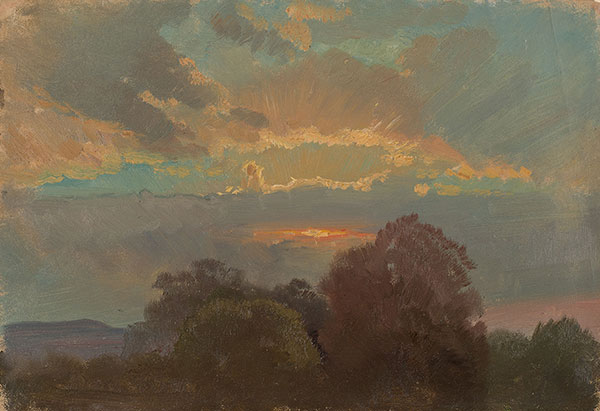
In his landmark 1800 treatise on landscape painting, Elements of Practical Perspective, Pierre Henri de Valenciennes lamented the difficulty of portraying the sun’s light using oil paint. An artist, he explained, cannot look at the blazing body for longer than a moment, lest they be dazzled, and even if they could, “as there is no color in nature that is luminous by itself, the painter is very limited in the means he uses to copy the light of nature. So we laugh at the vain efforts made by an artist when he wants to imitate the color of the sun.”
At the onset of the nineteenth century, artists increasingly took to painting in oil outdoors, or en plein air. As they did, the dilemmas that Valenciennes described were front of mind. This selection of oil sketches from the Thaw Collection explores how artists approached the relationship between luminosity and color. By portraying the sun directly, by painting the colors produced by the sun’s indirect reflection, and by turning their gaze to the moon, which cast the sun’s light more gently, these artists met the challenge of conjuring light from color.
Luminous Color highlights works from the collection of oil sketches given jointly to the Morgan and the Metropolitan Museum of Art by Eugene V. Thaw, a trustee of both institutions.
Carl Maria Nicolaus Hummel (German, 1821–1907). Sky Study, ca. 1850. Oil on paper. Thaw Collection, jointly owned by the Metropolitan Museum of Art and the Morgan Library & Museum, gift of Eugene V. Thaw, 2016.