

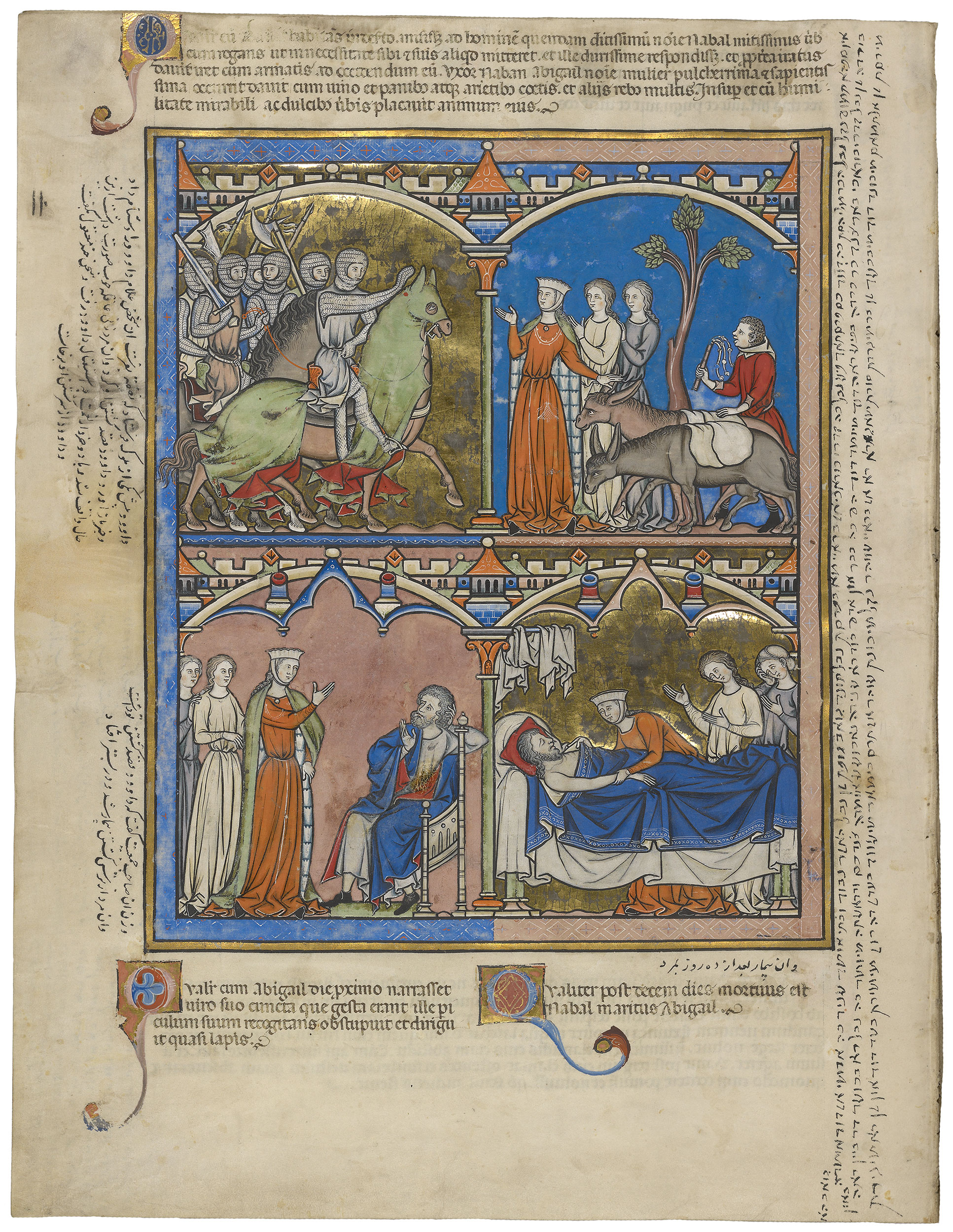
Abigail Cools David's Wrath, Nabal Terrified, Nabal's Death
Old Testament Miniatures with Latin, Persian, and Judeo-Persian inscriptions
Purchased by J.P. Morgan (1867–1943) in 1916
Folio 33v (Latin)
Upper half: How, when David was living in the desert, he sent messengers to some very rich man, Nabal by name, asking him, with very gentle words, to help him in his plight and send him something. Now, this person replied very harshly which angered David and, as he was going with armed men to kill him, Nabal’s wife, whose name was Abigail, a very beautiful and wise woman, rushed to him with wine and bread and cooked rams and many other things, and moreover, calmed his anger with incredible humanity and gentle words. (I Samuel 25: 2–35)
Lower left: How, when on the next day Abigail had told Nabal what had happened, he perceiving the danger, was astounded and almost turned into stone. (I Samuel 25: 36–37)
Lower right: How Nabal, Abigail’s husband, died after ten days. (I Samuel 25: 38)
Folio 33v (Persian)
Persian foliation: 11
Upper left margin: David sent to one of the kings [demanding] that he send provisions. That person cursed David’s slave and he informed David. David set out to slay him. And that man had a beautiful, wise wife who became aware of this affair and went before David with two ass loads of offerings and uttered some wise words. And David was dissuaded from killing him.
Lower left margin: The wife of those people’s master said, "David intended to slay you." And the man fell ill from the fear of slaying and took to bed."
Lower right: The stricken [man] died after ten days.
Folio 33v (Judeo-Persian)
Right margin: These pages are all about the tale of Nabal the Carmelite, namely, that David sent a person to Nabal, [saying], "Send us a little food." Nabal replied angrily [and negatively]. Nabal’s wife was not present. When she came and heard that a man came from David and was answered [negatively], Nabal’s wife took some assloads of food and came to meet David. When David heard the news from his man, he became displeased and took some men to go and kill Nabal. On the road he met that woman [Nabal’s wife] and the woman begged him [not to do so]. David forgave him [Nabal] and the woman returned [home] and related to her husband the incident. The husband fell ill out of fear [and] died after ten days. Afterwards David married that woman.
Abigail Cools David's Wrath
David has requested provisions from Nabal, a wealthy sheepherder, and promised in return to continue his protection of Nabal's flocks. But Nabal dismisses David's envoys with disparaging remarks. Abigail, Nabal's wife, regrets her husband's action. She meets David on the road with pack animals loaded with supplies for the army and thus allays David's wrath. (1 Kings 25:18–35)
Nabal Terrified
Nabal sits slumped in his chair after a night of heavy drinking, listening to Abigail reveal how narrowly he escaped the wrath of David. Nabal is struck with such fear that his heart dies within him, and he becomes like a stone. (1 Kings 25:36–37)
Nabal's Death
After ten days, Nabal dies. Abigail and her maidservants grieve at his bedside. When the news reaches David, he praises the Lord for returning Nabal's wickedness upon his own head. Abigail will shortly accept David's marriage proposal and join him in the wilderness. (1 Kings 25:38)