

Saul Victorious, A Proven Leader
Old Testament Miniatures with Latin, Persian, and Judeo-Persian inscriptions
Purchased by J.P. Morgan (1867–1943) in 1916
Folio 23v (Latin)
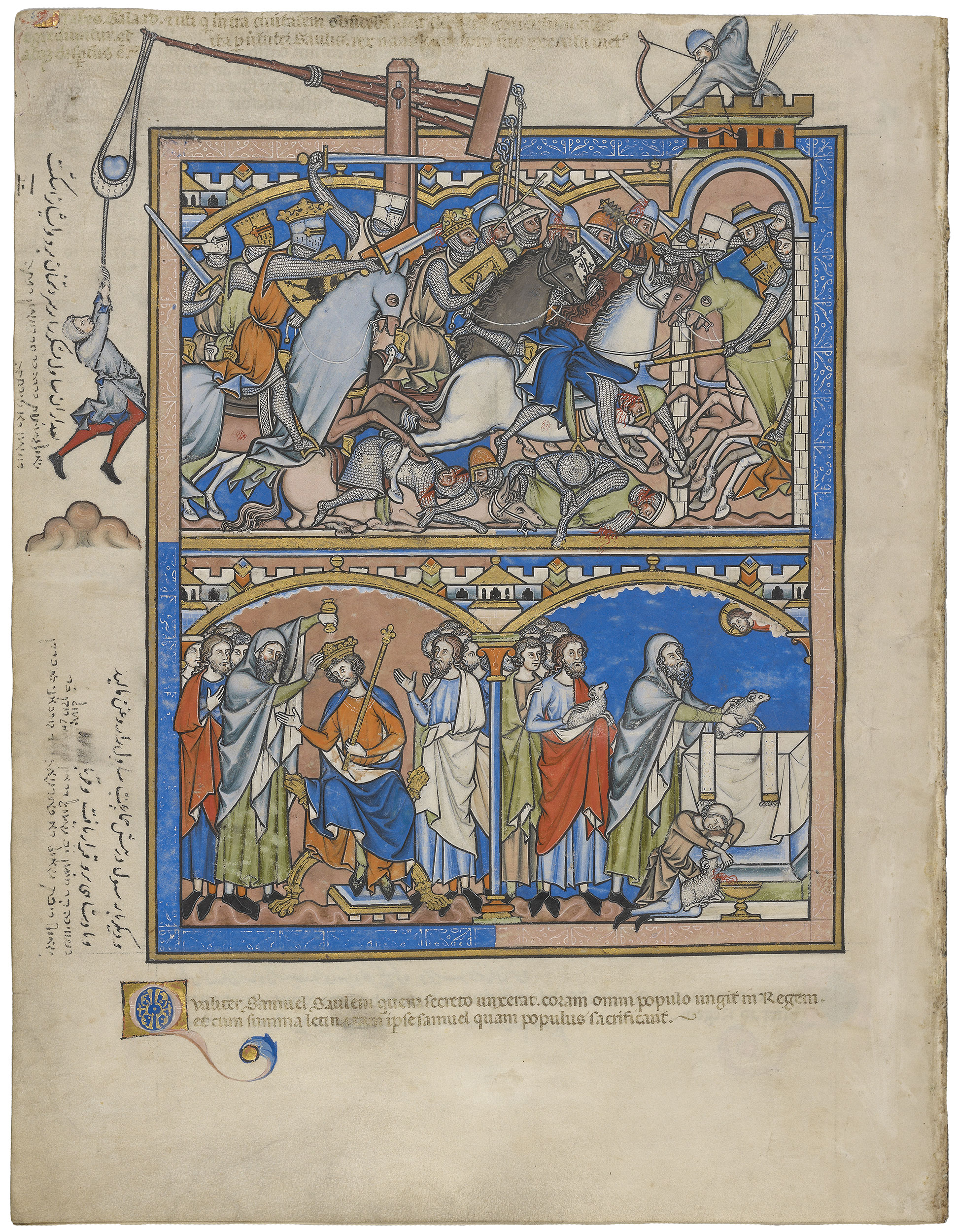
Upper half: How [Saul, messengers having been sent, came in the morning to help the people] of Jabesh-gilead, and those who were besieged in the city, aware of his arrival, went out, and thus through the courage of Saul, king Nahash and all his army were defeated and scattered. (I Samuel 11: 9–11)
Lower half: How Samuel, who had secretly anointed Saul, anointed him to be a king before the people and both Samuel and the people sacrificed with the utmost happiness. (I Samuel 11: 14–15)
Folio 23v (Persian)
Persian foliation: 21
Upper left margin: After that, Saul brought the army against the enemy and defeated them.
Lower left margin: And once again Samuel anointed Saul before the assembly and kingship was confirmed upon him and he offered sacrifices.
Folio 23v (Judeo-Persian)
Upper left margin, furthest left: Saul, having assembled the people, encountered the enemy and defeated them.
Lower left margin, furthest left: When he [Saul] returned safely, and Samuel sprinkled Saul with oil in this [manner], making him king, they offered sacrifices.
Saul Victorious
Saul and his army devastate the Ammonites. Nahash attempts to flee the battlefield, but Saul, crowned and wearing an orange tunic, cleaves his enemy's skull with his sword. The Ammonites are assailed from all sides. From atop the battlements, an archer takes aim at the only unwounded Ammonite. An enormous catapult, pulled completely taut, will send a boulder crushing through the Ammonite ranks. Another contingent of Israelites emerges from the city gates and deals fatal blows with sword and club; an Ammonite in a blue tunic is violently unhorsed by a soldier wielding a battle ax. (1 Kings 11:11)
A Proven Leader
The Israelite victory is celebrated with Saul's public anointing and coronation. The king's throne in this illustration is identical to the sella curulis—the folding coronation chair of French kings housed in the royal abbey of Saint Denis. To the right, Samuel offers sacrifices to the Lord, who gazes upon his loyal servant from the heavens. (1 Kings 11:14–15)