

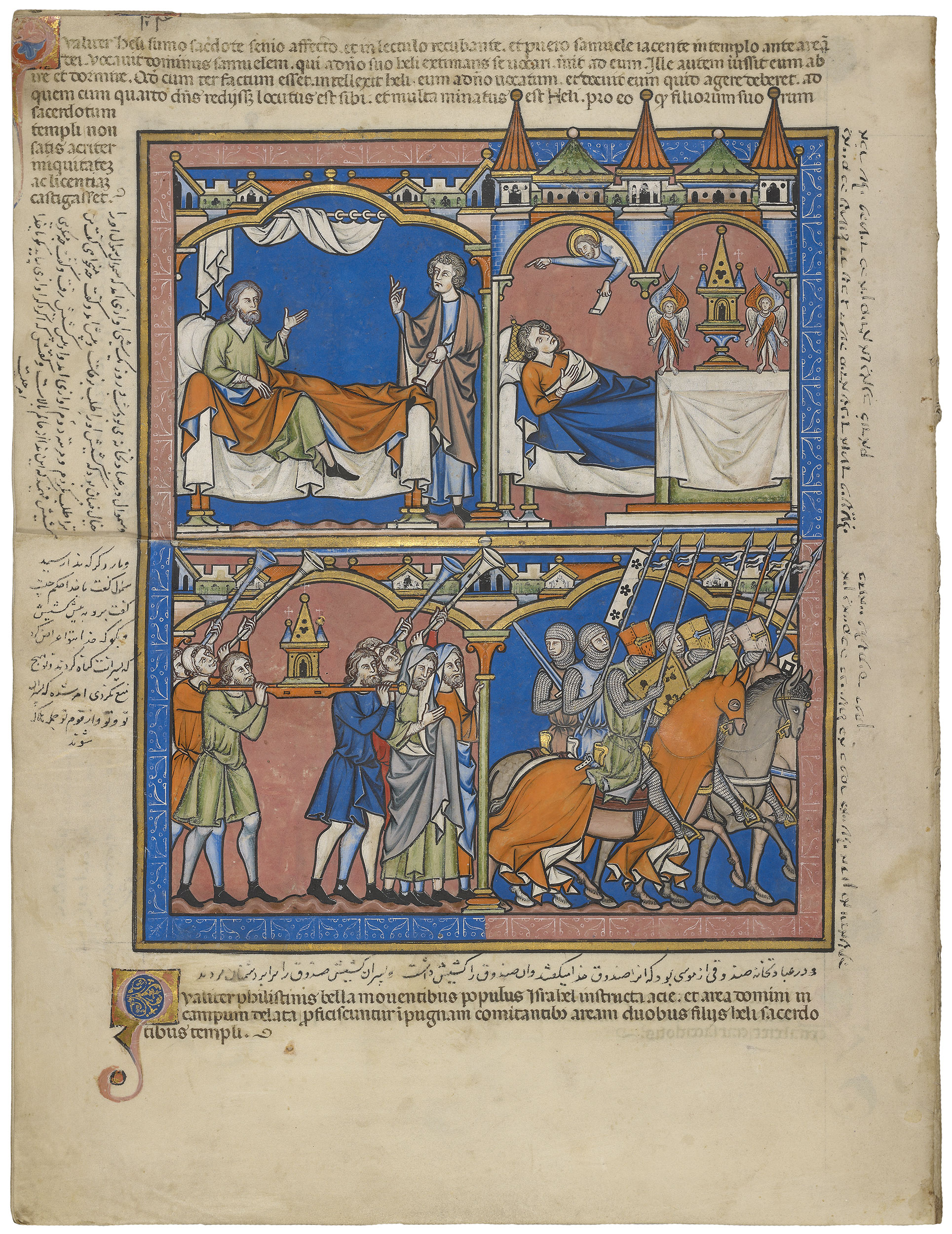
God Calls to Samuel, Destined for Defeat
Old Testament Miniatures with Latin, Persian, and Judeo-Persian inscriptions
Purchased by J.P. Morgan (1867–1943) in 1916
Folio 20v (Latin)
Upper half: How as Eli, the high priest, weakened by old age, was reclining in his bed, and the child Samuel was lying in the temple before the ark of God, the Lord called Samuel who, thinking that his master, Eli, was calling him, went to him. Yet, he ordered him to go and lie down to sleep. When this had happened three times, Eli understood that the Lord had called him and taught him what he ought to do. When the Lord had returned to him for the fourth time, he spoke to him and threatened Eli much, because he had not chastised the inequity and the license of his sons, the priests of the temple, with sufficient severity. (I Samuel 3: 1–14)
Lower half: How, as the Philistines were beginning a war, the people of Israel, having formed an army, set out to battle with the ark of the Lord which had been moved to the camp and with the two sons of Eli, the priests of the temple, escorting it. (I Samuel 4: 1–4)
Folio 20v (Persian)
Persian foliation: 24
Upper left margin: Samuel remained in the temple day and night. One night, a voice came calling, "Samuel, Samuel." Since he thought that the priest had called him, he came forth and said, "What do you wish?" He said, "I did not summon you." And the second time the voice came and he went to the priest and asked, "What are you saying?" The priest realized that the voice was from the heavens and said to him, "If another call comes, say, ’O Lord, what do you command?’"
Lower left margin: The next time that the call came, Samuel said, "O Lord, what do you command?" He [God] said, "Go to the priest and say that God has shunned you for your sons have sinned and you have not chastised them; it is commanded that your sons and you, all of your tribe, shall perish."
Lower half: In the temple, there was an Ark belonging to Moses which they called the Ark of God and the priest held the Ark and the priest’s sons brought the Ark before the enemy.
Folio 20v (Judeo-Persian)
Upper right margin: Here it is that Samuel hears a voice in the night three times; he comes before Eli, then Eli comprehends that this call is from God.
Lower right margin: Here it is that the Children of Israel, with the two sons of Eli, carry the Ark [of the covenant] as a remedy against the Philistines.
Italicized words are in Hebrew.
God Calls to Samuel
In the presence of the Ark, the Lord awakens the young Samuel and speaks to him for the first time, revealing the terrible destruction that will befall the House of Eli. Reluctantly, Samuel shares the Lord's tidings with his teacher. Raising his eyes and gesturing to heaven, Samuel repeats the judgment to the dismayed Eli, who can only resign himself to fate. This is a remarkable painting of the Ark of the Covenant, the only one in the Picture Bible that incorporates the winged cherubim described in the Book of Exodus. (1 Kings 3:10–18)
Destined for Defeat
Later, the corrupt sons of Eli, leading a procession of men who bear the Ark, accompany the Israelite army into battle against the Philistines. The last member of the cavalry looks over his shoulder toward the Ark; his worried expression foretokens the destruction that awaits the army. (1 Kings 4:1–4)