

Wives for the Benjamites, Ruth, a Loyal Daughter
Old Testament Miniatures with Latin, Persian, and Judeo-Persian inscriptions
Purchased by J.P. Morgan (1867–1943) in 1916
Folio 17r (Latin)
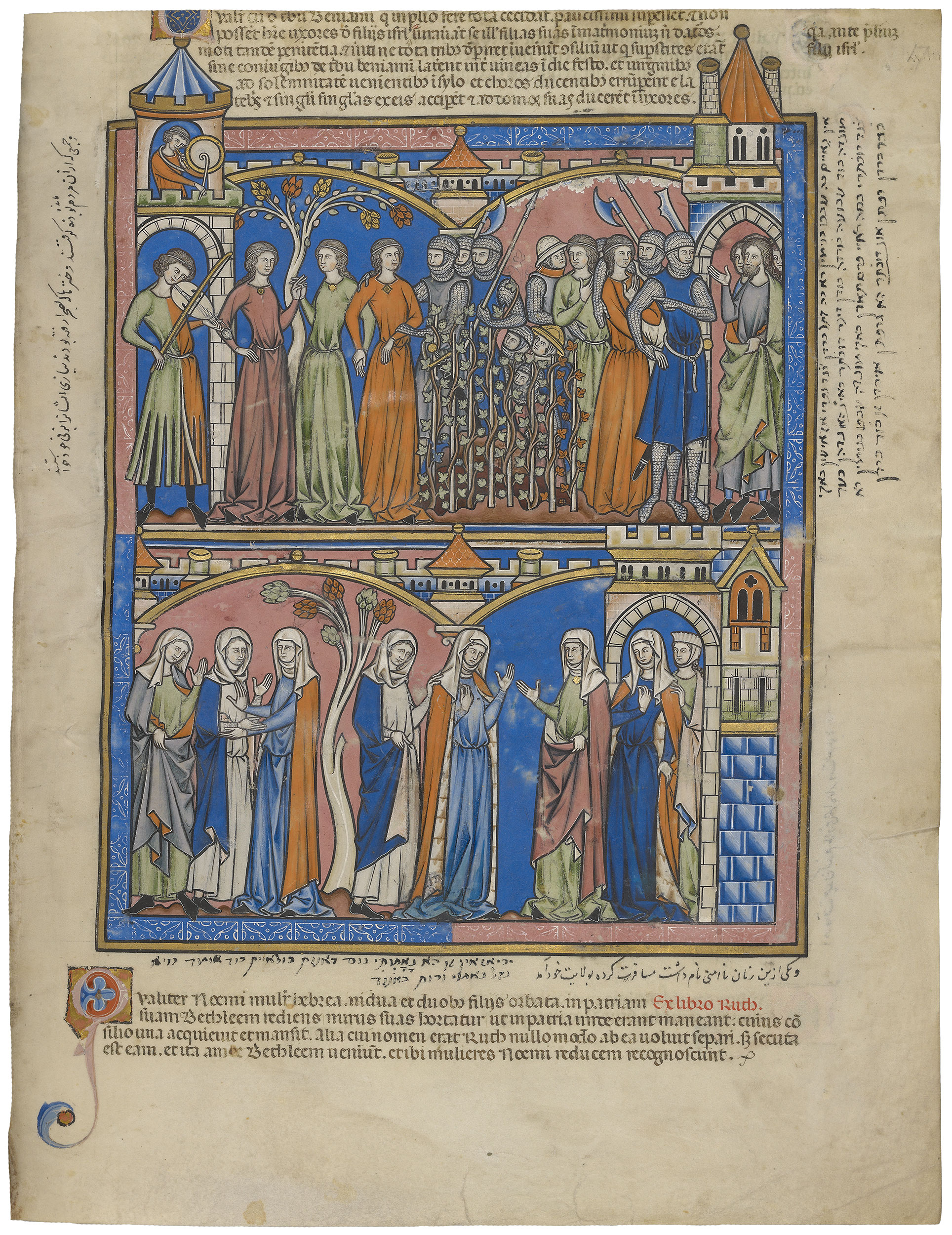
Upper half: How, when the tribe of Benjamin was almost wholly lost in battle and those few of it who had survived could not take wives from the children of Israel since, before the battle, the children of Israel had sworn not to give their daughters in marriage to them, at last, moved by repentance and wishing to help the tribe not to perish, they devise a plan that the survivors of the tribe of Benjamin who had no wives should hide in the vineyards and on a festive day, as the maidens go dancing to the feast in Shiloh, they should go out of their hiding places and each should receive a girl from them and lead her to his house to be his wife. (Judges 21)
Lower half: From the book of Ruth. How Naomi, a Hebrew widow who has lost both her sons, upon returning to her native Bethlehem, encourages her daughters-in-law to remain in their homeland where they were born, with which advice one was pleased and stayed. The other, whose name was Ruth, was by no means willing to be separated from her, but followed her, and thus they both reach Bethlehem where the women recognize Naomi who came back. (Ruth I)
Folio 17r (Persian)
Upper left margin: And they [the tribe of Benjamin] captured the group that had survived of those people and they deceitfully asked for the girls, who had gone to the fields, in marriage.
Lower right: And one of those women was called Naamni [Naomi]; she traveled [back] to her own country.
Folio 17r (Judeo-Persian)
Upper right margin: Here it is that the tribe of Benjamin of whom they [the Children of Israel] had killed, some of their members had survived, but they [the Children of Israel] swore an oath not to give their daughters [in marriage] to them. Then, [when] they sent some maidens to the field, those surviving from the tribe of Benjamin were informed and they went and captured those maidens.
Lower left, above Latin: One of these women is called Naomi; she came to her own province. That is, it is the tale of Naomi and Ruth.
Italicized words are in Hebrew.
Wives for the Benjamites
Before the war, the gathered tribes took an oath, swearing that none among them would ever again provide a wife to a Benjamite. Now, however, the tribes lament the loss of their brethren and ponder how they might find wives for those few hundred Benjamite men that survive. A remedy is devised by the tribal elders. The Benjamites are directed to Shiloh, where a festival is underway. Maidens in trailing skirts dance as minstrels play the viol, pipe, and tabor. The Benjamites, hidden in the vineyards, spring forth and take the young women. As they depart, they encourage the men of Shiloh not to fear for the integrity of their oath, for indeed they never gave their daughters willingly. (Judges 21: 20–23)
Ruth, a Loyal Daughter
Naomi, a widow, bids farewell to her daughters-in-law, who have also lost their husbands. One daughter-in-law, Ruth, refuses to remain in her native Moab and insists upon accompanying Naomi to Bethlehem. At the gates of Bethlehem, three women advance and joyously welcome Naomi home. "Do not call me Naomi; call me Mara," she tells them. 'Mara' is Hebrew for "the Almighty has dealt very bitterly with me." (Ruth 1:14–20)