

A Sorrowful Homecoming, A Grisly Message, Civil War
Old Testament Miniatures with Latin, Persian, and Judeo-Persian inscriptions
Purchased by J.P. Morgan (1867–1943) in 1916
Folio 16v (Latin)
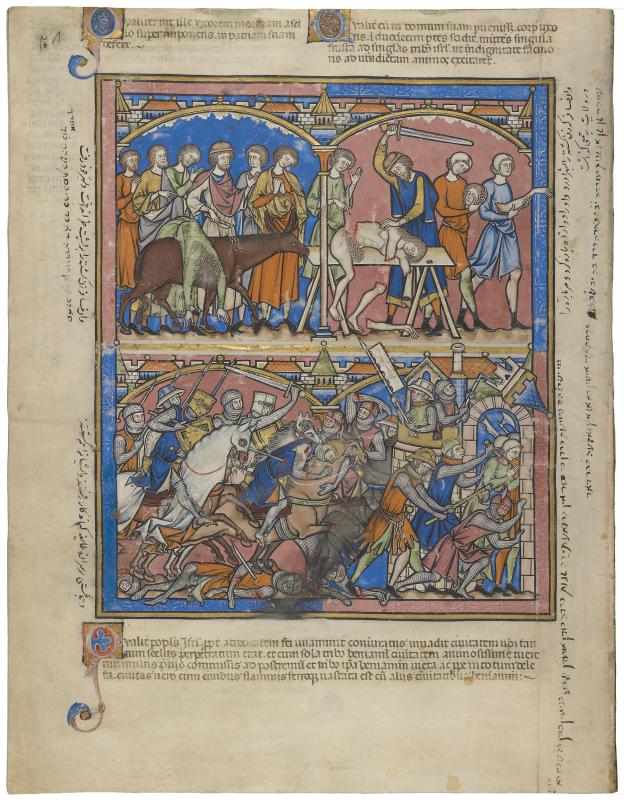
Upper left: How the man lay up his dead wife upon his ass and carried her back to his house. (Judges 19:28)
Upper right: How when he had reached his house, he cut his wife’s body, sending each part to each one of the twelve tribes of Israel, in order that the indignity of the crime might excite their hearts and cause them to retaliate. (Judges 19:29)
Lower half: How the people of Israel, unanimously conjoined by the atrocity of the deed, invade the city where such a crime was perpetrated. When only the tribe of Benjamin was very eagerly defending it, engaging in many battles, eventually, as both the tribe of Benjamin was defeated and the city was almost utterly destroyed, it was lay waste by flame and sword with its citizens and with other cities of Benjamin. (Judges 20)
Folio 16v (Persian)
Persian foliation: 28
Upper left margin: And the traveler lay his murdered wife across the back of an ass and returned to his own city.
Upper right margin: The traveler, having brought the murdered wife to the city, cut her up into twelve pieces and sent each piece to a group in the country.
Lower left margin: And a group descended upon that sinful tribe and slew them all.
Folio 16v (Judeo-Persian)
Upper left margin, furthest left: The woman’s companion tied the woman on the ass and brought her to his town.
Upper right margin, furthest right: The woman’s husband cut up into twelve parts the woman who died from fornication and sent them to [each of] the twelve tribes in order to inform them of this incident.
Lower right margin: And the Children of Israel gathered together against this community which had fornicated, who were of the tribe of Benjamin, and killed five thousand persons.
Italicized words are in Hebrew.
A Sorrowful Homecoming
The Levite throws his wife's body over an ass and, striking the animal with a whip, begins the journey home. Men gather round to express their sympathy and outrage at the behavior of the Benjamites. (Judges 19:28)
A Grisly Message
Upon his return to Ephraim, the Levite dismembers the corpse of his wife. Her body is to be cut into twelve parts and carried by messengers to all the territories of Israel. The outrage among the tribes over this egregious crime will begin a great war. (Judges 19:29)
Civil War
Four hundred thousand Israelite men have sworn vengeance against their brethren from the tribe of Benjamin because of the outrage committed against the Levite's wife. For three days a battle rages around the city of Gibeah. On the third day, the opposing tribes spring a successful ambush and slay over twenty five thousand of the Benjamites. As the victorious cavalry kill fleeing horsemen, foot soldiers deal harshly with men attempting to escape to the city. The victors capture the battlements and begin the destruction of Gibeah. (Judges 20:29–35)