

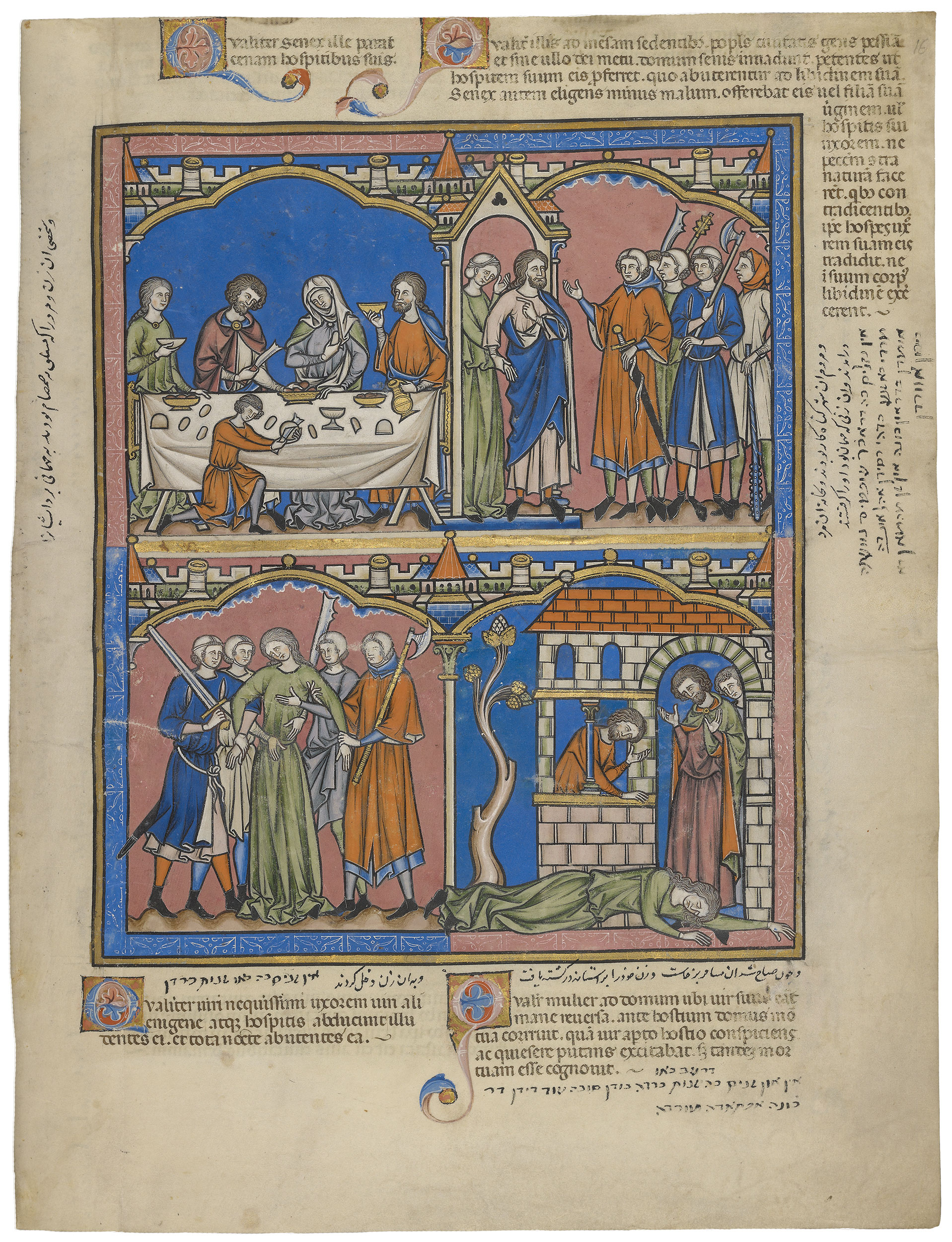
Hospitality, Reprehensible Demands, Gibeah's Crime, Death of the Levite's Wife
Old Testament Miniatures with Latin, Persian, and Judeo-Persian inscriptions
Purchased by J.P. Morgan (1867–1943) in 1916
Folio 16r (Latin)
Upper left: How that old man prepared a meal for his guests. (Judges 19:21)
Upper right: How, as they were sitting at the table, a most evil clan, devoid of any fear of God, entered the old man’s house, demanding him to bring forth his guest to them, that they might abuse him as they wished. Yet the old man, choosing a lesser evil, was offering them either his maiden daughter or his guest’s wife, lest they commit a sin against nature. When they had spoke against it, the guest himself delivered his wife to them lest they exercise their lust on his body. (Judges 19: 22–25)
Lower left: How the vile men took the wife of a foreigner and, moreover, a guest, amused themselves with her, and abused her all night long. (Judges 19:25)
Lower right: How in the morning the woman returned to the house where her husband was and fell down dead before the door of the house. Upon opening the door the man beheld her and was arousing her, thinking that she was taking her rest. Then, at length, he perceived that she was dead. (Judges 19:26–28)
Folio 16r (Persian)
Upper left margin: And someone took that man and woman, who belonged to Samson, to a banquet.
Upper right margin: The people of that city were sinners and they entered that man’s house and took away the woman who was his guest.
Lower left: And they violated that woman.
Lower right: When morning came, the traveler awoke and found his wife dead at the doorstep.
Folio 16r (Judeo-Persian)
Upper right margin, furthest right: This is a tale that occurs toward the end of [the Book of] Judges. A man and his wife arrived in a village, its people came to the door of that house [where they were lodging] to bring out that guest woman.
Lower left, above Latin to left: This is the woman with whom they fornicated.
Lower right, beneath Latin: This is that woman with whom they fornicated during the night. In the morning they saw her fallen dead by the door of the house.
Italicized words are in Hebrew.
Hospitality
After seeing to the Levite's donkeys, the old man and his daughter prepare a feast for their guests at a table set with golden dishes. In the foreground, a servant cuts bread. (Judges 19:21)
Reprehensible Demands
While the Levite and his wife are at table, their host is called away to his door. Men of Gibeah demand that the old man surrender the Levite so that they might rape and murder him. Rather than suffer this fate, the Levite turns over his wife so that they might use her in his stead. (Judges 19:22–24)
Gibeah's Crime
The rapists deal wickedly with the Levite's wife. (Judges 19:25)
Death of the Levite's Wife
With her remaining strength, the Levite's wife crawls to the door of the house where her husband is lodged. In the morning, the Levite and his host discover her unconscious on the threshold. (Judges 19:25–27)