
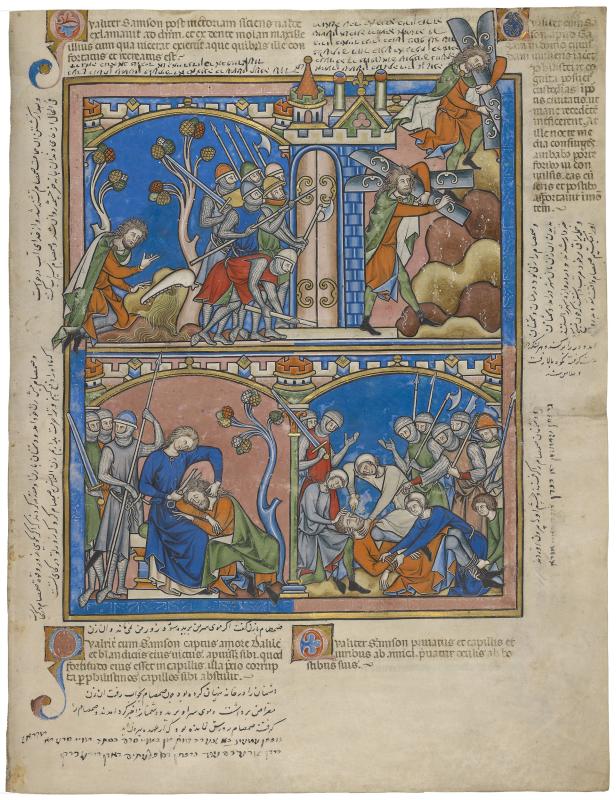

Parched, The Gates of Gaza, Shear Betrayal, Samson Blinded
Old Testament Miniatures with Latin, Persian, and Judeo-Persian inscriptions
Purchased by J.P. Morgan (1867–1943) in 1916
Folio 15r (Latin)
Upper left: How Samson, who was very thirsty after his victory, cried to the Lord and water came out from a great tooth in the jawbone with which he had become victorious, and he was thus much strengthened and refreshed. (Judges 15: 18–19)
Upper right: How when Samson was lying in Gaza in the house of some woman, the Philistines, upon discovering this, set guards at the gates of the city, that they might kill him as he went back. But he, rising in the middle of the night, carried the entire two doors of the gate with the bolts and the posts up to a hill. (Judges 16: 1–3)
Lower left: How when Samson, enticed by his love to Delilah and subdued by her charms, had revealed to her that his might was in his hair, she, whom the Philistines had bribed with money, shaved his hair. (Judges 16: 4–20)
Lower right: How Samson, having been deprived of his hair and his powers by his lover, is deprived of his eyesight by the Philistines. (Judges 16:21)
Folio 15r (Persian)
Upper left margin: And after slaying those people, Samson felt thirsty and asked God for water. Suddenly, water issued from the place of a tooth in the jawbone of the ass and Samson drank.
Upper right margin: And Samson had a wife from amongst the enemy. He came to that city to see his wife. The enemy was informed and they shut the gates of the city and they all armed themselves to slay him in the morning. Samson found out and came to the gate and removed the door and its posts in each hand. Then he climbed a mountain and was free.
Lower left margin: And Samson came to his wife and the enemies had conspired with his wife that, "If you tell us where Samson’s power and strength lies so that we may defeat him, we shall honor you." The woman implored Samson, "Wherein lies your power?"
Lower Left, above and below Latin inscription: Samson told her, "If the hair on my head is cut, my strength shall dissipate." And the wife had hidden [some of the] enemy in her house. When Samson fell asleep, she picked up the scissors and cut his hair and called on the enemies. They came and captured Samson; Samson was bereft of his power to dispel them.
Lower right margin: And the enemies captured Samson and gouged his eyes out.
Folio 15r (Judeo-Persian)
Upper left, below Latin: After Samson killed the Philistines with the jaw, he became thirsty; he prayed to God for water, and water appeared from one of the teeth of the ass’[s jaw].
Upper right: Samson’s arrival in Gaza, seeing a harlot, in the manner described in [Judges] chapter 16; the Philistines surround the house in order to capture and kill him in the morning when he comes out, but Samson comes out of the house at midnight and, uprooting the doors of the gate, carries them away.
Lower left, beneath Persian: [Upon] Samson’s telling his wife, "My strength is attached to the hair on my head," she cuts it off with [a pair of] scissors; his strength declines, [then] she captures him and gives him to the Philistines to blind him.
Lower right margin, furthest right: Samson’s capture and the plucking out of his eyes.
Parched
Weary from the slaughter, Samson discards the jawbone and asks God for water to quench his thirst. The Lord hears, and a miraculous spring wells up from the ground. (Judges 15:17–19)
The Gates of Gaza
Later, Samson arrives in Gaza, where vigilant Philistines prepare an ambush for him at the city gates. But before the trap is sprung, the cunning Samson wrests the very doors from the gates and defiantly carries them to the top of a high hill. (Judges 16:1–3)
Shear Betrayal
In the Valley of Sorek, Samson falls in love with the beautiful Delilah. Unbeknownst to him, Delilah is in league with the Philistines. Her persistent inquiries finally pay off, and Samson reveals to her the source of his superhuman strength—his hair. Indeed, a razor has never touched his head. When Samson falls asleep with his head on Delilah's knees, she quietly cuts his locks. Presently, her Philistine allies will capture him. (Judges 16:17–19)
Samson Blinded
The Philistines bring the helpless Samson back to Gaza. Still wary of their captive, they bind him in the presence of several armed men and gouge out his eyes. (Judges 16:20–21)