

Sweetener, Manna, The Lord Provides, Joshua, a Soldier
Old Testament Miniatures with Latin, Persian, and Judeo-Persian inscriptions
Purchased by J.P. Morgan (1867–1943) in 1916
Folio 9v (Latin)
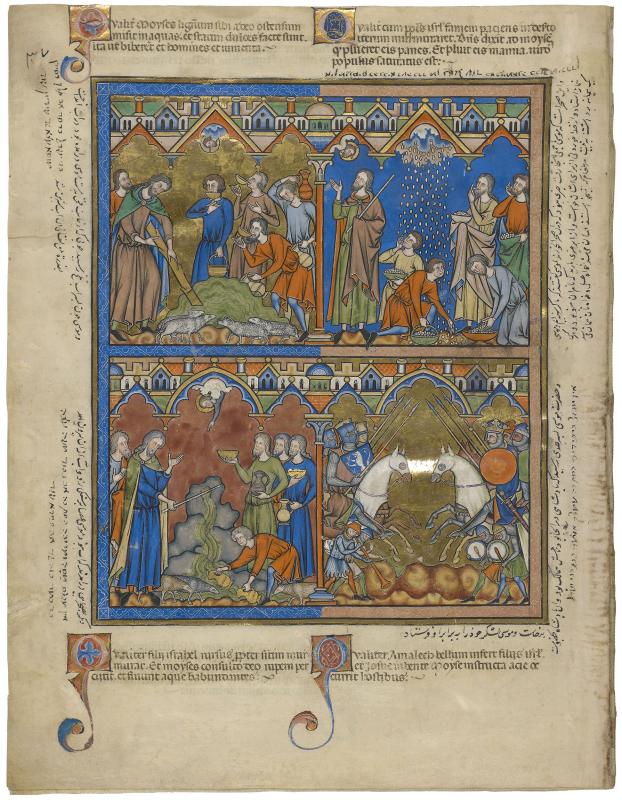
Upper left: How Moses cast into the water a tree which had been just shown to him and the water was made sweet so that the people and the cattle drank. (Exodus 15:25)
Upper right: How when the people of Israel, suffering from hunger, were murmuring once more in the desert, the Lord said to Moses that it would rain bread for them. And it rained manna, which satisfied the people. (Exodus 16: 1–15)
Lower left: How the people of Israel murmur again in thirst, and Moses, having consulted with God, smites a rock and water flows abundantly. (Exodus 17: 1–7)
Lower right: How Amalek attacks Israel and, at Moses’ command, Joshua forms an army and falls upon the enemies. (Exodus 17: 8–10)
Folio 9v (Persian)
Persian foliation: 37
Upper left margin: When Moses reached the bitter water, he threw the rod that he had received from God into the water; by the power of God the Exalted, the water turned sweet.
Upper right margin: And this is the desert into which Moses went with the community. There was nothing to eat in that desert. They said to Moses, "We are hungry." Moses stood in prayer and asked God for food for them. And it rained something from the cloud called Minoo [manna] and each took in a cup as much as they wished and for each it turned into what they desired, be it honey or bread.
Lower left margin: Then they came to a desert where there was no water; Moses struck a rock with the rod and water emerged.
Lower right margin & lower right: His Excellence Moses arrived at a frontier where there was a king named Hamalek [Amalek] and that king rose in enmity and Moses sent forth his army to confront him.
Folio 9v (Judeo-Persian)
Upper left margin, furthest left, corner:The Children of Israel, having arrived at the [spring of] bitter water, Moses struck it with [his] staff [and] sweetened it.
Upper right, below Latin: This is the scene when the prophet [Moses] prayed [and] manna descended; they carried it in goblets.
Lower left margin, furthest left: This is the scene of Massah and Meribah when there was no water and Moses struck the middle of the mountain [sic!] [and] water appeared.
Lower right margin, furthest right: This place is at Rephidim when Amalek came to fight the Children of Israel.
Italicized words are in Hebrew.
Sweetener
Moses, following the Lord's command, casts the tree into the bitter waters. The Israelites gather around with drinking cups and vessels to collect the sweetened waters. In the foreground, a group of sheep quenches its thirst. (Exodus 15:24–25)
Manna
Hunger has overcome the Israelites in the wilderness, and the congregation begins to murmur against Moses. The Lord hears these complaints, however, and rains bread from heaven upon the people. The Israelites collect the bread, each according to his own need, following the instructions Lord has given to Moses. (Exodus 16:11–15)
The Lord Provides
Once more the Israelites complain to Moses of thirst, but again the Lord provides. Moses, in obedience to God, strikes the rock at Horeb with his staff, and a spring bursts forth to quench the thirst of the people and their flocks. (Exodus 17:3–6)
Joshua, a Soldier
Amalek and his army threaten the Israelites with war. Moses commands Joshua, son of Nun, to assemble an army. The opponents face each other across a field at Rephidim, in this illustration arrayed in thirteenth-century battle dress. Joshua wears a brown tunic and carries a tri-point shield emblazoned with a lion. He and his cavalry all wear great helms. The enemy horsemen, to include the crowned Amalek, wear an older style of pointed helmet with a nasal guard. In the foreground, trumpeters and drummers sound the call to battle. (Exodus 17:8–13)