

The Egyptian Cattle Slain, Hail and Locusts, Passover, Deliverance
Old Testament Miniatures with Latin, Persian, and Judeo-Persian inscriptions
Purchased by J.P. Morgan (1867–1943) in 1916
Folio 8v (Latin)
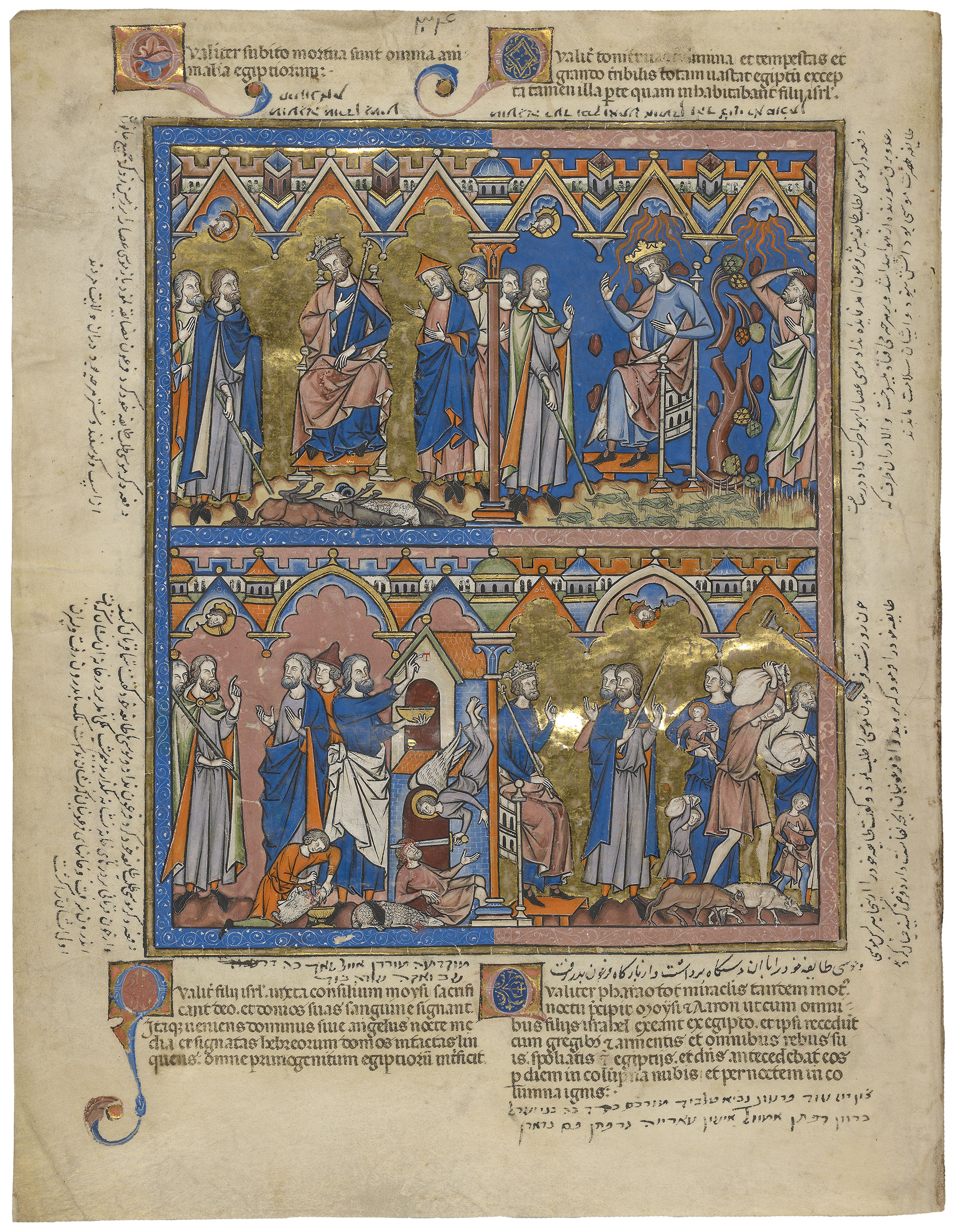
Upper left: How all the animals of the Egyptians died at once. (Exodus: 9–16)
Upper right: How thunder and lightning and storm and hail laid waste all of Egypt except the part where the children of Israel were dwelling. (Exodus 9:22–26)
Lower left: How the children of Israel sacrifice to God according to Moses’ counsel and mark their houses with blood. Thus God or an angel, coming at midnight and leaving the marked houses intact, kills each and every Egyptian firstborn. (Exodus 12: 21 – 29)
Lower right: How, Pharaoh, at last prevailed upon by so many miracles, orders Moses and Aaron at night to go out of Egypt with all the children of Israel, and they leave with their flocks and their herds and all of their possessions, the Egyptians having been despoiled, and the Lord goes before them by day in a pillar of cloud and by night in a pillar of fire. (Exodus 12:30 – 13: 22)
Folio 8v (Persian)
Persian foliation: 34
Upper left margin: Once again Moses demanded his tribe; Pharaoh refused. Again Moses struck the ground with the staff so that all animals, from horse and sheep and camel, whatever there was in that land, perished.
Upper right margin: The next time Moses came before Pharaoh demanding his tribe, he was unsuccessful. Moses shook his staff in the air. Suddenly, burning thunder and lightning appeared in the sky and it burned whatsoever it struck except [that] fire did not appear on the side where the tribe of His Excellence Moses was and they remained intact.
Lower left margin: The next time Moses demanded his tribe, Pharaoh refused and Moses told his tribe," Offer sacrifices and mark with the sacrificial blood the doors of the houses." At midnight, an angel came to the doors of the houses; if he found the mark, he did not enter, and he entered those houses of the Egyptians which were unmarked and he slew their first-born sons.
*Lower right margin: When day broke, Pharaoh summoned Moses and said, "Take away your tribe." So Moses told his tribe to go and borrow all that was valuable from the Egyptians; and they did so.
Lower right: And Moses took his people with the possessions and departed from the court of Pharaoh.
*The text starts from the right side of the illustration and continues at the bottom.
Folio 8v (Judeo-Persian)
Upper left, below Latin: The miracle of the death of all animals.
Upper right, below Latin: The miracle of thunder and lightning and the coming of fire which burned everything.
Lower left, above Latin: The miracle of the death of the firstborn which occurred at night.
Lower right, below Latin: When morning came Pharaoh sought out the prophet and gave permission for the Children of Israel to leave. They asked to borrow their [the Egyptians’] property but they did not give it.
Italicized words are in Hebrew.
The Egyptian Cattle Slain
Pharaoh still refuses to release the Israelites. In turn, the Lord brings a great plague upon Egypt's livestock; although oxen, sheep, goats, and horses lie dead, not a single animal has died from among the Israelite flocks. (Exodus 9:1–7)
Hail and Locusts
Again the king stubbornly ignores Moses' predictions of the Lord's wrath. Now the whole of Egypt suffers as lightning strikes the earth and hailstones hurtle from the sky, crushing trees, man, and beast. What little plant life is left is consumed by a voracious plague of locusts. Still, Pharaoh refuses to let the Israelites leave. (Exodus 9:23–26, Exodus 10:12–19)
Passover
The Lord vows to afflict Egypt with a final, most terrible plague: at midnight, the Lord will enter the land to kill the first-born sons of man and beast. Moses explains the Lord's instructions to the Israelites: take a lamb, and with its blood mark the door of every home. Seeing this sign, the Lord will pass over you, and keep you safe. Accordingly, one of the Israelites paints a 't' cross above his door with a pen. At midnight, before the unmarked door of an Egyptian house, the Lord arrives in the form of an angel of Death and begins the slaughter. (Exodus 12: 21–29)
Deliverance
The Lord has slain all of Egypt's firstborn, from the son of Pharaoh to the first-born of cattle. The king, broken, summons Moses and Aaron. Gather your herds and all of your possessions, Pharaoh commands, and depart from Egypt forever. The Israelites depart bearing sacks of unleavened dough. Note that in this miniature a woman holds in her arms a child with a halo and that the people are preceded by a floating column. The child and column are creative allusions to the biblical text; the haloed child reflects the Lord's command to consecrate every first-born male, and the column is a literal interpretation of the pillar of fire that was provided by the Lord to guide the Israelites at night. (Exodus 12:37–13:21)