

Divine Demands, The Nile Turned to Blood, Amphibian Assault, Vermin
Old Testament Miniatures with Latin, Persian, and Judeo-Persian inscriptions
Purchased by J.P. Morgan (1867–1943) in 1916
Folio 8r (Latin)
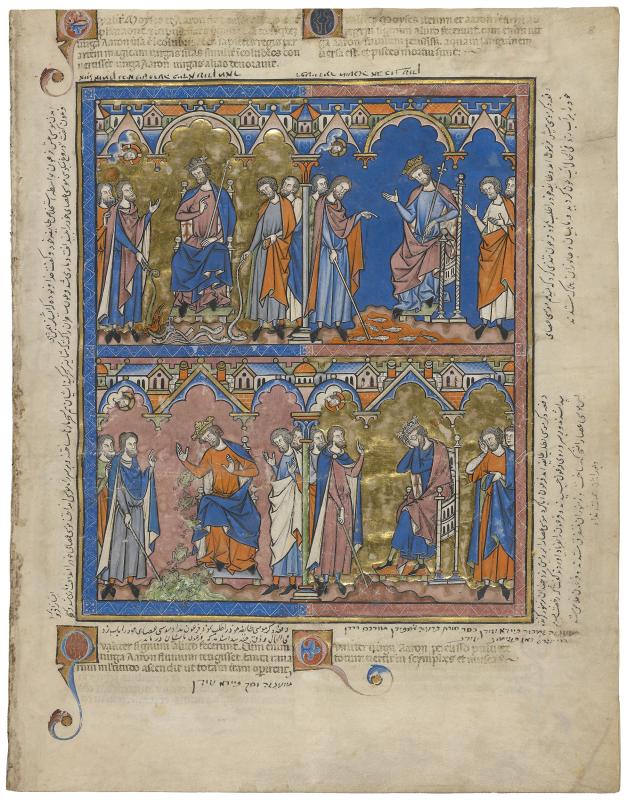
Upper left: How Moses and his brother Aaron talk to Pharaoh and start to show miracles before him. Indeed, Aaron’s rod had turned into a serpent, but when by their magical art the king’s wise men had also turned their rods into serpents, Aaron’s rod swallowed up the other rods. (Exodus 7: 1–12)
Upper right: How Moses and Aaron, having returned to the king, showed another miracle. For when Aaron had smote the river the water was turned into blood and the fish died. (Exodus 7: 19–21)
Lower left: How they showed another miracle. For when Aaron’s rod had touched the river such a multitude of frogs went up that they covered all the land. (Exodus 8:1–7)
Lower right: How, when Aaron’s rod had smote the dust, it all turned into lice and flies. (Exodus 8: 16–24)
Folio 8r (Persian)
Left Margin: Moses coming before Pharaoh for the liberation of his people, saying, "God has commanded that you deliver them to me." Pharaoh said, "You lie." Moses threw his staff and it turned into a serpent. Pharaoh told the magicians, "You too perform magic." They too made serpents with magic and threw them in Moses’ path. Moses threw his staff; it turned into a serpent and quelled their magic.
Lower left: Once again Moses came before Pharaoh and demanded his people. Pharaoh exhorted him, "I shall not give [them]." Moses struck water with his staff; the water instantly turned into blood and the fish and the creatures [in it] perished.
Upper right margin: The next time Moses came to demand his people, Pharaoh refused; Moses struck the water with his rod; instantly so many frogs appeared that the Pharaoh was helpless.
Lower right margin: The next time Moses came to demand his people, Pharaoh refused; Moses struck the ground with his staff; so many bees appeared and sat on Pharaoh’s head and face and made Pharaoh cry that he said to halt. So Moses shook his staff and the bees dispersed and Pharaoh was relieved and afterwards he did not release [them].
Folio 8r (Judeo-Persian)
Upper left, below Latin: The first coming of the prophet before Pharaoh.
Upper right, below Latin: On another occasion, the miracle of water turning into blood.
Lower left, below Latin: The miracle of the appearance of the frogs.
Lower right, above Latin: The miracle of the appearance of the bees and their sticking to the head of His Excellence, Pharaoh; his giving permission to the Children of Israel to [go and] repent.
Italicized words are in Hebrew.
Divine Demands
The Lord has sent Moses and his brother Aaron to Pharaoh with demands. As a sign of his power, the Lord has transformed Aaron's staff into a winged serpent, but Pharaoh is unimpressed because his own magicians duplicate the feat. Unnoticed by the Egyptians, Aaron's winged serpent devours those of the magicians, foreshadowing the coming wrath of the Lord. (Exodus 7:10–13)
The Nile Turned to Blood
Pharaoh and his sorcerers look on in dismay as Aaron strikes the Nile with his staff, transforming the waters into blood and killing the fish. Pharaoh is still not swayed, however, as his magicians duplicate this feat with false magic. (Exodus 7:20–22)
Amphibian Assault
Again Moses and Aaron confront Pharaoh; this time, when Aaron strikes the waters, a gruesome plague of frogs overtakes the land. The magicians are able to duplicate the feat, but Pharaoh is now uneasy. The king pleads with the brothers to take away the frogs; in turn, he promises to release the Hebrews so that they might sacrifice to the Lord. (Exodus 8:6–8)
Vermin
Once again, God hardens the heart of the king of Egypt in order that He might work great wonders before men. Always the Lord observes from heaven as the instruments of His will, Moses and Aaron, perform miracles before Pharaoh. Now Aaron, instructed by Moses, strikes the dust with his staff and summons forth a plague of lice and flies. (Exodus 8:17–25)