

Abraham's Vengeance, A Blessing, The Corruption of the Sodomites
Old Testament Miniatures with Latin, Persian, and Judeo-Persian inscriptions
Purchased by J.P. Morgan (1867–1943) in 1916
Folio 3v (Latin)
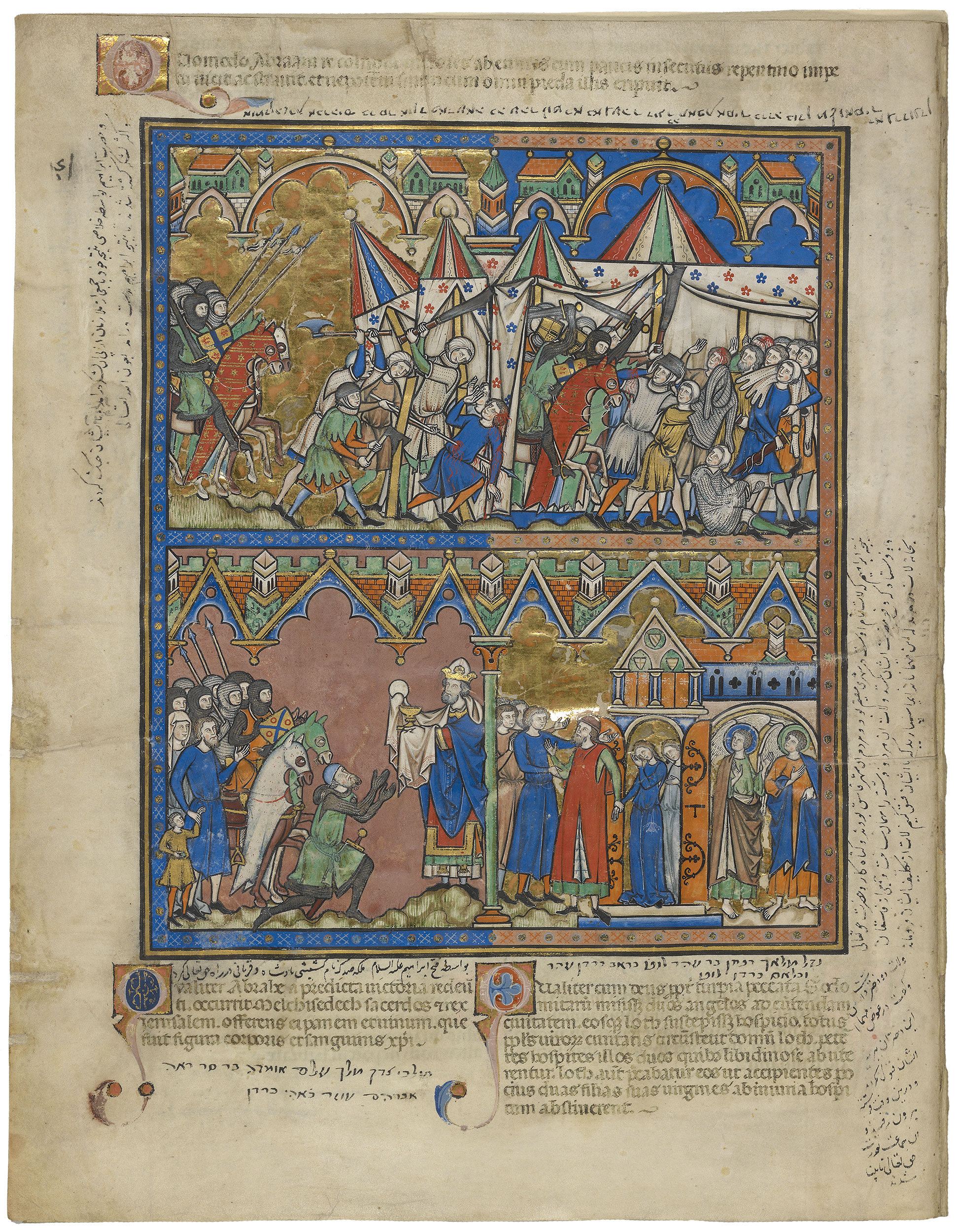
Upper half: How Abraham, upon discovering the matter, having pursued the victors who were going away with few men, defeated and scattered them and snatched away his nephew with all the spoils. (Genesis 14: 14–16)
Lower left: How Melchizedek, a priest and king of Jerusalem, met with Abraham as he was returning from the foretold victory, offering him bread and wine which were the prefiguration of the body and blood of Christ. (Genesis 14: 18–20)
Lower right: How when, due to the foul sins of the Sodomites, God had sent two angels to destroy the city and Lot had received them in hospitality, all the host of the men of the city surrounded Lot’s house, demanding the guests to basely abuse them. However, Lot was beseeching them to accept his two virgin daughters and avoid injuring the guests. (Genesis 19: 1–11)
Folio 3v (Persian)
Persian foliation: 41
Upper left margin: And his Excellence Abraham, with a group of his servants, pursued that army in order to rescue his relative. He fought them and most of the army was slain so that Abraham’s relative was recaptured by the assistance of God the Exalted.
Lower left: Because of Abraham’s victory, peace be upon him, the priest-king named Melchizedek and [sic] offered sacrifice to God the Exalted.
Lower right margin: Abraham’s relative, whose name was Lot, was resident at a city and the people of that city were sodomites and sinners. His Excellence God the Exalted sent two to ward against their harms and Lot hosted those two angels. A company of the sodomites came to Lot’s house [demanding], "Deliver these guests to us so that we fornicate with them." Lot did not oblige. And Lot had two daughters and said, "Take these girls instead of the guests." They did not accept and at this time the angel(s) went out and the group was blinded by the power of God the Exalted.
Folio 3v (Judeo-Persian)
Upper half: The coming of His Excellence Abraham against those four [sic!] kings who plundered and took prisoners [from] Lot’s town and other towns; he returns the goods and the prisoners.
Lower left, beneath Latin: Melchizedek, king of Salem, comes out to meet Abraham in order to apologize.
Lower right, above Latin: The tale of the angel going to Lot’s town in order to destroy it and his speaking with Lot.
Abraham's Vengeance
Abraham has gained word of Lot's capture and arrives on horseback to free his nephew. His foot soldiers attack the enemy pavilion, chopping down the support poles and spearing an enemy soldier. The remaining foes hurry to arm themselves but it is too late; the horsemen pursue them into the pavilion and strike them down. (Genesis 14:14–15)
A Blessing
Having rescued Lot and his family, Abraham receives the blessing of Melchizedek, king of Salem and high priest. As Abraham kneels, Melchizedek, vested as a bishop, holds aloft bread and wine. The Christian illuminator understood these offerings as prefiguring the Eucharist. (Genesis 14:18–20)
The Corruption of the Sodomites
In Sodom, Lot offers hospitality to two angels of the Lord. Later, an angry mob confronts Lot at the door of his home, demanding the surrender of the guests. Rather than dishonor the Lord's ambassadors, Lot offers his daughters. Still indoors, the angels prepare to strike Lot's attackers with blindness. (Genesis 19:3–8)