

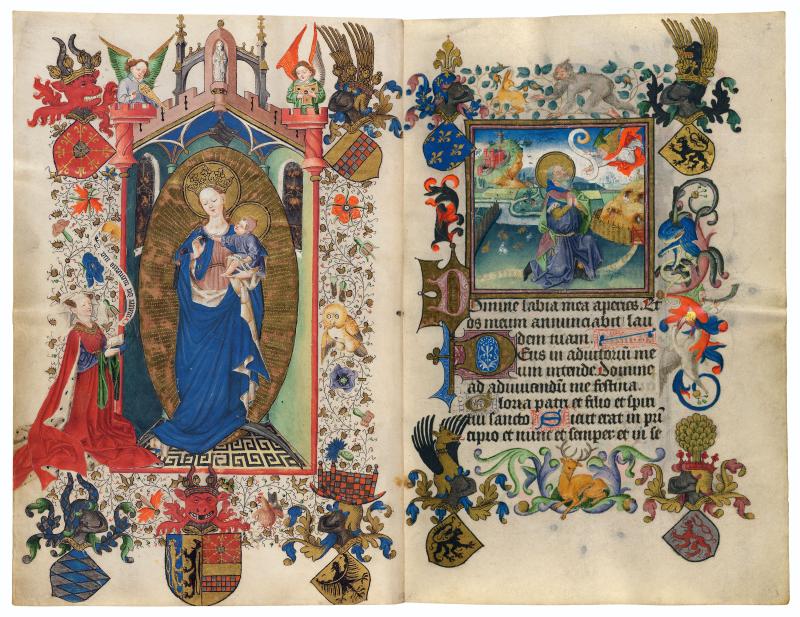

Hours of Catherine of Cleves (M.917/945)
M.917 was previously bound in tooled red morocco by Belz-Niedree (Jean-Philippe Belz; 1831-1917), mid-19th century, preserved separately; rebound in maroon morocco by Charlotte M. Ullman (1905-1988) in 1968, preserved separately. M.945 was previously bound in 19th-century burgundy velvet over boards, preserved separately. The two volumes were disbound in 2011 and rebound in three volumes in green velvet over card boards in 2017 by Maria Fredericks and Frank Trujillo.
MS M.917: Purchased on the Belle da Costa Greene Fund and with the assistance of the Fellows, 1963.
3 volumes (117, 124, 117 leaves) (1 column, 20 lines), bound : vellum, ill. ; 192 x 130 mm
Commissioned by Catherine of Cleves, duchess of Guelders, ca. 1440; sometime before 1856 the manuscript was taken apart, presumably by Jacques Joseph Techener, bookdealer in Paris, who shuffled the leaves and then rebound them into two volumes, making each volume look more or less complete; apparently, both volumes were still in Paris till 1862, when Gruel published Heures du moyen âge, which reproduces vignettes from both volumes. One part was acquired by the Rothschild family in 1855, who kept their manuscripts secret; bought by the Morgan (as "another Hours of Catherine of Cleves") from H.P. Kraus in 1963 (M.917). The other part (M.945, traditionally known as "The Hours of Catherine of Cleves") was put up for auction (by Techener) in London, Sotheby's, 3 Aug. 1858, lot 225 (added to the end of the S.W. Singer sale), where it failed to sell at £435; sold in or after 1862 by Techener (for 15,000 French francs) to Charles, prince of Arenberg (1831-1896); given by him to his wife, Júlia Hunyady de Kéthely (1831-1919); given by her to her husband's nephew, Engelbert Marie, duke of Arenberg (1872-1949) on 24 June 1896; inherited by his son Engelbert Charles, duke of Arenberg (1899-1974); bought from him by H.P. Kraus in 1957; sold by him to Alastair Bradley Martin (1915-2010) for his New York based Guennol Collection; bought by the Morgan through H.P. Kraus in 1970 (M.945). Studying the newly acquired book (MS M.917) along with the Martin volume (later MS M.945), Morgan curator John Plummer determined that they were actually two halves of one and the same codex. In 1964 the Morgan mounted an exhibition of both volumes, displaying all the miniatures via color transparencies. When a facsimile of the manuscript was published by George Braziller in 1966, the exhibition was repeated.
Ms. book of hours for the use of Windesheim; written and illuminated in The Netherlands, Utrecht, ca. 1440; manuscript separated into two or more parts (probably in the nineteenth century); the Morgan bought the first volume (MS M.917) in 1963 and the second volume (MS M.945) in 1970; both volumes were disbound in 2011; the pages and folios of the two volumes were restored to their original fifteenth-century sequence (the newly sequenced pages and folios were not refoliated, but retain the page and folio numbers that they had when the two volumes were acquired by the Morgan); rebound into three volumes in 2017 (MS M.917/945.1, MS M.917/945.2, and MS M.917/945.3).
MS M.917, which was paginated by a previous owner, contained 164 leaves; MS M.945 contained 194 leaves.
Present structure of the three volumes: volume 1 consists of (new) quires 1-14, beginning with p. 1 and ending with fol. 97v; volume 2 consists of (new) quires 15-30, beginning with fol. 98 and ending with p. 178; volume 3 consists of (new) quires 31-45, beginning with p. 27 and ending with p. 328. For a more thorough description of the quire structure, see Rob Dückers, et al. The Hours of Catherine of Cleves (Gütersloh, 2010), p. 107-121 (PDF attached)
Decoration: 25 full-page miniatures, 132 half-page miniatures, 1 historiated initial, decorated initials; almost all text pages have elaborate border decoration and pen flourishes.
Artist: Master of Catherine of Cleves.
The Hours of Catherine of Cleves is the greatest Dutch illuminated manuscript in the world. Its 157 miniatures are by the gifted Master of Catherine of Cleves (active ca. 1435-60), who is named after this book. The Master of Catherine of Cleves is considered the finest and most original illuminator of the medieval northern Netherlands, and this manuscript is his masterpiece.
The manuscript Catherine commissioned is a prayer book containing an unusually rich series of devotions illustrated with especially elaborate suites of miniatures. The artist's keen sense of observation combined with an interest in everyday objects was a style far ahead of its time (it would come to flower in seventeenth-century Dutch still-life painting). All the miniatures are filled with amazing detail. Narrative was also one of the great talents of the Master of Catherine of Cleves--he could tell a good story. Finally, Catherine's codex is famous for the artist's innovative borders, no two of which are alike.