
Purchased by Pierpont Morgan, 1904.
1 item (33 p.) ; 19.5-19.9 cm
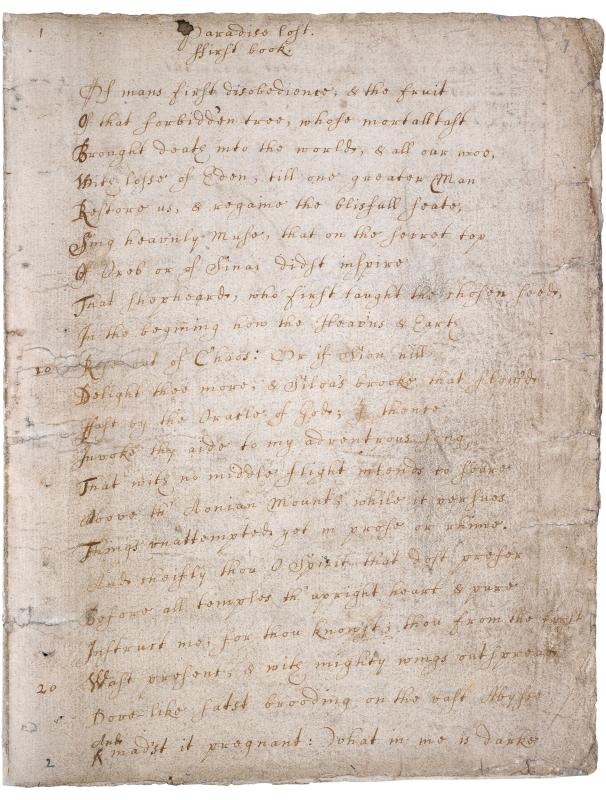
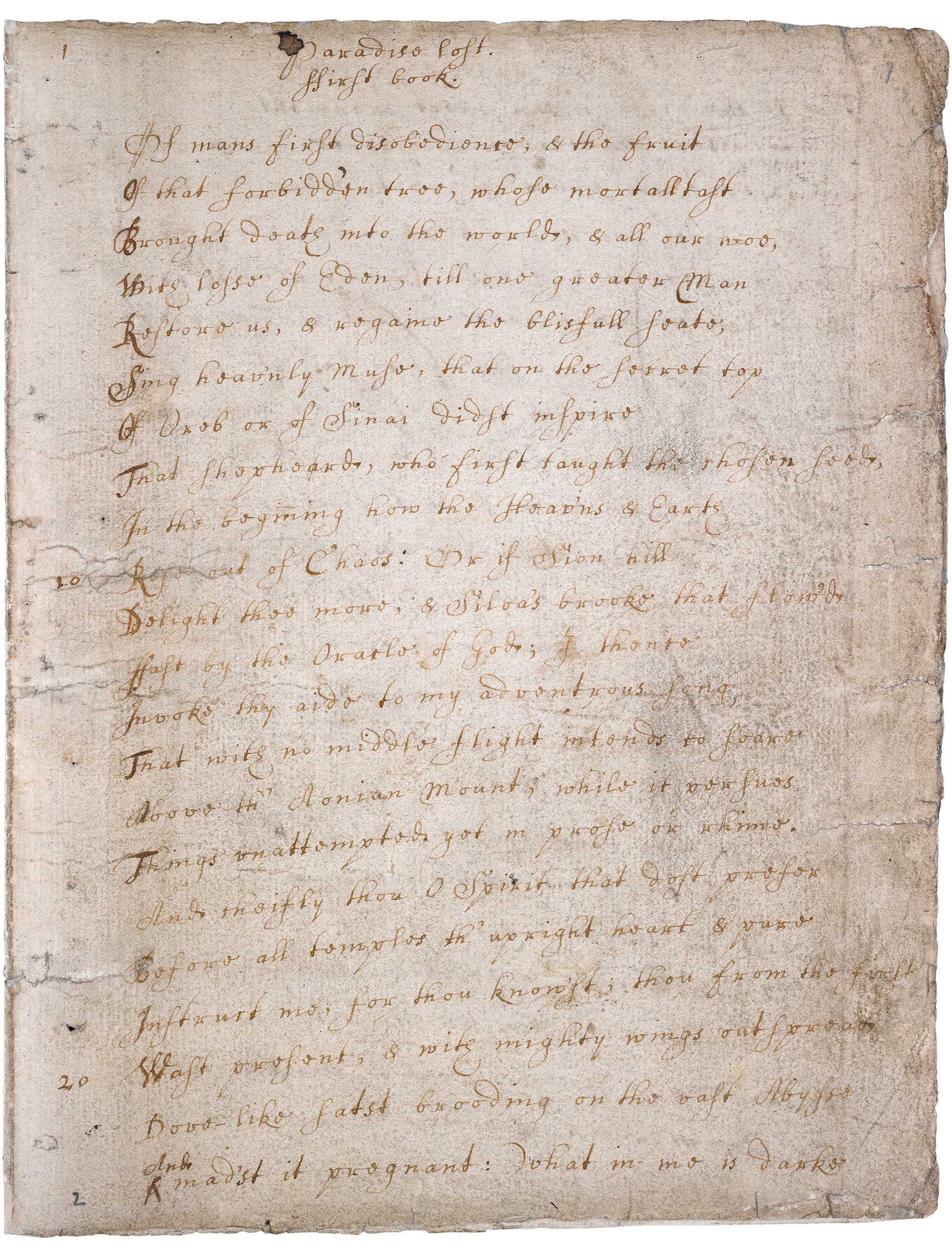
As sent to the printer, Samuel Simmons, having in the margins the printer's marks for the division into sheets.
Bearing the imprimatur of the chaplain to the Archbishop of Canterbury, reading: "Imprimatur / Tho. Tomkyns {Rmo in / Christo Patri ac Domino / Dno Gilberto divina Providentia / Archi-Episcopo Cantuariensi a / Sacris domesticis. / Richard Royston / Int.-- / p. Geo: Tokefeilde Cl :"
Some corrections in the hand of Milton's nephew Edward Phillips.
Watermark: on conjoined pages 2-3, along fold. Pot with one handle and with letters "F" over "DC" inside, base present and crescent at top.
Watermark: on conjoined pages 6-7, along fold. Pot with one handle and with letters "F over DC" inside, base present and crescent at top.
Sold by the author to the printer Samuel Simmons for £5 on 27 April 1667; sold by Simmons to the London bookseller Brabazon Aylmer for £25; sold by Aylmer to another bookseller, Jacob Tonson (1655-1736); by descent to his nephew, also Jacob Tonson (1682-1735); by descent to his son, also Jacob Tonson (1714-1767); by descent to his brother Richard Tonson; by descent William Baker and in the Baker family until Henry Clinton Baker of Bayfordsbury consigned the manuscript to Sotheby's, London, 25 January 1904 [the manuscript did not make the reserve and was not sold here]; purchased by Pierpont Morgan, 1904.
The only surviving manuscript of Paradise Lost is this 33-page fair copy, written in secretary script by a professional scribe, who probably transcribed patchwork pages of text Milton had dictated to several different amanuenses. This fair copy was corrected by at least five different hands under Milton's personal direction and became the printer's copy, used to set the type for the first edition of the book.
Blue cloth drop-spine box (22.2 cm)
This is the only surviving fragment of the manuscript used to print Paradise Lost, Milton's epic poem of the Edenic fall. It is difficult to overstate the influence of Milton's poem on subsequent writers and artists, particularly in his vivid portrayal of Satan, whose seductive logic and rhetorical virtuosity have captivated readers for generations. Driven to achieve "things unattempted yet in prose or rhyme," Milton adopted innovative thematic and formal approaches for Paradise Lost, sourcing his characters from the Bible (rather than British history) and composing his lines in blank verse instead of heroic couplets, which were more fashionable at the time.
Milton wrote the ten books of Paradise Lost between 1658 and 1663. He had first planned the work as early as 1640, intending to write a tragedy titled Adam Unparadised. By 1652 he had become completely blind, probably due to glaucoma. The final words on the manuscript's first page of text--"what in me is darke / [Illumine]"--refer not only to the speaker's moral and intellectual uncertainties but also allude to the physical darkness that engulfed the poet. Blindness forced Milton to compose orally, rendering him entirely reliant upon amanuenses (casual copyists among his friends and family circle) to whom he gave dictation. He composed the poem mostly at night or in the early morning, committing his composition to memory until someone was available to write down his words. He revised as his text was read back to him, so that a day's work amounted to twenty lines of verse. This fair copy of the poem's first book was transcribed by a scribe or literary secretary and bears further annotations by the printer (Samuel Simmons) and the compositors working for him.