Current
Upcoming
Online
Past
|
|
Exhibitions
Rococo and Revolution: Eighteenth-Century French Drawings October 2 through January 3, 2010
1
2
3
4
Next »
 +zoom | Louis-Léopold Boilly (1761–1845) Portraits of the Artist's Family and Servants
Black and white chalk, on light brown wove paper
17 13/16 x 11 11/16 inches (450 x 297 mm)
Thaw Collection, The Morgan Library & Museum; EVT 10
Judging from the costumes, it would appear that this drawing dates to around 1800. It is apparent from what we know about Boilly's family that his second wife, née Adélaïde-Françoise-Julie Leduc, and two of his sons are depicted: her likeness is in the center of the sheet, the sons in the upper right and bottom center. The man to the right of Boilly's wife is his friend the singer Simon Chenard, who also acted as tutor for the children of Boilly's first marriage. Of the four remaining portrait heads, three are most probably servants, while the woman at the lower left corner remains unidentified.
|
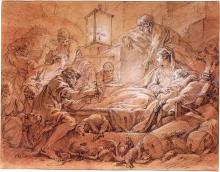
|  +zoom | François Boucher (1703–1770) Adoration of the Shepherds, ca. 1761–62
Pen and brown ink, brown and red wash, brown and black chalk, heightened with white chalk, worked wet, over traces of black chalk, on pink-prepared paper 11 3/8 x 14 5/8 inches (289 x 371 mm)
Thaw Collection, The Morgan Library & Museum; EVT 184
Of the artists who defined French art under the ancien régime, Boucher was perhaps the most prolific. This powerfully illumined sheet unites his lyrical sensibility for religious subjects and the complex experimentation with media and techniques that characterizes works from the last decade of his career. The subject is an unusual combination of a Nativity and an Adoration of the Shepherds and appears to be one of several explorations of nocturnal scenes dating after 1755.
|
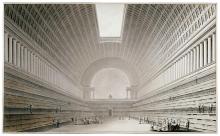
|  +zoom | Etienne Louis Boullée (1728–1799) Interior of a Library
Pen and black and some brown ink, gray wash, over faint traces of black chalk; compass point at center; ruled borders in pen and black ink at outer margin and framing design area
15 7/8 x 25 5/8 inches (420 x 653 mm)
Thaw Collection, The Morgan Library & Museum; EVT 12
Since most of his commissioned architectural works are no longer extant, Boullée is best known for a group of a hundred imaginative and rather grandiose designs that he left to the Bibliothèque nationale, Paris. Although he was commissioned to expand the royal library in 1780, his designs were never realized. In his treatise, Boullée explained that he was transforming "a . . . courtyard . . . into an immense [amphitheater-like] basilica lighted from above . . . [with] attendants spread about so that they could pass the books" from tier to tier. In brilliant, large-scale designs, such as the present example, he went beyond Neoclassicism to the visionary—even futuristic—clarity for which his work is now so admired.
|
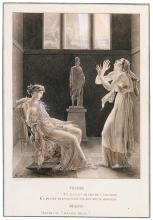
|  +zoom | Carmontelle (Louis Carrogis 1717–1806) Portrait of a Lady Seated by a Fire
Black, red, and white chalk, watercolor, with a touch of pen and black ink to accent the sitter's eye
7 9/16 x 8 9/16 inches (196 x 218 mm)
Purchased on the Walter C. Baker Fund; 1981.51
Many of Carmontelle's portraits are valuable both as aesthetic and historical documents, depicting a wide cross-section of late-eighteenth-century Parisian society. In addition to the present drawing, the artist made at least two other versions of this subject. One, a somewhat larger and less finished study, is in a private collection in Switzerland, while another remains with the sitter's family. The latter version confirms that the subject is Jeanne de Castellane-Mazaugues, who married the Marquis de Pontèves Castellane in 1778.
|
|  +zoom | François-Hubert Drouais (1727–1775) Boy with a Sketchbook
Black, white, and red chalk
Inscribed on the old mount, F. H. Drouais
16 x 10 inches (404 x 256 mm)
Purchased on the Sunny Crawford von Bülow Fund 1978; 1992.35
The portraitist François-Hubert was the best known of three generations of artists bearing the Drouais name. His success began with the Salon of 1755, and immediately thereafter he found favor at court with his double portrait of the infant sons of the dauphin, the future Louis XVI and Louis XVIII. The subject of a boy carrying a portfolio occurs several times in his oeuvre, and it has been proposed that they are depictions of the artist's son. Since some of these works are signed and dated 1760, this theory does not seem likely, as Drouais married only two years earlier.
|
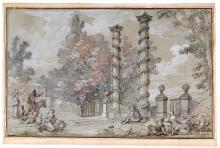
|  +zoom | Jean-Honoré Fragonard (1732–1806) Interior of a Park: The Gardens of Villa d'Este
Gouache on vellum
7 3/4 x 9 1/2 inches (197 x 242 mm)
Thaw Collection, The Morgan Library & Museum; 1997.85
During the summer of 1760 Fragonard stayed at the Villa d'Este at Tivoli. Inspired by the beauty and picturesque neglect, the young artist turned out many red chalk views of the lovely old gardens. This rare gouache is a reduction of his painting of the same subject now in the Wallace Collection, London. It is not possible to identify the precise spot depicted here since the artist's view is generally impressionistic and perhaps based on his recollection of the Dragon Fountain.
|
|
1
2
3
4
Next »
|