Current
Upcoming
Online
Past
|
|
Exhibitions
Pages of Gold: Medieval Illuminations from the Morgan June 19 through September 13, 2009
1
2
3
4
Next »
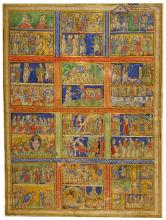
 +zoom | Biblical cycle, leaf from the prefatory cycle of the Eadwine Psalter. England, Canterbury, Christ Church Priory, ca. 1155–60.
400 x 290 mm
Purchased by Pierpont Morgan, 1911. MS M.521r.
This leaf, MS M. 724, and six other prefatory leaves were probably removed between 1584, when Richard Arkinstall gave the Psalter to Cambridge University, and its rebinding before Thomas Nevile (d. 1615) gave it to Trinity College, where it is today. The leaves may have been regarded as extraneous to the five different Psalter versions in the book. Four leaves were later acquired by William Young Ottley (1771–1836) and were in his sale at Sotheby's on 12 May 1838, lots 130–33. This leaf was lot 133. When Pierpont Morgan purchased it from Joseph Martini in 1911, it was bound in English nineteenth-century brown levant morocco with gilt panels. It was subsequently rebound with the second Morgan leaf by Marguerite Duprez-Lahey around 1927. Both leaves were subsequently disbound and matted.
This leaf is densely illustrated; twelve square compartments each contain two or more scenes from the life of Christ and parables.
Row 1: Two Seated Blind Men Call out to Christ and Are Healed; Apostles Eating Corn on the Sabbath, Christ and Apostles Rebuked by Pharisees; Christ Healing the Man's Withered Hand, Christ Healing the Blind and Dumb Demoniac
Row 2: Christ Feeding the Five Thousand; Christ Praying on the Mountain, Christ and Peter Walking on the Water; Canaanite Woman Asking Christ to Help Her Daughter, Dogs Eating the Crumbs
Row 3: Christ Giving the Keys to St. Peter, Transfiguration; Parable of the Unjust Servant; Parable of the Vineyard
Row 4: Woman Taken in Adultery; Story of the rich man and Lazarus; Story of the Prodigal Son
|
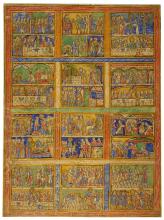
|  +zoom | Biblical cycle, leaf from the prefatory cycle of the Eadwine Psalter. England, Canterbury, Christ Church Priory, ca. 1155–60.
400 x 290 mm
Purchased by Pierpont Morgan, 1911. MS M.521v.
This leaf, MS M. 724, and six other prefatory leaves were probably removed between 1584, when Richard Arkinstall gave the Psalter to Cambridge University, and its rebinding before Thomas Nevile (d. 1615) gave it to Trinity College, where it is today. The leaves may have been regarded as extraneous to the five different Psalter versions in the book. Four leaves were later acquired by William Young Ottley (1771–1836) and were in his sale at Sotheby's on 12 May 1838, lots 130–33. This leaf was lot 133. When Pierpont Morgan purchased it from Joseph Martini in 1911, it was bound in English nineteenth-century brown levant morocco with gilt panels. It was subsequently rebound with the second Morgan leaf by Marguerite Duprez-Lahey around 1927. Both leaves were subsequently disbound and matted.
This leaf isvdensely illustrated; twelve square compartments each contain two scenes depicting the life of Christ or parables.
Row 1: Parable of the Wise and Foolish Virgins; Parable of the Ten Talents; Zaccheus in the Tree; Feasting with Christ and the Apostles
Row 2: Simon the Leper Preparing for Christ, Mary Magdalene Anointing the Feet of Christ; Christ and the Samaritan Women at the Well; Christ Entering the Samaritan Town; Christ in the House of Mary and Martha; Christ in the House of Simon the Leper, Where a Woman (Mary Magdalene) Anoints His Head
Row 3: Mary and Martha Plead with Christ to Help Lazarus; Raising of Lazarus; Christ's Entry into Jerusalem; Judas Receiving the Pieces of Silver
Row 4: Preparation for and the Last Supper; Christ Washing the Feet of the Apostles, Christ's Agony in the Garden; Betrayal of Christ
|
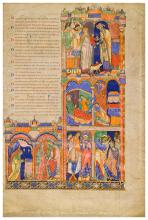
|  +zoom | Scenes from the Life of Samuel Verso: Scenes from the Life of David
Leaf from the Winchester Bible
Illuminated by the Master of the Morgan Leaf
England, Winchester, Cathedral Priory of St. Swithin, ca. 1160–80
583 x 396 mm
Purchased by Pierpont Morgan, 1912; MS M.619 (recto)
Although full-page miniatures were not originally planned for the Winchester Bible, a few were included.
The underdrawings by the Apocrypha Master on this leaf were closely adhered to, and the painting was a
collaborative effort between him and the Morgan Master, whose work is especially evident in the faces.
The leaf, removed when the Bible was rebound in 1820, ended up with Leo Olschki, the Florentine dealer.
He offered it to William Morris for £100 before it became Pierpont Morgan's greatest, and last, single leaf
purchase (about $6,000). Eric Millar recognized its connection with the Winchester Bible in 1926.
|
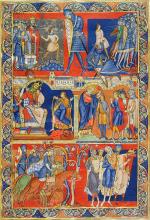
|  +zoom | Scenes from the Life of David Recto: Scenes from the Life of Samuel
Leaf from the Winchester Bible
Illuminated by the Master of the Morgan Leaf
England, Winchester, Cathedral Priory of St. Swithin, ca. 1160–80
583 x 396 mm
Purchased by Pierpont Morgan, 1912; MS M.619 (verso)
Described as the finest English painting of the twelfth century, this is the Morgan's most important single
leaf. The Winchester Bible, the largest and finest English Romanesque Bible, was begun about 1160 but
never finished. Four full-page drawings by the Apocrypha Master were executed; two remain in the refectory Bible. The
only painted leaf (1170s) is this one, the masterpiece of the Master of the Morgan Leaf. It prefaced the Book
of Samuel and depicts in each tier:Saul Watching David Slay Goliath, Saul Hurling a Spear at David and Samuel Anointing David, and Joab Killing Absalom and David Mourning the Death of His Young Son. The Morgan Master
simplified the drawing by reducing the number of feet (of both horses and men).
|
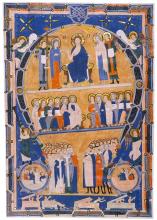
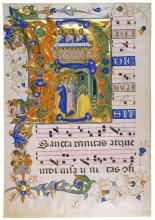
|  +zoom | Last Judgment, in an initial A Leaf from an Antiphonary, in Latin.
Italy, probably Florence, ca. 1280
Illuminated by the Maestro Geometrico.
550 x 365 mm
Purchased by Pierpont Morgan from Leo Olschki, 1907. MS M.273.
This depiction is divided into tiers, imitating large-scale frescoes and mosaics of the period. The top scene depicts Christ as judge, exposing his wounds and flanked by the Virgin Mary and John the Baptist. Attendant archangels hold instruments of the Passion. In the middle section are the twelve apostles holding books or scrolls. The elect, occupying the third tier, represent the clergy on the left and the lay world on the right. The small bearded man among the elect may possibly represent the artist. Below, the dead are summoned from their graves by angels blasting trumpets. This leaf was originally the frontispiece of an Antiphonary (which contains the music for the Divine Office), for the initial A (of Aspiciens) begins the response for the first Sunday in Advent, the beginning of the church year. The so-called Maestro Geometrico (or Terzo master) was active about 1270–80 and worked on Choir Books E and F in the church of Santa Maria Novella in Florence.
|
|  +zoom | Scenes from the Life of Christ Leaf from the Hungarian Anjou Legendary
Illuminated by the Hungarian Master and his workshop for a Hungarian patron
Italy, Bologna?, ca. 1325–35
Purchased by Pierpont Morgan, 1909; MS M.360.10
The Hungarian Anjou Legendary was one of the most lavishly illuminated manuscripts of its time. Nearly
550 scenes have survived, but there may have been about a third more. The Legendary contains the stories
(lives) of Christ, the Virgin, and saints, arranged according to church hierarchy, placing the female saints last.
Each folio originally contained four compartments with numbered scenes and Latin inscriptions.
The presence of Hungarian and Anjou saints has led to the suggestion that the Legendary was commissioned
by Charles Robert of Anjou, king of Hungary. The Hungarian Master, an Italian active in Bologna, was so
named because his two most important works were made for Hungarians. His style has much in common
with the Master of 1328, with whom he may have worked and trained.
The complete manuscript apparently was owned by Giovanni Battista Saluzzo (1579–1642) in 1630, when
he cut many of the quadripartite miniatures into four scenes, mounting them, one per page, in a small
album. He did not cut up all of the leaves, however, and 106 of them are, with their original inscriptions, in
the Vatican Library (Lat. 8541).
|
|
1
2
3
4
Next »
|