
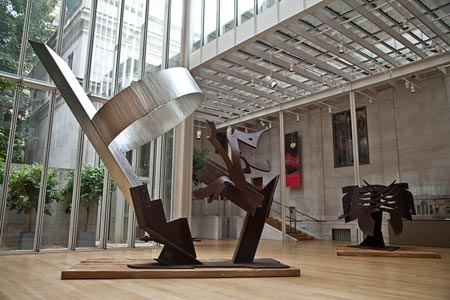
The temporary installation of three sculptures by Mark di Suvero in the Gilbert Court was prompted by the friendship and mutual admiration between di Suvero and Renzo Piano, the architect who designed the court. The geometric rigor and simple elegance of the soaring space provide a counterpoint to di Suvero's expressionist sculptures, which Piano has compared to "wild guys" who have come to disrupt the serenity of the place.
Because of their scale, materials, and techniques, di Suvero's sculptures have always had a special relationship to architecture. His early works, from the late 1950s and 1960s, were made of rough timbers salvaged from demolished buildings. In his more recent sculptures, fragments of I-beams evoke industrial construction and at the Morgan directly echo the steel columns of Piano's architecture. But while Piano's columns are polished, painted, and most of all functional, di Suvero's beams are cut, twisted, and raw, and their function is purely expressive and poetic. Piano once described di Suvero's method: "Well, Mark just picks 'em all up and moves them around with a crane, and then when he likes it, he just welds it, and turns it over sometimes."
Di Suvero may begin a piece with drawings—"It's easier to make your mistakes on paper than it is in steel," he has said—but the works are for the most part constructed intuitively "following the way the material wants to go." The sculptures in the exhibition were made during the last fifteen years. The elegantly curved lines of Heraldic Bourgogne contrast with the aggressiveness of its claw-like elements. In the dramatic Homebody, the artist set up a dialogue of shapes, colors, and textures between the large, dominant circle and the tangled forms of the lower part. The smaller Sandwich I playfully balances two I-beam sections, endowing these heavy construction pieces with a beautiful sense of lightness. Although different in size, the three sculptures are all of an imposing scale, which interacts with the monumentality of the ambient architecture. They transform and animate the space with their projecting elements. Like Renzo Piano's architecture, di Suvero's sculptures are at once powerful and lyrical. They transcend their materiality to arouse the emotions and stir the imagination.
Born to Italian parents in Shanghai in 1933, Mark di Suvero immigrated with his family to San Francisco in 1941. After earning a B.A. in philosophy from the University of California at Berkeley, he moved to New York in 1957. His highly successful first exhibition in 1960 included sculptures made of rough timbers, the shapes of which echoed the gestural brushstrokes of the dominant Abstract Expressionist movement. After a near-fatal accident left him paralyzed, di Suvero learned to operate a crane and use an electric arc welder and began creating the monumental steel sculptures for which he has achieved international fame. In 1975 he became the first living artist to have his work shown in the Tuileries Gardens in Paris.
An idealist with a strong belief in art's ability to improve the world and an equally strong commitment to aspiring artists, di Suvero converted an abandoned landfill adjacent to the East River in Queens into the Socrates Sculpture Park, which has offered young sculptors a place to exhibit large-scale works since 1986. The recipient of numerous awards, di Suvero maintains three studios—one on the site of a former brickyard on the edge of the East River in Long Island; another in Petaluma, California; and a third on the banks of the Saône in Chalon-sur-Saône, France.
This installation is made possible through the generosity of Richard and Ronay Menschel.
Left: Homebody, 2004, stainless steel, steel, 13' 10" x 15' 3" x 8'
Right: Heraldic Bourgogne, 1995, steel, 78" x 85 3/4" x 89 3/4"