
Histoire Naturelle des Indes
104 of 122
Accession number: MA 3900
Credit: The Morgan Library & Museum. Bequest of Clara S. Peck, 1983.
Title: Histoire Naturelle des Indes [supplied on an 18th century title page]
Contents: 199 images of West Indian plants, animals and human life, with accompanying manuscript captions written in late sixteenth-century French.
Medium: Most of the illustrations consist of a black chalk underdrawing and a combination of pen and brown ink with watercolor; on some images selected areas have also been glazed with a gum.
Dimensions: Binding: 30 x 21 cm; individual leaves: 29.3 x 19.7 cm.
Binding: Bound or rebound in brown leather in the late 18th century.
Pagination: Penciled folio numbers (1–125) in lower right corner of each page were added by The Morgan Library & Museum. Folios 92v–93, 93v–94, and 95v–96 are fold-out leaves.
Histoire Naturelle des Indes
Continued from fol. 106
a distance of approximately nine leagues. The barges do not take long at all to come down to the sea and to be on the way to Nombre de Dios on account of the river's strong current. The barges are all laden with gold and silver and have only eight to ten negro slaves who swim when there is no proper wind, and one Spaniard, called Major-domo, who commands them. Having arrived in Nombre de Dios and unloaded the gold and silver, they take on merchandise meant for delivery to Panama and from there to Peru, having to leave half of their merchandise at the grange, a place close to said Chagres River, because the barges—unless they are lightened—cannot go upstream on account of its violent current and swiftness. To this end they have to be pushed with poles so that laden with the treasures mentioned above, they need only six to seven hours to come downstream while, on the other hand, it takes them four to five days to go back upstream.
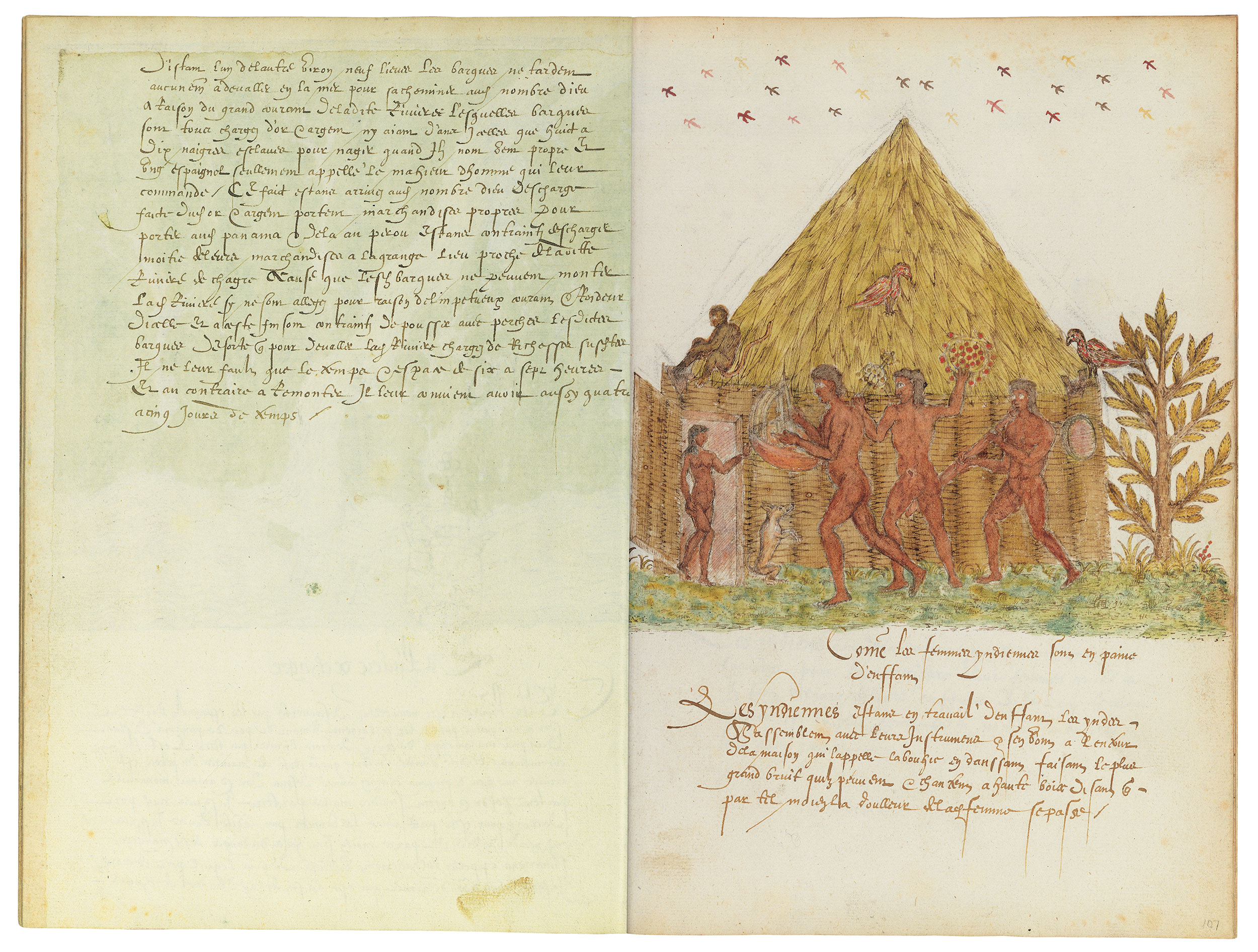
Come Les Femmes Yndiennes Sont En Paine D'enffant (How the Indian Women Suffer Labor Pains)
When the Indian women are in labor, the Indian men gather with their musical instruments and walk around the house called "la bouhie," dancing, making as much noise as possible and singing in a loud voice, saying that by this means the woman's pain will go away.
Histoire Naturelle des Indes
Illustrated manuscript, ca. 1586
Bequest of Clara S. Peck, 1983; MA 3900 (fol. 106v–107)