
Demons and Devotion: The Hours of Catherine of Cleves
57 of 129
The Hours of Catherine of Cleves
Created in Utrecht, The Netherlands, around 1440, the manuscript was taken apart sometime before 1856. Its leaves were shuffled and then rebound into two volumes to make each look more or less complete. The first part was acquired by the duke of Arenberg, whose descendants owned it until 1957, when it was bought by New York dealer H. P. Kraus, who sold it to Alistair Bradley Martin. This volume had been known by scholars as the "Hours of Catherine of Cleves."
Meanwhile, the second part had been acquired by the Rothschild family, who kept their manuscripts secret. In 1963 their volume was sold to the Morgan as yet another "Hours of Catherine of Cleves." Studying the newly acquired book (it became MS M.917) along with the Martin volume, Morgan curator John Plummer determined that they were actually two halves of one and the same codex. In 1964 the Morgan mounted an exhibition of both volumes, displaying all the miniatures via color transparencies. When a facsimile of the manuscript was published by George Braziller in 1966, the exhibition was repeated. Finally, in 1970, the Morgan was able to buy the Martin volume (it became MS M.945), and thus came to own both parts of this greatest of all Dutch manuscripts.
Both volumes have been disbound in preparation for rebinding the leaves in proper order.
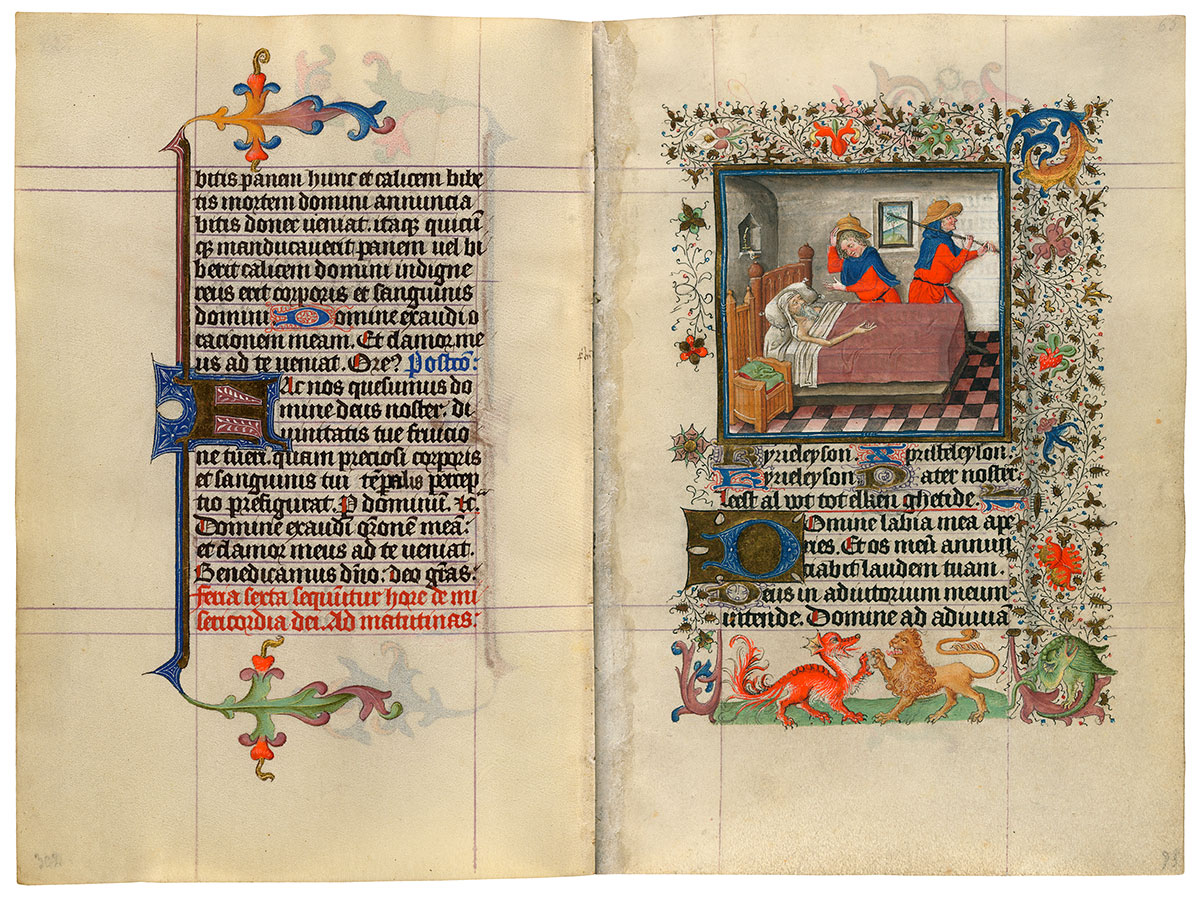
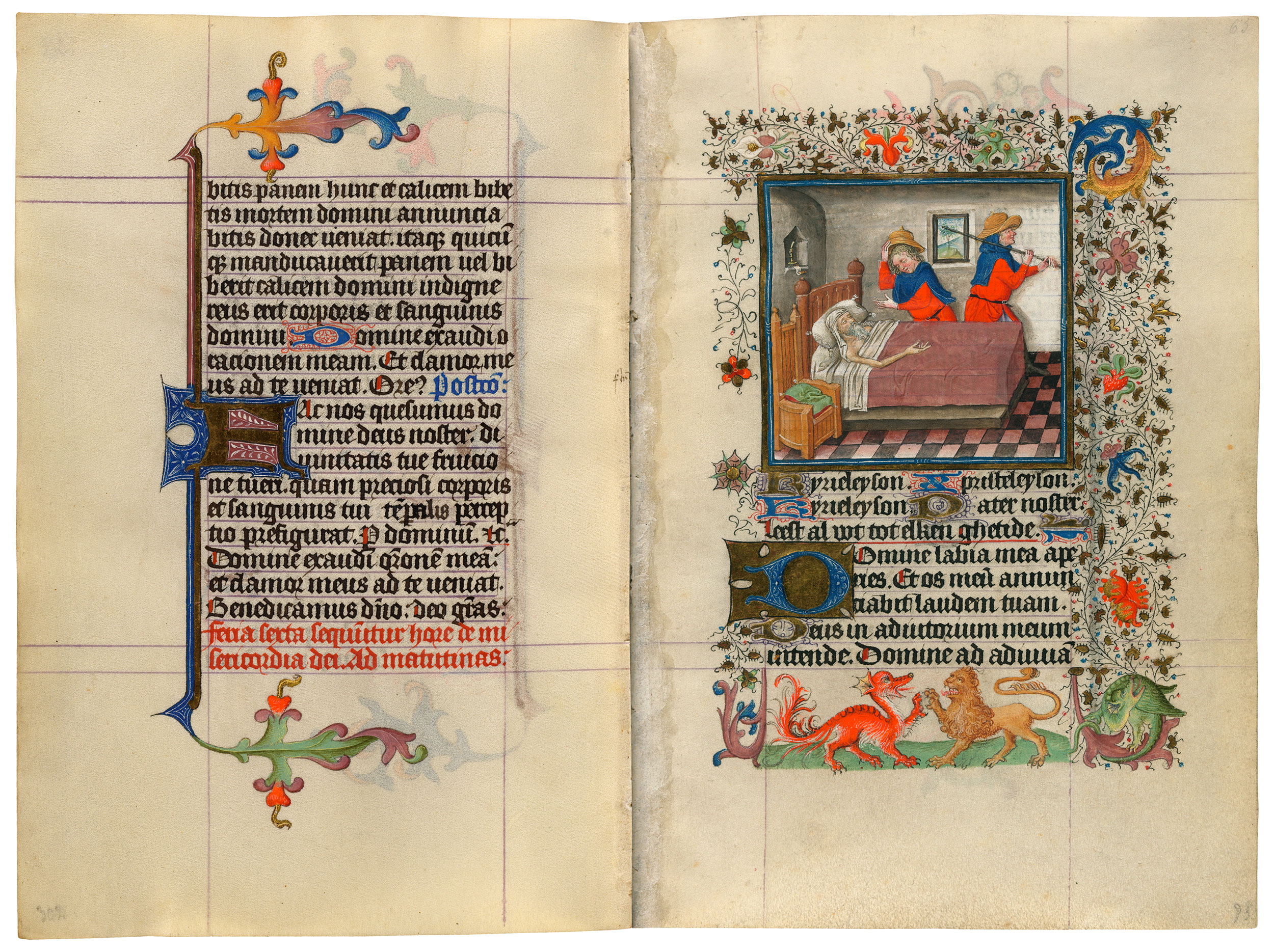
The Dying Adam Dispatching Seth to Paradise
Friday Hours of the Compassion of God: Matins
Hours of Catherine of Cleves, in Latin
Illuminated by the Master of Catherine of Cleves
The Netherlands, Utrecht, ca. 1440
7 1/2 x 5 1/8 inches (192 x 130 mm)
The rare Friday Hours of the Compassion of God plus the Mass of the Holy Cross are illustrated with a series of nine images, all of which are exhibited here. (Two introductory large miniatures for the Hours and the Mass are missing.) The iconography of the medieval legend of the True Cross offers an imaginative link—physical and metaphysical—between Adam and Christ and between terrestrial and celestial Paradise. The cycle begins with a remorseful Adam, on his deathbed, sending his third son, Seth, to the Garden of Eden to fetch a branch of the Tree of Mercy.
Purchased on the Belle da Costa Greene Fund with the assistance of the Fellows and with special assistance of Mrs. Frederick B. Adams, Sr., Mrs. Robert Charles, Mr. Laurens M. Hamilton, The Heineman Foundation, Mrs. Donald F. Hyde, Mrs. Jacob M. Kaplan, Mrs. John Kean, Mr. Paul Mellon, Mr. and Mrs. Charles F. Morgan, Mr. Lessing J. Rosenwald, Mr. and Mrs. August H. Schilling, Mrs. Herbert N. Straus, Mrs. Landon K. Thorne, Mrs. Alan Valentine, Mr. and Mrs. Arnold Whitridge, and Miss Julia P. Wightman, 1970; purchased on the Belle da Costa Greene Fund with the assistance of the Fellows, 1963; MSS M.945, f. 150v–M.917, p. 75
Hours and Masses for the Seven Days of the Week
The most unusual texts in Catherine's manuscript are the series of Hours and Masses for every day of the week. Medieval Christian tradition associated certain figures or themes with different days. Thus Sunday, the day of the Resurrection, was the Lord's Day; Thursday was connected with the Eucharist since that sacrament was instituted on Holy Thursday; and Monday was the day of the dead, since their torments were suspended on Sunday but recommenced the following day. In Catherine's prayer book, the themes for the Hours and Masses of the seven days of the week are:
| Sunday |
the Trinity |
| Monday |
the Dead |
| Tuesday |
the Holy Spirit |
| Wednesday |
All Saints |
| Thursday |
the Blessed Sacrament |
| Friday |
the Compassion of God |
| Saturday |
the Virgin. |
Who Was Catherine of Cleves?
Catherine of Cleves (1417–1476) is known for two
things: her Book of Hours and her protracted
political battle against her husband. In 1430 she
married Arnold of Egmond (1410 –1473), becoming
duchess of Guelders. Although she bore her
husband six children, the marriage was not happy.
By 1440 Catherine refused to live with him.
War between husband and wife was sparked
by Arnold's disinheriting his only living son, Adolf
(1438–1477; rumor had it that Adolf accused his
father of homosexuality). Catherine's siding with
her son in the conflict led to anarchy. The cities
of Nijmegen, Zutphen, and Arnhem supported
Catherine and her son; Roermond sided with the
duke. In 1465 mother and son imprisoned Arnold,
forcing him to abdicate. Adolf, as duke, spent
six years in ceaseless struggles with his father's
supporters.
In 1471 Catherine watched in horror as Arnold
secured his freedom and regained his title while Adolf
was imprisoned. Arnold died in 1473, disinheriting
both wife and son. Catherine's death in 1476 robbed
her seeing the release of her son. Adolf's liberty was
short-lived; he died the next year.